Uno Roboto is an electronic version of the classic card game in which a small talking robot acts as dealer’s helper, referee and chief troublemaker. Released by Mattel around 2010–2011, the unit records each player’s name and one custom “house rule”, then interrupts the match with randomised commands and challenges. The card-matching heart of UNO stays the same, but the robot’s voice decides a lot of what happens next. This guide to the Uno Roboto rules explains exactly what is in the box, how to set the unit up, how a turn works, what the robot can order you to do, and how the game is won — all checked against Mattel’s own instruction sheet so you can separate the real rules from the myths.
Quick Facts
| Game | Uno Roboto (electronic UNO), Mattel |
| Released | c. 2010–2011 |
| Players | 2–6 (databases cite up to 10) |
| Age | 7+ |
| Cards | 112 (incl. 4 House Rule cards set aside) |
| Power | 3 × AA alkaline (demo cells replace) |
| Objective | Be first to play all your cards |
What Uno Roboto Is and What Comes in the Box
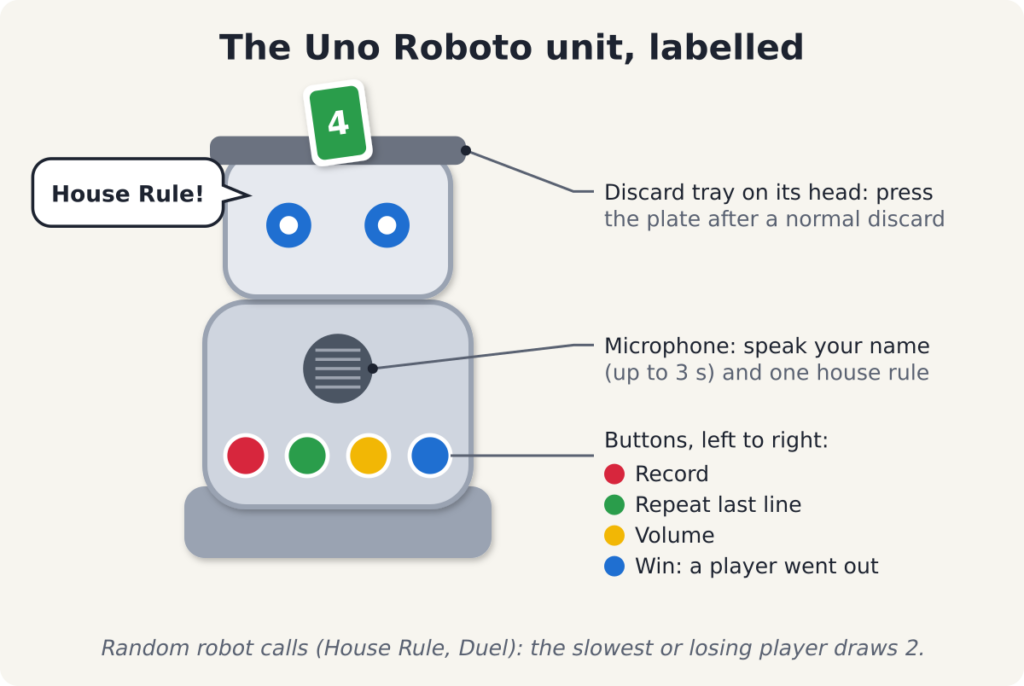
At the centre of the game is the Uno Roboto unit: a battery-powered figure with a microphone in its belly, a discard tray on its head and a row of coloured buttons. It greets players, stores their names, holds the recorded house rule and speaks up at random moments. Because the robot — not a human — introduces most of the chaos, children and adults end up on a far more even footing than in a standard game, where experience and memory usually win out.
The deck contains 112 cards. That is the familiar UNO line-up plus a set of four special “House Rule” cards. If you already know the core UNO mechanics, almost everything about matching by colour, number or symbol carries straight over.
| Card type | Quantity | Role |
|---|---|---|
| Number cards (0–9) | 76 | Four colours; match by colour or number. |
| Draw Two | 8 | Next player draws 2 and loses their turn. |
| Reverse | 8 | Reverses the direction of play. |
| Skip | 8 | Next player misses their turn. |
| Wild | 4 | Change the colour in play. |
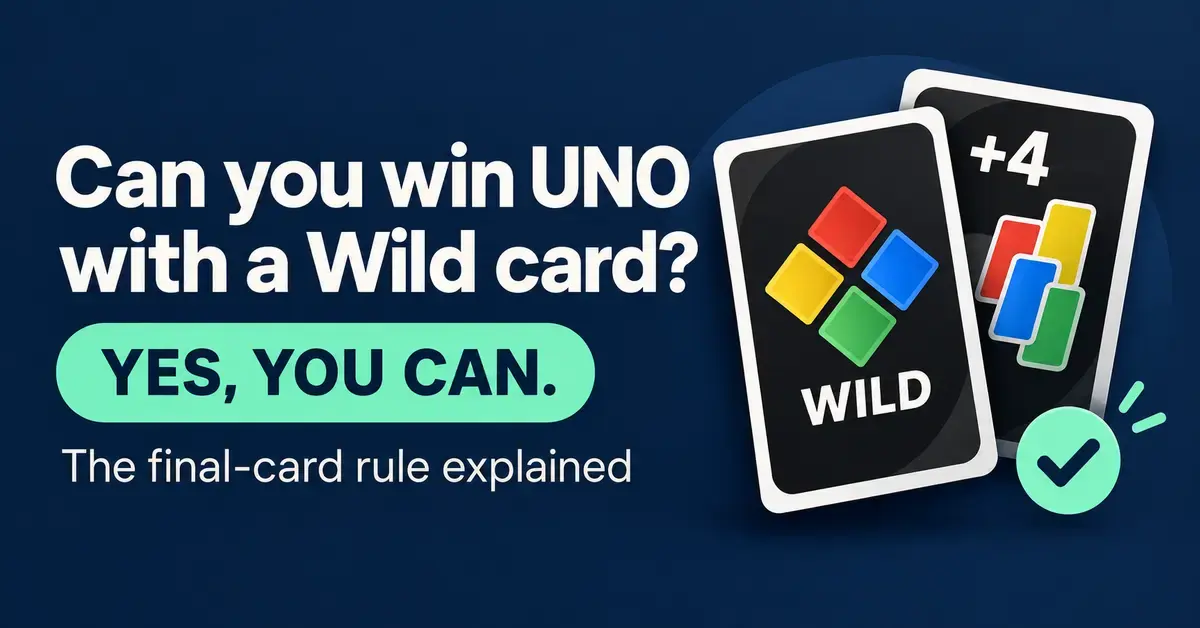
| Wild Draw Four | 4 | Change colour; next player draws 4 (challengeable). |
| House Rule cards | 4 | Set aside during robot play (see below). |
Setting Up the Robot and the Deck
Setup matters more here than in ordinary UNO, because the robot needs to store your names before play can flow. The unit takes three AA alkaline batteries; the cells included in the box are for demonstration only and should be replaced before a real session. If the lights dim or the speech becomes distorted, fresh batteries usually fix it.
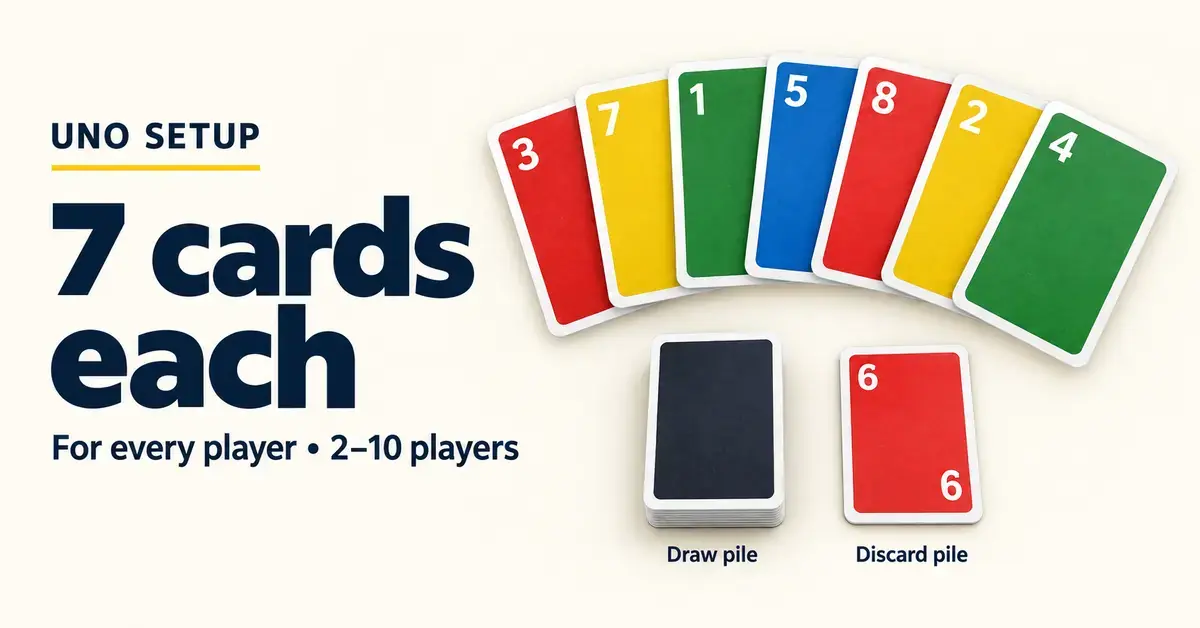
Slide the power switch to On for a full game. The Try Me position is only a shop demo mode and records a single name, so avoid it at the table. Then prepare the cards: remove the four House Rule cards and set them aside, deal seven cards to each player, and place the rest face down as the draw pile. Flip the top card onto the discard tray on the robot’s head to start the discard pile; if that card is an action card, slide it back and turn over another.
With the unit on, each player in turn holds the red Record button, speaks their name clearly into the microphone (up to three seconds) and releases it. Press the discard plate once when everyone is recorded. The robot then picks a player to record one shared house rule — a short custom action up to ten seconds long, such as “stand on one leg” or “everyone swaps seats”. You can skip this step by pressing the discard plate. The robot will replay that recording at random points during the game.
| Button | What it does |
|---|---|
| Red – Record | Hold to record your name or the house rule. |
| Green – Repeat | Plays back the last thing the robot said. |
| Yellow – Volume | Cycles through three volume levels. |
| Blue – Win | Press when a player goes out to end the game. |
| Discard plate (head tray) | Press once after a normal discard so the robot confirms with a beep. |
Key Points
- A talking robot records player names and one custom house rule, then interrupts play with random commands.
- The four House Rule cards are removed at setup; the robot triggers the recorded rule on its own.
- Press the discard plate after a normal discard — but not after command-driven cards or when you win.
- House Rule calls and duels add draw-two penalties; a Surprise Command can rename a player.
- Say “UNO” on your last card and press the blue Win button to finish the game.
How a Turn Works
Play moves clockwise. On your turn you match the top card of the discard pile by colour, number or symbol, lay your card in the robot’s head tray, and press the discard plate once so the robot acknowledges the move with a beep. If you cannot match, you draw one card from the draw pile: if it is playable you may lay it down that turn, and if it is not, play passes to the next person. As in standard UNO, you may choose not to play a card you are holding, but then you must draw.
The robot does not run a hidden “move timer” that punishes slow play — that is a common misconception. What it does have is a Sleep feature: after about a minute of inactivity it beeps, and a tap on the discard plate keeps it awake. If it powers down completely, the current game’s recordings are lost and you start again. The important habit to build is pressing the discard plate after an ordinary discard — but not after cards you play because of a robot command, which are handled differently.
The Robot’s Random Commands
The defining feature of Uno Roboto is that the unit interrupts play without any card being involved. When its lights flash and it starts to speak, stop and listen. Three documented events drive the game:
- House Rule call: the robot announces “House Rule!” and plays back the recorded action. Everyone races to complete it; the last player to finish draws two cards. The robot then picks a random player to continue.
- Duel: the robot names two players who race to react. The loser of the duel draws two cards.
- Surprise Command: the robot may tell one player to record a nickname for another player, which it then uses for the rest of the game — a light-hearted twist rather than a card penalty.
These interruptions are why hand sizes can swing quickly and why you can never fully plan ahead. They are also what make the game forgiving for younger players, in the same spirit as our guide to UNO rules for kids vs adults.
| Robot event | Trigger | Effect |
|---|---|---|
| House Rule | Random, robot-initiated | All players race; last to finish draws 2. |
| Duel | Random, two named players | Loser draws 2 cards. |
| Surprise Command | Random, robot-initiated | A player records a nickname for another. |
| Sleep prompt | About 1 minute idle | Tap the discard plate to stay in the game. |
Action Cards and the House Rule Cards
The coloured action cards behave as they do in classic UNO. A Skip makes the next player miss a turn, a Reverse flips the direction of play, and a Draw Two forces the next player to take two cards and lose their turn. A Wild lets you choose the next colour at any time. A Wild Draw Four also sets the colour and makes the next player draw four, but you may only play it when you have no card matching the current colour. If an opponent suspects you played it illegally, they can challenge; the official challenge rule is explained in our guide to the UNO Wild Draw Four rules.
The four House Rule cards are the part most guides get wrong. In the robot-led game they are removed before dealing and set aside — they are not played as wild cards and they do not trigger the recorded rule. The robot handles the house rule entirely on its own, which is why those cards sit out. If you ever want them in play, that becomes a UNO house rule of your own rather than part of the official game.
Saying “Uno” and Winning
The UNO call survives intact. When you play your second-to-last card, leaving one in hand, you must shout “UNO!” If an opponent catches you before the next player’s turn begins, you draw two cards — the same window explained in our guide to what happens if you forget to say UNO. If a robot command empties your hand down to one card, discard one card at a time and call “UNO” after your next-to-last card, and do not press the discard plate for those command-driven cards.
The round ends the moment a player lays down their final card. Instead of the discard plate, press the blue Win button so the robot congratulates the winner. If the draw pile runs out before anyone goes out, reshuffle the discard pile into a fresh draw pile and carry on — the same principle covered in what happens when the draw pile runs out.
Keeping Score (Optional)
Uno Roboto’s own instructions describe a single-game win rather than a points race, and the unit does not tally scores. Groups who want a longer competition usually borrow the standard UNO scoring system: the winner collects points for the cards left in everyone else’s hands, playing to an agreed target such as 500. Number cards score their face value, Skip, Reverse and Draw Two score 20 each, and Wild and Wild Draw Four score 50 each. A human scorekeeper writes the totals down, since the robot will not. For the full method see how UNO scoring works.
Players, Ages and Who It Suits
Uno Roboto is built for small-to-medium groups. Mattel’s electronic edition is commonly listed for 2 to 6 players, while board-game databases cite up to 10; either way the recording step gets slower with very large groups, so 3–5 players tends to be the sweet spot. The recommended age is around 7 and up. The game shines at family game nights, parties and ice-breakers, where the robot’s voice keeps everyone engaged and takes strategy pressure off younger children. Fans of electronic UNO often enjoy it alongside UNO Attack, which replaces the robot with a card launcher, and the many other UNO gameplay variations.
Common Mistakes and Troubleshooting
A few issues come up again and again with the unit:
- Using demo batteries or the Try Me switch: replace the demo cells with three fresh AA alkalines and set the switch to On, or the robot will not record a full group.
- Pressing the discard plate at the wrong time: press it after a normal discard, but not after cards played because of a House Rule or other command, and not when you win — use the blue Win button then.
- Letting the robot sleep: if it beeps during a lull, tap the discard plate; if it powers off, the recorded names and rule are lost for that game.
- Unclear name playback: record names in a quiet room and keep the volume up, so the robot can be heard over table chatter during duels.
Sources
Frequently Asked Questions (FAQ)
How many cards are in Uno Roboto?
The game includes 112 cards: 76 number cards, 8 each of Draw Two, Reverse and Skip, 4 Wild, 4 Wild Draw Four and 4 House Rule cards. The four House Rule cards are set aside before dealing in the robot-led game.
What do the House Rule cards actually do?
In the standard robot game they do nothing during play — they are removed at setup. The recorded house rule is triggered by the robot itself at random moments, not by playing a card.
How many batteries does the Uno Roboto unit need?
It needs three AA alkaline batteries. The cells packed with the game are intended only for in-store demonstration, so replace them before you play a full session.
Does the robot keep score?
No. The robot only announces the winner of a single game when the blue Win button is pressed. If you want to play to a points target such as 500, a human needs to tally scores using the standard UNO card values.
Do I still have to say “Uno”?
Yes. You must call “UNO” when you are down to one card. If an opponent catches you before the next turn starts, you draw two cards, exactly as in classic UNO.