Advanced UNO is less about luck and more about probability, timing and reading the table. Once you understand the deck’s exact make-up, how the scoring system rewards a patient long game, and how to steer turn order in your favour, you can consistently out-manoeuvre casual opponents. This guide breaks down the higher-level tactics — deck tracking, point management, colour starvation, Wild Draw Four bluffs and endgame card counting — and grounds every one of them in the official rules so your plays stay legal and repeatable.
Key Points
- Deck awareness: track the 108-card make-up to work out which cards opponents cannot hold.
- Tempo control: choose when to hold a card or draw voluntarily to mask your hand.
- Point mitigation: shed 50-point wilds and 20-point action cards before you can be caught with them.
- Table reading: spot voluntary draws and UNO-call windows to force penalties and stop the leader.
Read the deck: probability and card tracking
Every classic UNO deck contains exactly 108 cards, and knowing that breakdown is the foundation of card tracking. There are 76 number cards, 24 coloured action cards and 8 wild cards. Because each colour holds only a single zero and two each of the numbers 1 to 9, you can often deduce what an opponent cannot possibly be holding. If you have seen both red 7s go to the discard pile, for example, nobody can match a 7 on colour alone — they must switch colour, use another 7 of a different colour, or play a wild.
Advanced players use this to build roadblocks: keep steering play toward "closed" numbers or colours where few matching cards remain, and opponents are forced to draw. Every forced draw inflates their hand size and, just as importantly, the points they will hand you if you finish the round first.
| Card type | Quantity in deck | How common |
|---|---|---|
| Number cards 1–9 | 72 (2 per colour, per number) | Common |
| Zero cards | 4 (1 per colour) | Scarce |
| Action cards | 24 (Skip, Reverse, Draw Two) | Uncommon |
| Wild & Wild Draw Four | 8 (4 of each) | Uncommon but high value |
Why the zero card is worth tracking
With only four zeros in the whole deck — one per colour — a zero is one of the tidiest ways to hold a colour steady. If you play a green zero and the other three zeros have already been discarded, you have removed a common numerical bridge opponents could otherwise use to change the number without spending a wild.
Point management: winning the long game to 500
A full game of UNO is a race to 500 points, and the winner collects the value of every card left in the losers’ hands. That means the points you avoid giving away matter as much as the round you win. Under official UNO scoring, number cards are worth their face value, every action card is worth 20, and each Wild or Wild Draw Four is worth 50. Holding two wilds and a Skip when someone else goes out hands them 120 points in a single round — almost a quarter of the way to victory.
The practical takeaway is to lower your hand’s "point density" early. Play down high-value cards when it is safe to do so, and keep your remaining hand cheap, so that if you are caught mid-round the damage is small.
Card Scoring Values
| Card | Points at end of round |
|---|---|
| Number cards (0–9) | Face value |
| Skip, Reverse, Draw Two | 20 each |
| Wild, Wild Draw Four | 50 each |
| Game target | First player to 500 points wins |
When to dump high-value cards
- The 50-point rule: if you suspect an opponent is close to going out, play a Wild or Wild Draw Four rather than holding it as a 50-point liability.
- Clear your action cards: spend Skips, Reverses and Draw Twos mid-round so you are never caught with a fistful of 20-point cards.
- Shed the big numbers first: if you must keep numbers, keep the 0s, 1s and 2s and offload the 8s and 9s, which cost you most if someone else wins.
Colour starvation and isolating opponents
Colour starvation means deliberately keeping the game on a colour a specific opponent clearly lacks. The tell is a voluntary draw: if a player draws when, say, blue is live and cannot play, they are almost certainly out of blue. From there, use your Skips, Reverses and wilds to keep the game blue so that player keeps drawing and their hand keeps growing. It is especially effective when the rest of the table quietly cooperates to stop whoever is leading on points.
| Tactic | Objective | How it works |
|---|---|---|
| Starvation | Prevent a win | Hold the game on a colour the target cannot match |
| Flushing | Drain resources | Bait action cards out early so an opponent has no defence later |
| Cycling | Probe for weakness | Change colours quickly to find the one an opponent lacks |
Bluffing with the Wild Draw Four
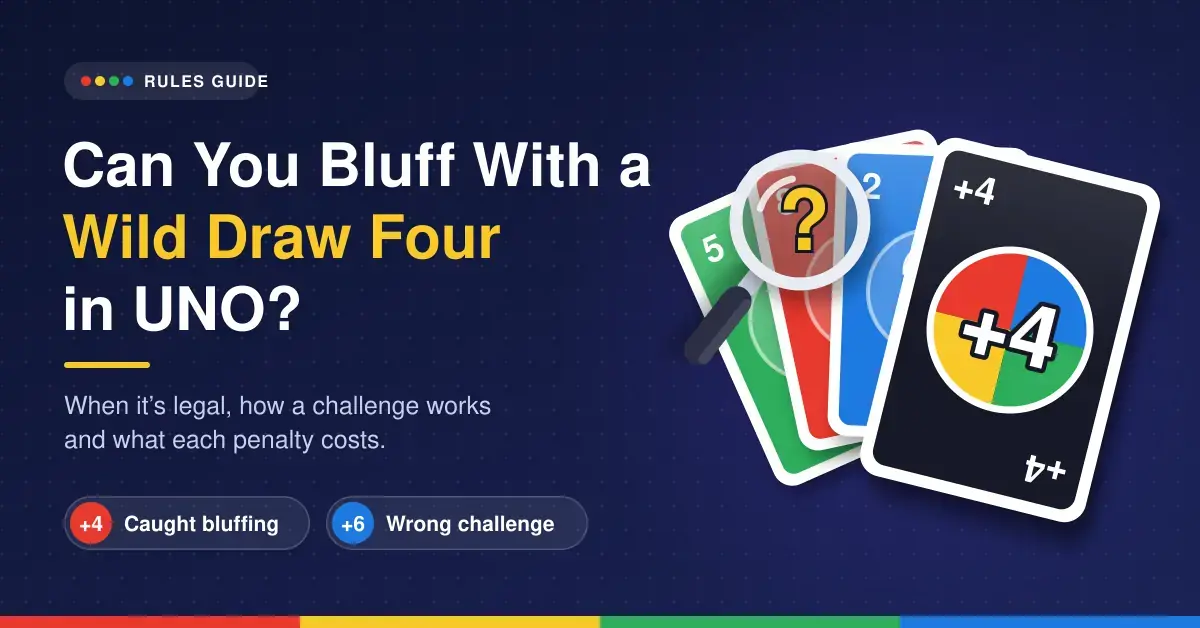
The Wild Draw Four is the only card with a legality condition: officially you may play it only when you hold no card matching the current colour. Because hands are hidden, a player can still play it when they technically shouldn’t — that is the bluff. The next player may challenge; if the challenge succeeds, the bluffer draws four, and if it fails, the challenger draws six and misses their turn. Understanding those odds is the whole game: opponents who dislike risking a six-card penalty rarely challenge, which is exactly when a bluff pays off. Our full breakdown of the Wild Draw Four rules covers the challenge procedure in detail.
- Weigh the risk: only bluff when swinging the colour and stinging an opponent is worth the chance of being caught.
- Profile the challenger: the tactic works best against players who almost never challenge.
- Switch to your strong colour: use the play to move the game to the colour you hold a run in.
Seat position and turn-order control
In UNO the player to your right feeds you cards and the player to your left is the one you can most directly attack. Advanced play uses the Reverse card to reshape that relationship. If an aggressive player on your left keeps skipping you, a well-timed Reverse flips the order so you are now the one feeding them Skips and Draw Twos. Positional awareness also means tracking who is loaded with cards and who is nearly out.
| Seat | Relationship | How to play it |
|---|---|---|
| To your right | Your supplier | Watch their discards to predict the colour coming to you |
| To your left | Your target | Aim Skips and Draw Twos here to slow them down |
| Across the table | Neutral | Reverse play back toward them to buy the table another rotation |
There is a defensive use too: if the player on your left has called UNO, a Reverse doesn’t just change direction — it moves the next turn to your right, giving the rest of the table another full lap to stop them.
The "UNO" call: timing and penalties
Failing to call "UNO" as you play your second-to-last card is a two-card penalty, but only if an opponent catches you before the next player takes their turn — that is, before they play a card, draw, or touch the discard pile. Once that next turn begins, the window closes and the penalty can no longer be applied. Knowing exactly where that window opens and shuts is what separates a clean catch from a missed one; our guide to forgetting to say UNO walks through the timing.
To protect yourself, get into the habit of calling "UNO" the instant your penultimate card leaves your hand rather than a beat later.
Endgame card counting after a reshuffle
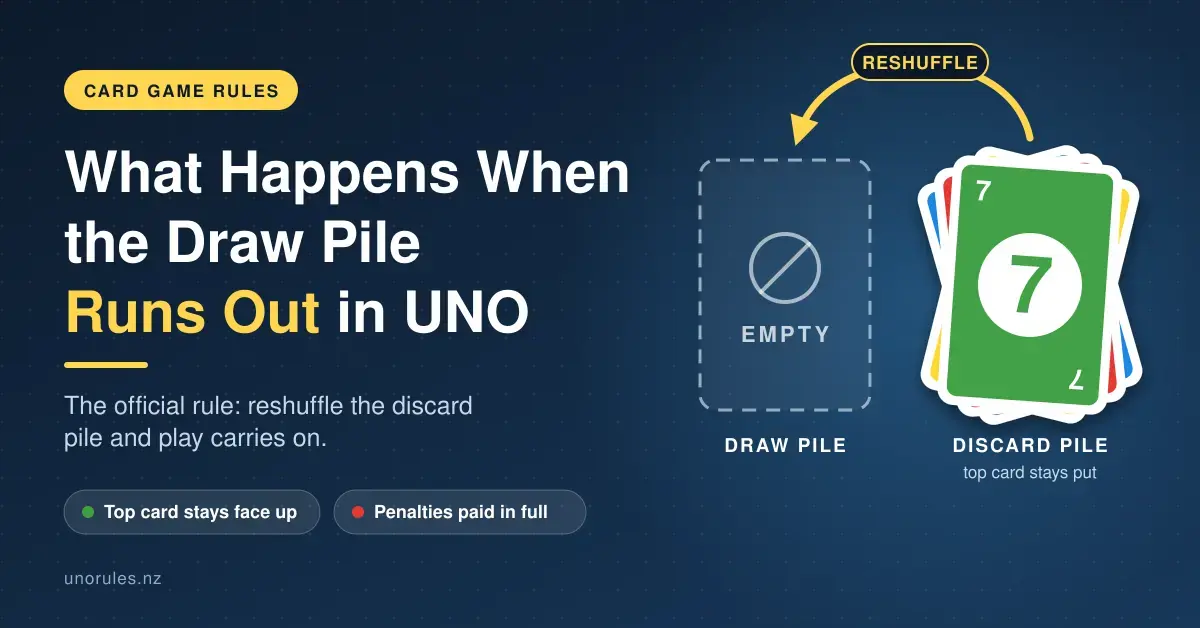
When the draw pile is exhausted it is reshuffled from the discards, so it is not a fresh random deck — it is a recycled history of the round. If the early game was heavy on red and blue, the new draw pile will be too. That lets you estimate your odds: if you are stuck with green cards and the deck skews red, it is often smarter to spend a wild to change the colour now than to risk drawing cards you cannot use. Tracking roughly how many wilds and Draw Twos have already appeared tells you how much danger is still in play.
House-rule variants: Jump-In and beyond
Plenty of groups add house rules that reward speed and pattern recognition. Jump-In is a popular one: it lets a player drop a card out of turn if it is an exact match — same colour and same number or symbol — to the card on top of the pile, skipping everyone in between. It is not part of the official Mattel rules, so agree on it before you start, and you can find further background reading over on Wikipedia. It is also worth confirming that stacking is not allowed under the official rules: you cannot answer a Draw Two with another Draw Two to pass the penalty along unless the table has opted into it as a house rule.
Play the meta-game: read the scoreboard
Across a match, you do not need to win every round — you need to stop the overall leader from running away with it. Once someone is closing in on 500, the smart table effectively cooperates to keep that player from taking another round, sometimes even helping whoever is in second place go out first. Balancing your own ambitions against the need to check the leader is where seasoned players separate themselves, and it matters most in structured tournament play where every point is recorded across many hands.
A quick note on the voluntary draw: the official rules do let you draw even when you hold a playable card — a handy way to disguise your hand size — but you may then only play the card you just drew, not a different one from your hand. Use it sparingly, because a drawn Wild or high number can make your hand more expensive if someone else finishes first.
Sources
Frequently Asked Questions (FAQ)
What is the best card to hold until the end of a round?
A standard Wild is the most flexible "exit" card because it can be played on anything, but remember it is worth 50 points if you are caught with it, so do not cling to it too long.
Can I draw a card even when I already have a playable one?
Yes. The official rules allow a voluntary draw, which players use to hide hand strength, but you may only play the card you just drew that turn — not another card from your hand.
How do I stop an opponent who keeps winning rounds?
Use colour starvation: identify a colour they clearly lack, then use Skips, Reverses and wilds to keep the game on that colour so they are forced to keep drawing.
What happens if my Wild Draw Four is challenged and I lose?
If the challenge succeeds you draw four cards instead of the opponent. If the challenge fails, the challenger draws six cards and misses their turn, which is why bluffs often go unchallenged.
Is stacking Draw Two cards part of advanced UNO?
No. Official Mattel rules do not allow stacking one Draw Two on another; it only appears where a group agrees to play it as a house rule.