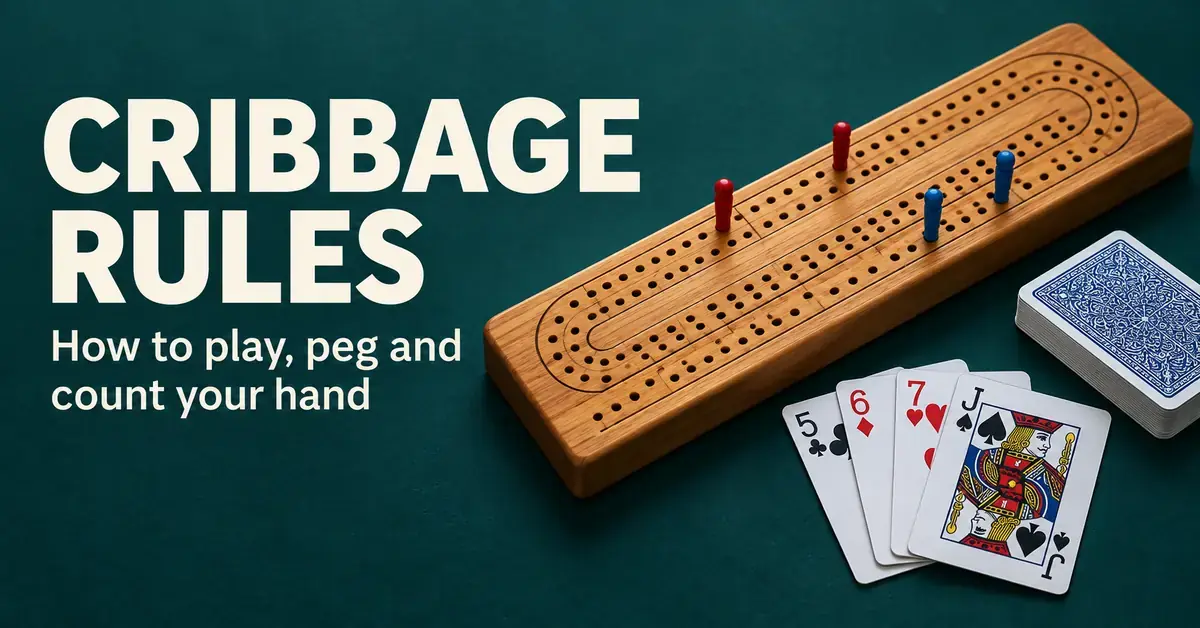
Cribbage is a fast, tactical card game for two players that has been enjoyed for roughly 400 years. It mixes a little luck with plenty of arithmetic and strategy, and it is instantly recognisable by its wooden scoring board dotted with holes and pegs. This guide explains cribbage rules from the ground up: how to deal, how to score points during the play (known as pegging), and how to count your hand at the show — everything a beginner needs to sit down and play a full game to 121 points.
Quick Facts
| Players | 2 (classic); variants for 3 and 4 |
|---|---|
| Deck | Standard 52 cards (no jokers) |
| Cards dealt | 6 each for 2 players; 5 each for 3–4 players |
| Target score | 121 points (or 61 for a short game) |
| Equipment | Cribbage board and pegs, or pen and paper |
| Card values | Ace = 1, cards 2–10 = face value, J/Q/K = 10 |
| Skill level | Easy to learn, deep to master |
| Playing time | About 15–30 minutes |
What Is Cribbage?
Cribbage is a two-player card game (with variants for three and four players) in which the goal is to be the first to reach 121 points. Points are scored in two ways: during the play of the cards, and afterwards when each player counts their hand. A unique feature is the crib — an extra, fifth hand made up of cards both players discard, which is scored by the dealer.
The game is usually credited to the English poet Sir John Suckling in the early 17th century, developed from an older game called Noddy. There is no hard proof he invented it, but the attribution has stuck. English settlers carried cribbage to North America, where it remains especially popular, and it is a firm favourite among the world’s best card games for two.
What You Need to Play
Cribbage needs very little equipment:
- A standard 52-card deck (remove the jokers).
- A cribbage board with pegs — or simply pen and paper to keep score.
- Two players for the classic game.
Card values
Every card has a counting value used for making fifteens and for the running total during play:
- Ace = 1 (always low; it does not count as high).
- Number cards 2–10 = their face value.
- Jack, Queen, King = 10 each.
For runs, cards are ranked in order Ace (low), 2, 3, 4, 5, 6, 7, 8, 9, 10, Jack, Queen, King, so a Jack-Queen-King sequence still counts as a run even though all three cards are worth 10.
How to Set Up and Deal
To decide the first dealer, each player cuts the deck; the player who cuts the lower card deals first. The deal alternates every hand, which matters because the dealer owns the crib.
In the two-player game the dealer gives each player six cards, one at a time. Both players then look at their hands and lay away two cards face down into the crib. This leaves each player with four cards to play, and creates a four-card crib that belongs to the dealer. Choosing which two cards to throw is a key skill — you want a strong four-card hand, while remembering that if you are the dealer the discards help you and if you are not, they help your opponent.
The Starter Card and “His Heels”
Once the crib is set, the non-dealer cuts the remaining deck and the dealer turns up the top card of the lower packet. This face-up card is the starter (also called the cut card). It is not played during the round, but it is added to every hand and to the crib when they are counted.
If the starter is a Jack, the dealer immediately pegs 2 points. This is called “his heels” (sometimes spelled “his nibs”). Do not confuse it with “his nobs”, which is scored later during the show.
The Play: How Pegging Works
Pegging is the play phase, and it is where cribbage gets its name for the board. Starting with the non-dealer, players take turns laying one card face up in front of themselves and announcing a running total out loud. The total must never go above 31.
Scoring during the play
You peg points the moment your card creates any of the following:
- Fifteen: if your card brings the running total to exactly 15, score 2 points.
- Thirty-one: if your card brings the total to exactly 31, score 2 points.
- Pair: playing a card of the same rank as the one just played scores 2 points; a third of the same rank (pair royal) scores 6, and a fourth (double pair royal) scores 12.
- Run: if the last cards played form a sequence of three or more (in any order, e.g. 4-6-5), score 1 point per card in the run.
“Go” and the last card
If you cannot play a card without pushing the total over 31, you say “Go”. Your opponent then plays any cards they still can. Whoever plays the last card before a Go — or before nobody can play — pegs 1 point for the last card (or 2 if it lands exactly on 31). The count then resets to zero and play continues with the remaining cards until all eight cards have been played.
The Show: Counting Your Hand
After the play, each player picks their four cards back up and counts their value together with the starter card, making a five-card scoring hand. Every scoring combination is added up. The order is fixed and important: the non-dealer counts first, then the dealer, and finally the dealer counts the crib. In a close game this order can decide the winner, because whoever reaches 121 first wins immediately.
The combinations you look for are the same each time:
Scoring Chart
| Combination | Points | Where it counts |
|---|---|---|
| Fifteen (cards totalling 15) | 2 | Play and the show |
| Thirty-one (running total hits 31) | 2 | Play only |
| Pair (two of a kind) | 2 | Play and the show |
| Pair royal (three of a kind) | 6 | Play and the show |
| Double pair royal (four of a kind) | 12 | Play and the show |
| Run of three / four / five cards | 3 / 4 / 5 | Play and the show |
| Flush (4 cards in hand, same suit) | 4 | The show (hand) |
| Flush including the starter (5 same suit) | 5 | The show (hand and crib) |
| His nobs (Jack in hand matching starter suit) | 1 | The show |
| His heels (starter is a Jack) | 2 | At the cut (dealer) |
| Go / last card | 1 | Play only |
Fifteens, pairs and runs
Add up any combination of cards that totals 15 — each separate combination is worth 2 points, and a single card can appear in several fifteens. Each pair is 2 points, three of a kind is 6, and four of a kind is 12. A run of three or more consecutive cards scores one point per card, and the same card can be part of a run and a fifteen at once.
Flushes and his nobs
A flush scores 4 points if all four cards in your hand are the same suit; if the starter is also that suit you score 5. In the crib, a flush only counts if all five cards (including the starter) share a suit, for 5 points. Finally, his nobs is worth 1 point: if you hold the Jack of the same suit as the starter, peg one extra. The single highest possible hand in cribbage is 29 points — three fives and a Jack in hand, with the fourth five turned as the starter matching the Jack’s suit.
Muggins (optional)
Some players use the “muggins” rule: if you under-count your hand and move on, your opponent may call “Muggins!” and claim the points you missed. Agree before the game whether you are using it, as it rewards sharp arithmetic and punishes sloppy counting.
Winning, Skunks and the Board
The first player to peg to 121 wins the moment they get there — you do not need to finish the round. A standard cribbage board has two rows of 60 holes per player, so a full game is scored “twice around and one more hole”. A shorter game to 61 (once around) is also common.
Two colourful margins are often tracked:
- Skunk: if the winner reaches 121 while the loser has not passed 90 (i.e. is below 91), it is a skunk and usually counts as a double win.
- Double skunk: if the loser is still below 61, it is a double skunk, often counted as a quadruple win in tournaments.
Each player moves two pegs up the board; the rear peg always jumps ahead of the front peg for each new score, which keeps an honest record of your last move.
Three- and Four-Player Cribbage
Cribbage adapts well to more players. In the three-handed game each player is dealt five cards, one extra card is dealt straight to the crib, and each player discards one — again giving a four-card crib. Play and counting move clockwise, and a triangular board is handy. If you enjoy games that flex their player count, browse more three-player card games and other card games for two players.
The four-handed game is played in partnerships of two, sitting across from each other. Each player is dealt five cards and discards one to the dealer’s crib. Partners combine their scores, which adds a cooperative layer of strategy to the discards and the play.
Common Mistakes to Avoid
- Forgetting the crib is the dealer’s. When you are not the dealer, never throw two strong cards into the crib — you are handing your opponent points.
- Miscounting fifteens. Beginners often miss that a single card can be part of several fifteens; count every combination.
- Confusing his heels with his nobs. His heels (starter Jack) is 2 for the dealer; his nobs (a Jack in hand matching the starter’s suit) is 1 for its holder.
- Overshooting 31 in the play. Track the running total carefully and say “Go” rather than play an illegal card.
- Counting in the wrong order. The non-dealer always counts first — in a tight finish this can win the game before the dealer counts.
Once the counting clicks, cribbage becomes wonderfully quick. If you are gathering players for a games night, it sits nicely alongside other timeless favourites such as Crazy Eights and plenty more fun card games for the whole table.
Sources
Frequently Asked Questions (FAQ)
What is the goal of cribbage?
The goal is to be the first player to score 121 points. Points are earned both during the play of the cards (pegging) and afterwards when each hand is counted with the starter card. The winner reaches 121 the instant they get there, so counting order can matter.
How many cards are dealt in two-player cribbage?
Each player is dealt six cards. Both players then discard two cards face down into the crib, leaving four cards each to play. The crib becomes a fifth four-card hand that only the dealer scores.
What is the highest possible cribbage hand?
The maximum is 29 points. It is made of three fives and a Jack in your hand, with the fourth five turned up as the starter, and the Jack matching that starter’s suit for his nobs. It is famously rare.
What is the difference between his heels and his nobs?
His heels (sometimes his nibs) is scored when the starter card is a Jack, giving the dealer 2 points straight away. His nobs is worth 1 point and is scored during the show if you hold the Jack of the same suit as the starter.
Do you need a cribbage board to play?
No. A board with pegs is the traditional and most convenient way to keep score, but you can play a full game with nothing more than a deck of cards and pen and paper to track each player’s running total to 121.