UNO house rules are the unofficial, homemade tweaks that friends and families add to the standard UNO card game to make a round faster, sneakier or simply more fun. They are not printed on the box, and Mattel — the company that makes UNO — does not treat them as official. Yet in most living rooms in New Zealand and around the world, some version of these extra rules is exactly how UNO actually gets played.
Quick Facts
- What they are: Unofficial rule tweaks added on top of standard UNO
- Official status: Not part of Mattel’s printed rules (with rare exceptions like UNO No Mercy)
- Players: Same as standard UNO — 2 to 10
- Best-known examples: Stacking, Seven-Zero (7-0), Jump-In
- Golden rule: Agree on every house rule before you deal
What are UNO house rules?
A house rule is any agreed change to the game that a group decides to use for their own table. In UNO, the standard rules are the ones printed in the instruction leaflet, while house rules are the informal add-ons players layer on top of them. Common examples include letting players stack Draw cards, swapping hands when a certain number is played, or adding a penalty for forgetting to say “UNO.”
House rules are usually agreed before the first card is dealt. Because they are informal, they vary from group to group and even from one game night to the next. There is no single “UNO House” edition, app or online version — the term simply describes the mix of extra rules a particular group chooses to play with.
Official rules vs house rules
To understand house rules, it helps to know what the standard game looks like first. A regular UNO deck has 108 cards across four colours — red, yellow, green and blue — plus Wild cards. The game is for 2 to 10 players, each dealt 7 cards. On your turn you match the top card of the discard pile by colour, number or symbol; if you cannot, you draw a card. When you are down to one card you must call “UNO,” and the first player to reach 500 points wins.
House rules change or add to those basics. The important distinction is that many popular “UNO rules” people assume are official are actually house rules. The clearest example is stacking: in 2019 Mattel publicly confirmed that you cannot stack Draw Two or Draw Four cards in the standard game — the targeted player must simply draw the cards and lose their turn. If you enjoy the deep end of the rulebook, it is worth reading up on the official rules versus house rules and refreshing the standard UNO rules before you start bending them.
Popular UNO house rules
These are the best-known house rules you are likely to meet. None of them are part of the standard printed game unless noted otherwise.
- Stacking (Progressive Draw): When someone plays a Draw Two against you, you may play your own Draw Two to pass the penalty on. The next player then draws four unless they can stack again, and so on until someone cannot respond. Some groups let Draw Four cards stack the same way.
- Seven-Zero (7-0): Playing a 7 forces you to swap your entire hand with another player, and playing a 0 makes everyone pass their whole hand to the next player in the direction of play. It is one of the most game-changing house rules.
- Jump-In: If you hold a card that is an exact match — same colour and same number — of the top discard, you may play it immediately, even out of turn. Play then continues from you.
- Draw until you can play: Instead of drawing a single card when you cannot match, you keep drawing until you get a playable card.
- Force play: If you can legally play a card, you must — you are not allowed to draw by choice.
- No ending on an action card: Some groups say your final card cannot be a Skip, Reverse, Draw Two or Wild, forcing you to win on a number card instead.
House Rules Comparison
| House rule | What it does | Part of official rules? |
|---|---|---|
| Stacking (Progressive Draw) | Play a matching Draw card to pass the draw penalty to the next player | No (official only in UNO No Mercy) |
| Seven-Zero (7-0) | Playing a 7 swaps two hands; playing a 0 rotates all hands | No |
| Jump-In | Play an exact-match card out of turn | No |
| Draw until you can play | Keep drawing until you get a playable card | No |
| Force play | You must play a card if you legally can | No |
| No ending on an action card | Your final card must be a number card | No |
How special cards change under house rules
House rules most often target the action cards, because they have the biggest impact on a round:
- Skip: Normally skips the next player. A house rule may let it skip several players in a row or bounce back around the table.
- Reverse: Normally flips the direction of play. Groups sometimes rule that in a two-player game it acts like a Skip, or that it can skip two players. You can dig into the details on the Reverse card page.
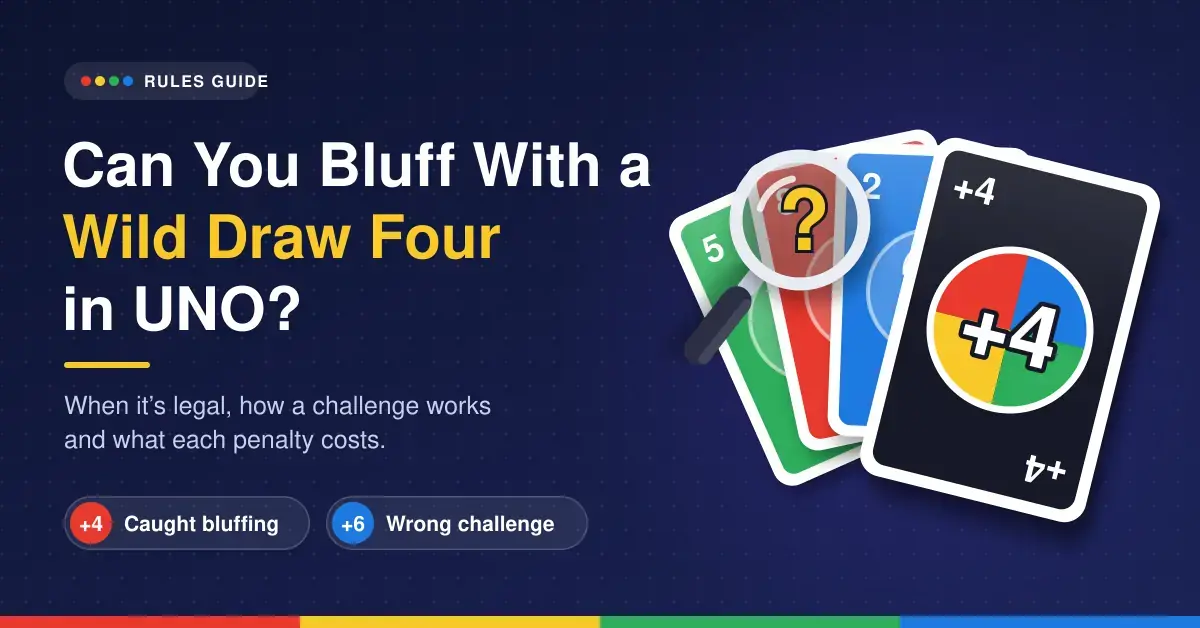
- Draw Two and Wild Draw Four: The most common target of stacking. In the standard game the Wild Draw Four can only be played legally when you have no other card matching the current colour, but many casual tables ignore that restriction.
- Wild: Usually just changes the colour. A popular twist is using it to force a hand-swap or to make everyone draw a card.
If you want stacking done as an official mechanic rather than a house rule, the separate UNO No Mercy set builds heavy draw penalties into its printed rules.
Scoring and winning
Most house rules keep the standard scoring system. When a player empties their hand to win the round, they collect points from the cards left in everyone else’s hands: number cards score their face value, Skip, Reverse and Draw Two are worth 20 points each, and Wild and Wild Draw Four are worth 50 points each. The first player to reach 500 points wins the game.
Some groups tweak this — for example, deducting points for failing to call “UNO,” or playing to a lower target for a quicker game. If you want the full breakdown of the standard system before you change it, see how scoring works in UNO.
How to agree on house rules with your group
House rules only work smoothly when everyone knows them in advance. A few simple habits prevent mid-game arguments:
- Agree before you deal: Decide which rules are in play at the start, not when a card is already on the table.
- Introduce one at a time: Adding several new rules at once can make the game confusing, especially for newcomers.
- Write them down: For longer sessions or tournaments, a short list settles disputes instantly.
- Keep it fair: Choose rules that apply equally to everyone rather than singling out one player.
Common mistakes and disputes
Because house rules are informal, they cause most of UNO’s famous arguments. The usual culprits are:
- Assuming stacking is official when it is not — check whether stacking is allowed in official UNO before insisting on it.
- Mixing incompatible rules, such as Jump-In and strict turn order, without agreeing how they interact.
- Starting a game with one set of rules in each player’s head because nobody confirmed them out loud.
- Adding so many penalties that beginners lose track and stop enjoying the game.
Who UNO house rules suit
House rules are ideal for families and friend groups who play often and want more variety, and for party settings where chaos is part of the fun. Newer players may prefer to master the standard game first, since extra rules add complexity. Anyone playing a competitive or tournament game should stick to the official rules, where house variations are set aside for consistency.
Sources
Frequently Asked Questions (FAQ)
Are UNO house rules official?
No. House rules are unofficial changes that individual groups choose to add. They are not part of Mattel’s printed instructions, which is why the same rule can be played differently from one table to the next.
Can you stack Draw Two and Draw Four cards in UNO?
Not under the standard rules. Mattel confirmed in 2019 that stacking is not official — the targeted player simply draws the cards and loses their turn. Stacking is a very common house rule, and it is built into the separate UNO No Mercy set, but it is not part of the classic game.
What is the 7-0 rule in UNO?
The Seven-Zero rule is a house rule where playing a 7 forces you to swap hands with another player, and playing a 0 makes every player pass their whole hand to the next player in the direction of play. It is popular but not part of the standard printed rules.
Do house rules change how UNO is scored?
They can. Most groups keep the standard scoring — face value for number cards, 20 points for Skip, Reverse and Draw Two, and 50 points for Wild and Wild Draw Four, playing to 500. Some groups add penalties or lower the target for a shorter game.
How do we decide which house rules to use?
Agree on them before the first card is dealt so everyone is playing the same game. It helps to introduce one new rule at a time, keep the rules fair for all players, and write them down for longer sessions to avoid disputes.