Running out of cards mid-hand is one of the most common moments of confusion in UNO, yet the official rulebook settles it in a single sentence: the game does not stop. When the draw pile is empty, the discard pile is reshuffled into a fresh draw pile and play continues. This guide covers the official Mattel rule, the practical steps for rebuilding the deck, how action-card penalties are still paid when the stack is empty, the rare true deadlock, and the house-rule variations many New Zealand tables use.
Key Facts
- Official rule: when the draw pile is empty and no one has gone out, reshuffle the discard pile to make a new draw pile.
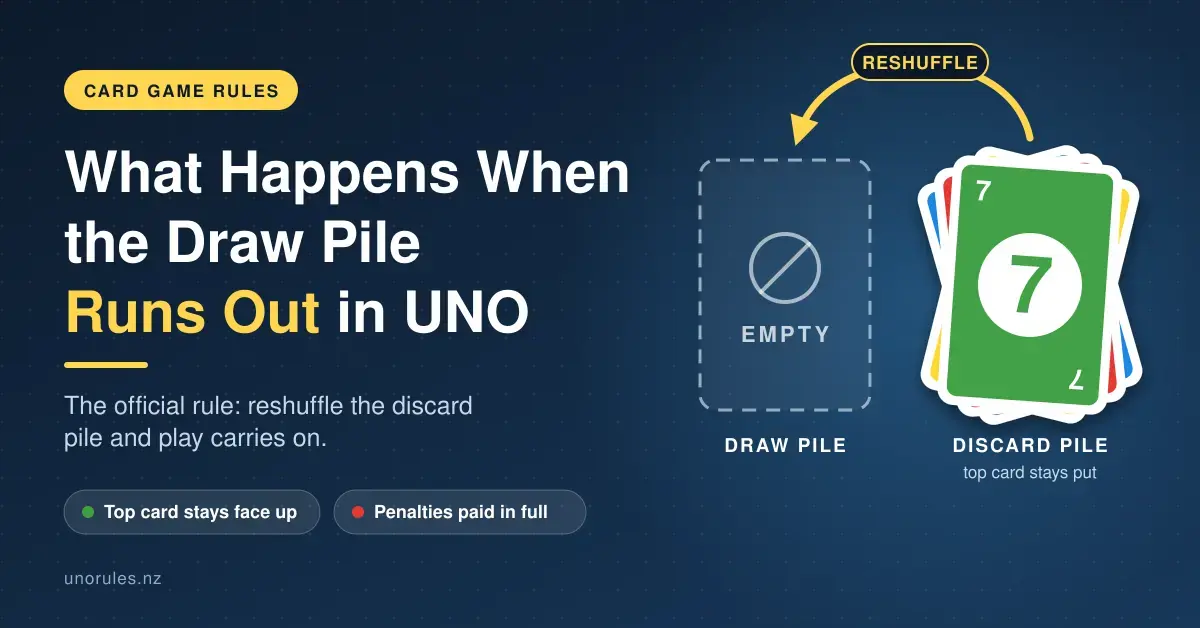
- Active card stays put: the current top discard remains face up; only the cards beneath it are reshuffled.
- Penalties paid in full: for a Draw Two or Wild Draw Four, take what is left, reshuffle, then draw the remainder.
- Round end: a hand ends when a player plays their last card, not when the deck runs out.
- Use a full deck: a complete UNO deck has 108 cards, which keeps shortages and deadlocks rare.
The official rule when the draw pile runs out
According to Mattel’s printed UNO instructions, “if no one is out of cards by the time the draw pile is depleted, reshuffle the discard pile and continue play.” In other words, an empty draw pile is a routine event, not the end of the round. The cards that players have been discarding all game become the raw material for a brand-new draw pile, so the hand keeps running until someone plays their final card. This can happen more than once in a single round, especially in games of four or more players where cards are drawn frequently.
Because the rule is so short, most disputes come from how the reshuffle is performed rather than whether it happens. The steps below match the standard method used almost everywhere, and they line up with the wider UNO draw rules for taking cards from the pile.
How to rebuild the draw pile step by step
The reshuffle only involves the discard pile and takes a few seconds. Nothing changes in any player’s hand.
- Confirm the pile is empty. A card is needed — by choice or because of a penalty — but the draw stack has zero cards left.
- Keep the top discard. Leave the current top card of the discard pile face up on the table. It stays in play as the card to match.
- Gather and shuffle. Collect every card sitting beneath that top card and shuffle them thoroughly.
- Deal the new pile. Place the shuffled cards face down to form the new draw pile, and the current player takes the card or cards they owe.
Shuffle it properly
Discard piles tend to build up in clusters of the same colour, because players follow suit for several turns in a row. A quick overhand shuffle often leaves those runs partly intact, producing a new draw pile that feels repetitive. A riffle or bridge shuffle breaks the sequences up far more reliably, which keeps the refreshed deck fair for everyone at the table.
Why the active card stays on the table
The single most common reshuffle mistake is sweeping the top discard card into the new deck. That card is the “active” card: it defines the colour, number, or symbol the next player must match. If it disappears into the draw pile, the game loses its reference point and nobody knows what to play against. Leaving it face up preserves the game state.
This matters most when the top card is a Wild or Wild Draw Four. The colour chosen by the player who laid it down must still apply after the reshuffle, so keep that card visible and remember the nominated colour before you start mixing the rest.
Paying action-card penalties when the deck is empty
A tricky situation arises when the pile runs dry exactly as someone is told to draw. The penalty is never reduced or cancelled because of a card shortage — it is always paid in full. If a Draw Two card lands on you and only one card remains, you take that card, the discard pile is reshuffled, and you draw the second card from the new pile. The same logic applies to a Wild Draw Four: draw whatever is available, reshuffle, then draw the rest.
- Draw what is left first, then reshuffle for the remaining cards you owe.
- The penalty keeps its full power regardless of how many cards were in the pile.
- The turn still passes as normal — a player forced to draw by a Draw Two or Wild Draw Four also forfeits their turn.
These penalty cards also count against you if the round ends while they are still in your hand, which links directly to how scoring works in UNO.
When no one can play: the rare deadlock
Very occasionally — usually with an incomplete deck or a heavily customised game — the pile is reshuffled and players still cannot make a legal move, then the new pile empties again with no match found. The official rules do not spell out a resolution for this true stalemate, because with a complete 108-card deck it is extremely unlikely. In practice, groups agree to end the round at that point and total the cards left in each hand, with the lowest hand treated as the round winner. Because this is a table agreement rather than a printed rule, settle it before you deal if you are worried about it.
How a reshuffle changes your strategy
When the pile is reshuffled, the “memory” of the round resets. Any card counting you were doing — noticing that most red cards had already been played, for example — is undone the moment the discards are flipped and mixed. Cards you thought were out of circulation are suddenly available again.
- Power cards return. If all four Wild Draw Fours had been played, they are now back in the draw pile.
- Colour odds even out. The chance of drawing any particular colour resets toward a more balanced spread.
- Timing counts. If you are close to winning, a reshuffle can hand opponents fresh Skip or Reverse cards, so plan your finish before the pile runs dry.
It helps to know the point values still sitting in hands, since a longer round tends to inflate the winner’s score:
| Card | Point value |
|---|---|
| Number cards 0–9 | Face value |
| Draw Two, Skip, Reverse | 20 points each |
| Wild, Wild Draw Four | 50 points each |
House rules and New Zealand variations
While Mattel’s rule is a straightforward reshuffle, plenty of Kiwi households run their own version when the cards run out. These are not part of the printed rules, so agree on them before the first card is dealt to avoid any backyard barneys.
- Sudden death: the round ends the instant the draw pile empties, and the player holding the fewest points wins.
- No reshuffle (pass): once the pile is gone, you may only play what is in your hand; if you cannot match, you pass.
- Penalty draw: some tables let the next player take a card from the discard pile without a shuffle.
For a broader look at where the rulebook and the kitchen table diverge, see our guide to the official rules versus house rules, and browse more crowd-favourite house rules for extra ideas. For general background on the game and its many spin-offs, an external Wikipedia reference is also available.
Official vs House Rules
| Approach | What happens when the pile runs out | Status |
|---|---|---|
| Official reshuffle | Keep the top discard; shuffle the rest into a new draw pile and continue. | Official Mattel rule |
| Sudden death | The round ends immediately; the player with the fewest points wins. | House rule |
| No reshuffle (pass) | You may only play from your hand; if you cannot match, you pass. | House rule |
| Penalty draw | The next player takes a card from the discard pile without a shuffle. | House rule |
Avoiding disputes during the reshuffle
Because the reshuffle temporarily hands one person control of the deck, a little etiquette keeps things fair — especially in club play.
- Use a neutral shuffler. Ideally the person shuffling is not the one who benefits from the current draw, which avoids any suggestion of stacking.
- Keep the pile tidy. A squared discard pile makes for a cleaner, more transparent transition.
- Verify the active card. Fan the new pile briefly to be sure the face-up card was not accidentally shuffled in.
Finally, play with a full 108-card deck. Travel editions or decks with missing cards run out far more often and make premature shortages — and the rare deadlock — much more likely.
Sources
Frequently Asked Questions
What do you do when the UNO draw pile runs out?
Leave the current top card of the discard pile face up, gather all the cards beneath it, shuffle them thoroughly, and place them face down as a new draw pile. Play then continues as normal.
Does the top discard card get shuffled back in?
No. The top card stays on the table because it sets the colour, number, or symbol the next player has to match. Only the cards underneath it are reshuffled into the new draw pile.
What if you must draw more cards than are left in the pile?
You take whatever cards remain first, then the discard pile is reshuffled and you draw the rest from the new pile. The full penalty is always paid — a card shortage never reduces it.
Does the game ever end just because the deck runs out?
Under the official rules, no. The round ends only when a player plays their last card. Ending the game when the pile empties is a house rule (often called sudden death) rather than an official one.
Who should shuffle the new draw pile?
The rules do not name anyone specifically. It is common practice for the dealer or a neutral player who does not benefit from the current draw to shuffle, which keeps the reset fair and transparent.