The Wild Draw Four is the most powerful action card in the standard 108-card UNO deck. It lets the player who lays it choose the next colour of play and forces the following player to draw four cards and miss a turn. Its strength is balanced by a strict condition on when it can be played, plus a built-in “challenge” rule that keeps players honest. This guide explains how the card works under the official Mattel rules, when you are allowed to play it, how challenges are resolved, how it is scored, and the common house-rule mistakes that trip players up.
Key Points
- Type: a wild action card in the standard 108-card UNO deck (there are four of them).
- Effect: you choose the next colour, and the next player draws four cards and misses a turn.
- Legal-play rule: officially playable only when you hold no card matching the current colour.
- Challenge: a failed challenge makes the challenger draw six cards (four plus two) and miss a turn.
- Value: 50 points — the highest-scoring card, tied with the ordinary Wild.
- Stacking: not part of the official Mattel rules.
What the Wild Draw Four Does
An action card is any card that changes the flow of play rather than simply matching a number. The Wild Draw Four is a “wild” action card, meaning it belongs to no single colour. When you play it, you do two things at once:
- Choose the colour: you name the colour that play must continue in (red, blue, green or yellow), regardless of what is in your hand.
- Apply the penalty: the next player must draw four cards from the draw pile and forfeit their turn. Play then passes to the player after them.
Because it both redirects the game and hands out a four-card penalty, it is often held back for the late game. For a fuller picture of how it compares with the plain Wild card, see the UNO Wild card rules.
When You Can Legally Play a Wild Draw Four
Unlike the ordinary Wild card, which can be played on any turn, the Wild Draw Four has a play restriction: under the official rules you may only play it when you have no card in your hand that matches the current colour of the discard pile (the pile of played cards). It is intended as a “last resort” for colour matching.
Importantly, only a colour match blocks the play. You may still play a Wild Draw Four while holding cards that match by number or by symbol, as long as none of them share the active colour.
| Situation | Legal to play? | What it means |
|---|---|---|
| No card matches the active colour | Legal | Play the card and name the new colour |
| You hold a card in the active colour | Not legal | You should play a colour match instead |
| You hold a matching number in a different colour | Legal | A number match does not block the play |
| You hold a matching action card in a different colour | Legal | A symbol match does not block the play |
Colour Versus Number Matches
For example, if the discard pile shows a red 7 and your only 7 is a blue 7, you are allowed to play a Wild Draw Four, because you hold no red card. The blue 7 shares the number but not the colour, so it does not restrict the play.
The Challenge Rule
Because the card has a legal-play restriction, the rules include a challenge mechanic. If you are the player being told to draw four, and you believe the person who played the card actually held a matching colour, you may challenge them before you draw. The challenged player must then privately show their hand so it can be checked.
- Timing: the challenge must be made before you draw the four cards.
- Verification: the accused player reveals their hand to the challenger.
- If they were guilty (they did hold a matching colour): the accused player draws the four cards instead of you.
- If they were innocent (no matching colour): you draw six cards in total — the original four plus two more — and still miss your turn.
The Risk of a Failed Challenge
The six-card penalty is what discourages careless challenges. Drawing six extra cards adds a large point liability to your hand and usually surrenders the round, so a challenge is worth making only when you have a genuine reason to suspect the play was illegal.
Bluffing and the Challenge
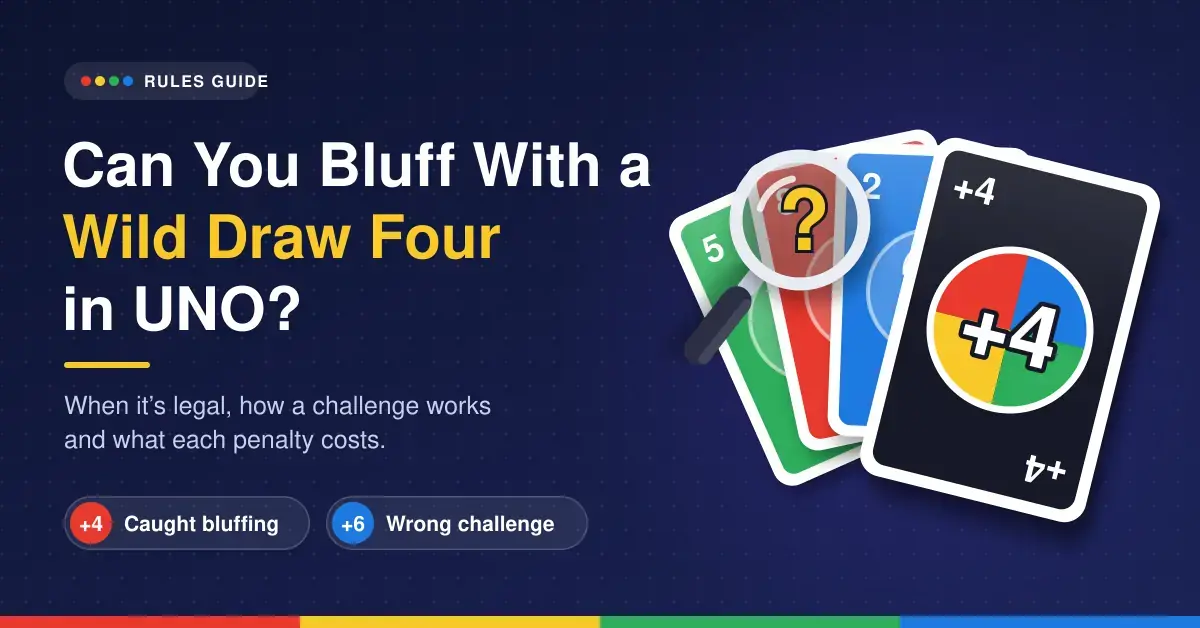
The challenge rule exists precisely because the Wild Draw Four can be played illegally as a bluff — laying it while secretly holding a matching colour, in the hope that no one challenges. If the play goes unchallenged, it simply stands and the colour changes. Whether the risk is worth it depends entirely on how likely the next player is to challenge. This is a topic in its own right; for a focused look, read whether you can bluff with a Wild Draw Four.
Points and Scoring
UNO is usually played to 500 points, and at the end of each round the winner scores the value of the cards left in every other player’s hand. The Wild Draw Four is worth 50 points — the highest value of any card, tied with the ordinary Wild. For comparison, number cards score their face value (0–9) and the other action cards (Skip, Reverse, Draw Two) score 20 each.
- Wild Draw Four: 50 points.
- Wild: 50 points.
- Skip, Reverse, Draw Two: 20 points each.
- Number cards: face value (0–9).
Because it carries such a high value, being caught holding a Wild Draw Four when someone else goes out is costly. Many players prefer to use it during a round rather than risk it counting against them. For the full method, see how scoring works in UNO.
Can You Stack Wild Draw Fours?
A widespread house rule lets a player respond to a Draw Four (or a Draw Two) with another of their own, passing an ever-growing pile of cards down the table. This “stacking” is not part of the official Mattel rules. Officially, when a Wild Draw Four is played the next player must resolve it immediately — draw four and miss their turn — and cannot deflect it by playing another card.
| Point | Official rule | Common house rule |
|---|---|---|
| Response allowed? | None; draw four and miss the turn | Play another +4 to “stack” |
| Cards drawn | Fixed at four | Accumulates (8, 12, 16…) |
| Turn flow | The penalised player is skipped | Passes on until someone cannot respond |
Stacking is a legitimate and popular variant if everyone agrees to it before playing, but it is not the default. You can compare more variants in the guide to whether stacking is allowed in official UNO rules and the related UNO Draw Two card rules.
Starting the Game With a Wild Draw Four
To begin a round, the top card of the draw pile is flipped to start the discard pile. If that card happens to be a Wild Draw Four, the official rules treat it as too powerful to open with: it is returned to the deck, the cards are reshuffled, and a new card is flipped. This avoids penalising the first player before the game has really started. By contrast, if an ordinary Wild card is flipped, the first player simply chooses the colour and play begins.
Wild Draw Four in Two-Player Games
In a head-to-head game the card is especially strong. Your opponent draws four and their turn is skipped, which passes play straight back to you — effectively giving you another turn. You can use that to switch the colour to one you hold plenty of and continue playing. The trade-off is that challenges tend to be more common in a two-player game, because your opponent can track your colours more easily and the six-card penalty is a smaller deterrent when only one other person collects points.
Playing a Wild Draw Four as Your Last Card
You are allowed to win the round by playing a Wild Draw Four as your final card. The round is not settled until the penalty is resolved: the next player still draws their four cards, and those cards are counted along with everyone else’s hand when the winner’s score is totalled. In other words, a player cannot escape the point consequences of the draw simply because the card that triggered it emptied someone’s hand.
Wild Versus Wild Draw Four
Both cards let you change the colour and both are worth 50 points, but they are not interchangeable. The comparison below highlights the key differences.
Wild vs Wild Draw Four
| Feature | Wild | Wild Draw Four |
|---|---|---|
| Changes the colour | Yes | Yes |
| Forces the next player to draw | No | Yes — four cards |
| Skips the next player’s turn | No | Yes |
| Restriction on when it can be played | None; playable any turn | Only when you hold no matching colour |
| Can be challenged | No | Yes |
| Can start the game if flipped first | Yes (first player picks the colour) | No; returned and reshuffled |
| Point value | 50 | 50 |
For historical background on how these rules have developed over time, the Wikipedia entry on the game offers additional context.
Sources
Frequently Asked Questions (FAQ)
Can you play a Wild Draw Four if you have a matching number?
Yes. Only a matching colour blocks the play. If you hold a matching number or symbol in a different colour, you may still play the Wild Draw Four legally.
What is the penalty for a failed challenge?
If you challenge and the accused player turns out to have had no matching colour, you must draw six cards — the original four plus two more — and you still miss your turn.
Can you stack a Wild Draw Four onto another Draw card?
Not under the official rules. Stacking is a house-rule variant. Officially, the penalised player must draw the four cards and cannot respond with another card.
How many points is a Wild Draw Four worth?
Fifty points, tied with the ordinary Wild card for the highest value of any card in the deck. Number cards score their face value and other action cards score twenty each.
What happens if a Wild Draw Four is the first card flipped?
It is returned to the deck, the cards are reshuffled, and a new card is flipped to start the game, because the card is considered too powerful to open a round.