UNO is one of the world's most recognisable card games, yet the gap between a casual family round and a genuinely competitive one comes down to knowing the official rules precisely. This guide breaks down the core mechanics of standard UNO as published by Mattel: what is inside the deck, how each action and Wild card works, how the "UNO" call and the Wild Draw Four challenge are handled, and how points are scored across a match. Every rule below reflects the official rulebook rather than the many house variations that circulate around kitchen tables.
Key Points
- Deck: 108 cards in four colours (red, blue, green, yellow), plus eight Wild cards.
- Goal: empty your hand each round; the first player to reach 500 points wins the match.
- Say "UNO": call it the moment you have one card left, or risk a two-card penalty.
- Wild Draw Four: only legal when you hold no card of the current colour.
- No stacking: official rules do not let you stack Draw Two or Draw Four cards.
Understanding the standard UNO deck
A traditional UNO deck contains 108 cards, split across four colour suits — red, blue, green and yellow. Each colour holds one 0 card, two each of the numbers 1 to 9, and a set of action cards; the Wild cards sit outside the colour system entirely. Newer retail decks are sometimes printed with 112 cards, adding a Wild Swap Hands (or Wild Shuffle Hands) card and a few blank Wild Customizable cards, but the 108-card structure remains the reference point for official play. Knowing the exact make-up of the deck is the first step toward tracking which cards have already been played. If you are new to the game, our definitive beginner's guide to UNO covers the basics before you dig into the detail here.
- Total cards: 108 in a standard deck.
- Colour distribution: 25 cards in each of the four colours.
- Number cards: 76 in total, valued 0 to 9.
- Action cards: 24 (Skip, Reverse and Draw Two).
- Wild cards: 8 (four Wild and four Wild Draw Four).
Number cards and colour probability
Because there is only a single 0 in each colour but two of every number from 1 to 9, mid-range and high-range cards are twice as common in your hand as zeros. Any one colour accounts for 25 of the 108 cards — roughly 23% of the deck — with the eight Wilds able to stand in for any colour. That balance is what lets attentive players estimate which colours opponents are likely short of as a round progresses.
The Skip card
When a Skip is played, the next player in the current order loses their turn entirely. That makes it a tempo tool as much as a defensive one: skipping the player to your left gives the rest of the table another pass before that player can act. In a two-player game a Skip effectively hands you an immediate second turn, because the only opponent is the one being skipped. A Skip must be matched to the colour on the discard pile or played on another Skip. Our full breakdown of UNO Skip card rules goes deeper into turn management and timing.
The most valuable moment to play a Skip is against a player who has just called "UNO" or is clearly down to one card: skipping them buys the table an extra round to change the colour or force them to keep drawing, neutralising their chance to go out.
The Reverse card
The Reverse card flips the direction of play from clockwise to counter-clockwise, or back again. In a two-player game it behaves exactly like a Skip. With three or more players it becomes a positional tool — a well-timed Reverse can send an approaching Draw Two or Wild Draw Four back toward the player who is closest to winning rather than absorbing it yourself. Like other coloured action cards, a Reverse must match the current colour or be played on another Reverse. If a Reverse is the very first card flipped to start the discard pile, the dealer takes the first turn and play proceeds in the reversed direction. You can read more about how it works in our guide to the UNO Reverse card.
The Draw Two card
The Draw Two forces the next player to draw two cards from the pile and forfeit their turn. It must match the colour of the card beneath it or be played on another Draw Two. Crucially, it is a turn-ender: the penalised player cannot play a card even after taking their two. This card is the centre of a common misunderstanding about "stacking" — under the official Mattel rules you may not stack a Draw Two onto another Draw Two to pass the penalty along, even though many households play that way. Our article on whether stacking is allowed in official UNO rules explains the distinction in full. Each Draw Two left in your hand at the end of a round is also worth 20 points.
Card Reference
| Card | Effect | Point value |
|---|---|---|
| Number 0–9 | Matched by colour or number | Face value (0–9) |
| Skip | Next player misses their turn | 20 |
| Reverse | Reverses direction; acts as a Skip with two players | 20 |
| Draw Two | Next player draws two and misses their turn | 20 |
| Wild | Change the active colour to any colour | 50 |
| Wild Draw Four | Next player draws four; change colour; legal only with no colour match | 50 |
Wild and Wild Draw Four cards
Wild cards are the most flexible in the deck. A standard Wild can be played at any time — even when you hold a playable coloured card — and lets you change the active colour to whatever you choose, which makes it a useful way to steer play toward the colour you hold most of. The moment you play it, you must announce the new colour.
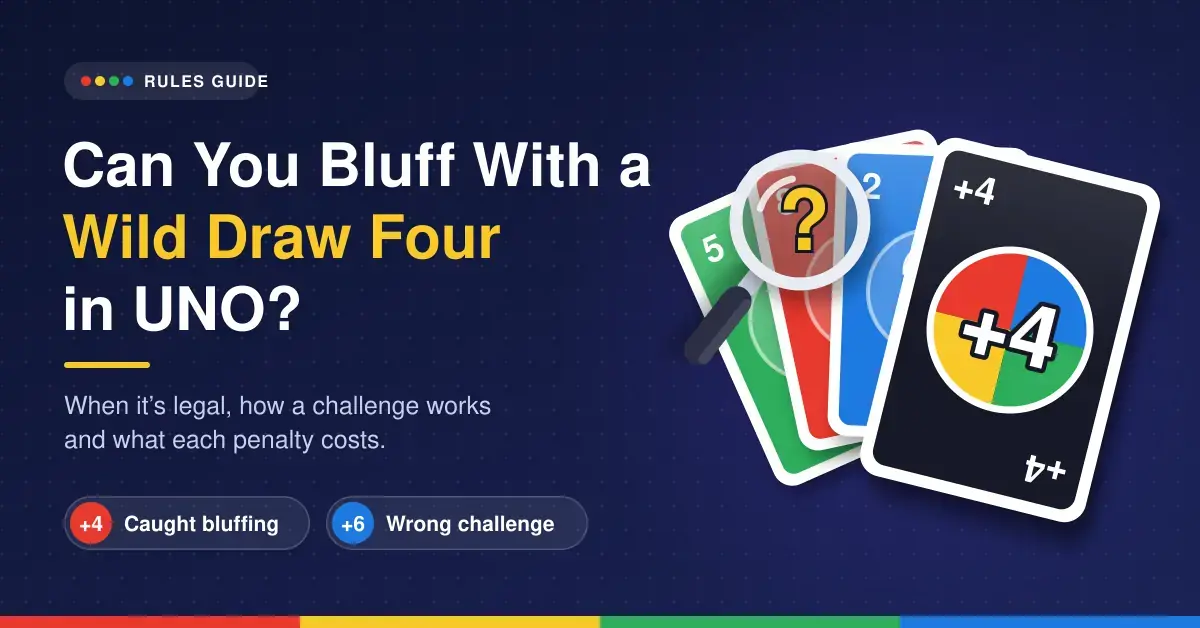
The Wild Draw Four is the most powerful card and carries a strict condition: it may only be played when you have no card in hand matching the current colour. If the next player suspects you played it illegally, they can challenge you and you must privately show your hand. If the challenge succeeds, you draw four cards instead; if it fails, the challenger draws six cards — the original four plus two more — and misses their turn. That risk-and-reward mechanic is what turns the Wild Draw Four into a bluffing tool. Our detailed UNO Wild Draw Four rules walk through the challenge process step by step. Both Wild types are worth 50 points if caught in a hand at scoring.
Calling "UNO"
The game's signature rule is the requirement to say "UNO" the moment you are down to a single card. If another player catches you failing to call it before the next player takes their turn, you draw two cards as a penalty. There is no official penalty for wrongly accusing someone who did call correctly, though it is considered poor sportsmanship. The rule rewards watching opponents' hand sizes as closely as you watch the discard pile.
- Timing: announce it as you play your second-to-last card.
- Penalty: draw two cards if caught in time.
- Detection window: a challenge must come before the next player plays or draws.
- False accusations: no penalty under official rules.
Scoring and winning conditions
Casual games often end the instant someone empties their hand, but the official rules use a points system across multiple rounds. The player who goes out scores the combined value of the cards still held by everyone else, and the first player to reach 500 points wins the match. Because high-value cards hurt the most, this rewards going out quickly and shedding Wilds and action cards early. Our explainer on how scoring works in UNO covers the maths in more detail.
- Number cards: counted at face value (0–9).
- Skip, Reverse, Draw Two: 20 points each.
- Wild and Wild Draw Four: 50 points each.
- Match target: first to 500 points wins.
A common house alternative reverses the goal: players keep individual running totals and the aim is to have the lowest score when someone reaches 500, which encourages dumping high-value cards as early as possible.
Dealing and initial setup
A game begins by choosing a dealer, then dealing seven cards to each player. The rest of the deck becomes the face-down draw pile, and the top card is turned over to start the discard pile. If that first card is a Skip, Reverse or Draw Two, its effect applies immediately to the start of play; if it is a Wild, the player to the dealer's left names the starting colour; and if it is a Wild Draw Four, it is returned to the deck and a new card is turned over instead.
- Starting hand: seven cards per player.
- First move: the player to the dealer's left.
- Action-card start: a Skip, Reverse or Draw Two takes effect on the first turn.
- Wild start: the first player chooses the colour; a Wild Draw Four is re-drawn.
Common mistakes players get wrong
Several "rules" that feel official are actually house customs. You cannot stack Draw Two or Draw Four cards under the standard rulebook. A 0 or 7 does not swap or rotate hands in official play — those are variant rules. And the Wild Draw Four restriction is about colour only: you may legally play it regardless of whether you hold a matching number or action card, provided you have none of the current colour. Keeping the official version straight is what makes matches consistent when you play with new groups.
Final thoughts
Mastering UNO is less about luck than about knowing the 108-card deck, applying action cards at the right moment, and staying honest about the details — the "UNO" call and the true limits of the Wild Draw Four in particular. Play the official version and every table stays fair and competitive, whether you are counting points to 500 or simply racing to empty your hand. For a wider look at how card games have influenced popular culture, general encyclopaedic references such as Wikipedia offer additional background.
Sources
Frequently Asked Questions (FAQ)
What happens if the last card played is a Draw Two?
The next player still has to draw the two cards before the round is scored, and those cards count toward the winner's point total.
Can you play a Wild Draw Four if you have a matching number?
Yes. The restriction applies only to matching colours, so a matching number or action card does not make the play illegal — you simply must hold no card of the current colour.
Is there a penalty for calling UNO on someone who actually has two cards?
No. Official rules impose no penalty for a false accusation, although repeatedly doing so is considered poor sportsmanship.
Can you win the game with a Wild card?
Yes. A Wild or Wild Draw Four can legally be your final card played to win a round.
What happens if the draw pile runs out?
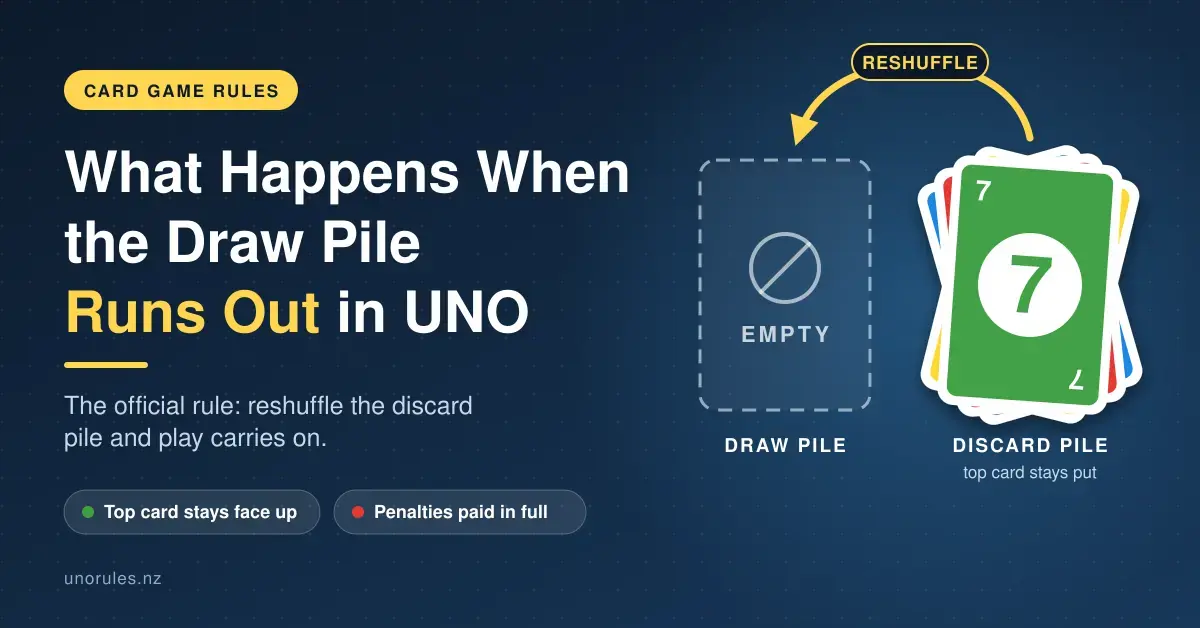
The discard pile is shuffled — leaving its top card in place — and turned face down to form a fresh draw pile so play continues.