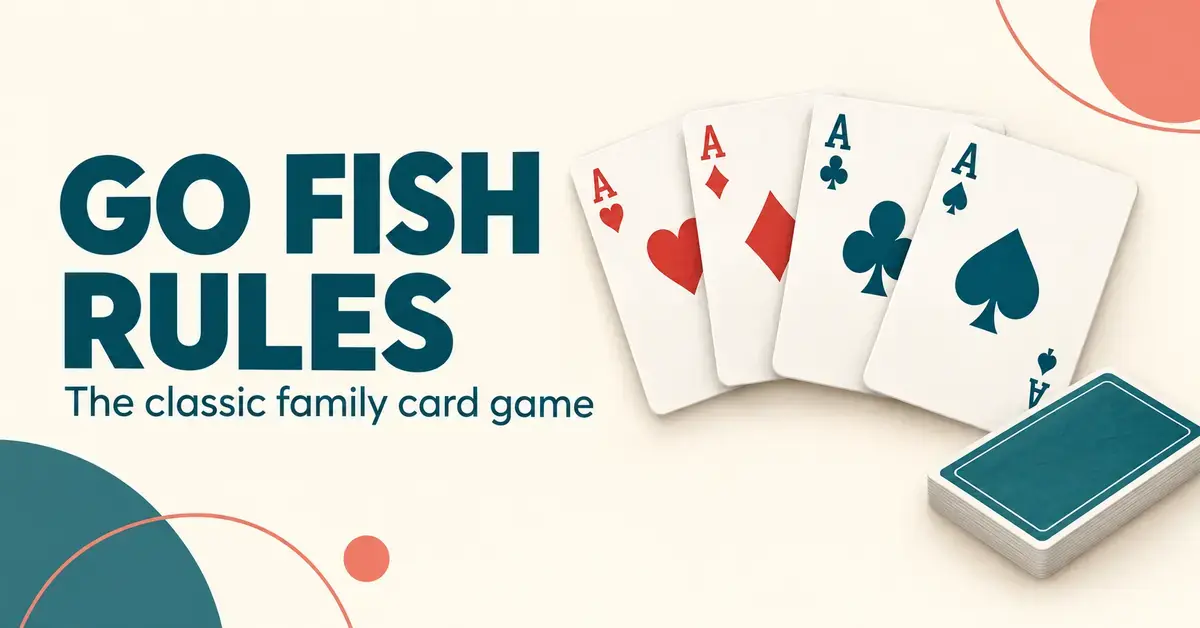
Go Fish is one of the easiest card games to learn and one of the most popular ways to introduce children to playing cards. Two or more players use a single standard deck to “fish” for matching cards, collect complete sets of four, and race to build the most sets by the end of the game. Below you will find the full rules, from dealing the first hand to declaring a winner, plus common variations and quick answers to the questions new players ask most.
What Is Go Fish?
Go Fish is a matching card game in which players ask each other for cards of a particular rank (all the 7s, all the Kings, and so on) in order to collect “books” — complete sets of four cards of the same rank. It is a game of simple deduction and memory rather than complex strategy, which is why it is a staple of family game nights and classrooms.
The game is sometimes just called “Fish,” and it is closely related to the traditional British game Happy Families, which uses almost identical rules. Some historians trace fishing-style card games back to an Italian game described around the end of the 15th century, though no detailed rules from that era survive. Today Go Fish is played all over the world with an ordinary deck of cards.
What You Need to Play
Go Fish needs almost nothing beyond a deck of cards, which makes it ideal for travel, waiting rooms and rainy afternoons.
- Players: 2 to 6 (best with 3 to 5).
- Deck: one standard 52-card pack, no jokers.
- Age: suitable from about 4 years and up.
- Time: roughly 5 to 15 minutes per game.
Quick Facts
| Players | 2–6 (best with 3–5) |
|---|---|
| Deck | One standard 52-card pack (no jokers) |
| Cards dealt | 7 each for 2–3 players; 5 each for 4+ players |
| Objective | Collect the most “books” (sets of four matching cards) |
| Books in a game | 13 (one per rank, Ace to King) |
| Age | About 4 and up |
| Playing time | Around 5–15 minutes |
How to Set Up the Game
Choose a dealer (for example, the youngest player, or the winner of the previous round). The dealer shuffles the pack and deals cards one at a time, face down, to each player in a clockwise direction:
- 2 or 3 players: deal 7 cards to each person.
- 4, 5 or 6 players: deal 5 cards to each person.
Place the remaining cards face down in a pile in the middle of the table. This draw pile is usually called the “stock,” though many families call it the “pool,” “pond” or “ocean” — which is where the phrase “Go Fish” comes from. Players may look at their own cards but should keep them hidden from everyone else.
How to Play Go Fish
Play starts with the person to the dealer’s left and moves clockwise. On your turn you try to collect cards of the same rank by asking one opponent for them.
Asking for cards
Choose any one opponent and ask them for a specific rank, for example: “Do you have any Queens?” There is one important condition: you must already be holding at least one card of the rank you ask for. You cannot ask for a rank you do not have in your own hand.
If the player you asked has any cards of that rank, they must hand over all of them — not just one. You then get to take another turn and may ask the same player or a different one for another rank. Your turn continues as long as each request is successful.
When you are told to “Go Fish”
If the player you asked does not have any cards of the rank you named, they say “Go Fish!” You then draw the top card from the stock pile in the middle. What happens next depends on that card:
- If you happen to draw a card of the exact rank you just asked for (called “making a catch” or “fishing your wish”), show it, and you get to take another turn.
- If you draw any other card, you simply keep it in your hand and your turn ends. Play then passes to the player on your left.
Making a book
Whenever you collect all four cards of the same rank — for example all four 9s — you have completed a “book.” Immediately place the four cards face up on the table in front of you so everyone can see them, and continue your turn. Completed books stay on the table until the game ends and are how the winner is decided.
Key Points
- Ask one opponent for a rank you already hold at least one of.
- A hit means they give you all matching cards, and you go again.
- A miss means “Go Fish” — draw one card from the stock.
- Drawing the exact rank you asked for earns another turn.
- Four of a kind is a “book” — lay it face up straight away.
- The game ends when all 13 books are made; most books wins.
Running Out of Cards
Because a successful ask can strip several cards from your hand, you may run out of cards before the game is over. If this happens, on your next turn simply draw one card from the stock and then ask for that rank as usual. If the stock is also empty, you are out for the rest of the game — but the books you have already made still count toward your final score.
How to Win Go Fish
A full deck contains 13 ranks (Ace through King), so there are exactly 13 books to be made in a game. The game ends when all 13 books have been completed and laid on the table. Each player then counts the books they collected, and the player with the most books wins. If two players tie on the number of books, they can either share the win or play a quick tie-breaker round.
Common Rule Variations
Go Fish has no single governing body, so house rules are common. Agree on any variations before you deal. Popular options include:
- Pairs instead of books: collect matching pairs (two of a kind) rather than sets of four. This speeds the game up and suits very young children.
- Give only one card: when asked, a player hands over just one matching card instead of all of them, which makes the game last longer.
- Ask for a specific card: instead of a rank, players ask for an exact card, such as “the Queen of Hearts,” adding a memory challenge.
- Jokers as wild cards: add the two jokers, which can stand in for any rank to help complete a book.
- Empty-hand ends the game: some families end the game the moment any player empties their hand rather than waiting for all 13 books.
If your group enjoys tinkering with rules, you may also like exploring how the same idea plays out in other games — from the shedding-style Crazy Eights to the many UNO gameplay variations that reward similar quick thinking.
Tips for New Players
Go Fish rewards attention more than luck once you get the hang of it:
- Listen carefully. Remember which ranks other players have asked for — it tells you what they are holding.
- Watch what gets handed over. When someone gives away cards, note who received them so you can ask for them later.
- Complete books quickly. Lay down a book as soon as you can so no one can pull those cards from you.
- Do not tip your hand. Try to vary who you ask so opponents cannot easily read your collection.
How Go Fish Compares to Other Easy Card Games
If your table enjoys quick, low-setup games, Go Fish sits alongside several other family favourites. The table below shows how it lines up with a few popular alternatives you can play with a standard or dedicated deck.
Comparison
| Game | Players | Deck | Goal | Difficulty |
|---|---|---|---|---|
| Go Fish | 2–6 | Standard 52-card | Collect the most books of four | Very easy |
| Old Maid | 2–8 | Standard deck (one card removed) | Avoid being left with the odd card | Very easy |
| Snap | 2–4 | Standard 52-card | Win cards by spotting matching pairs | Very easy |
| Crazy Eights | 2–7 | Standard 52-card | Be first to shed all your cards | Easy |
| UNO | 2–10 | Dedicated UNO deck | Be first to empty your hand | Easy |
For more ideas, browse our round-ups of easy card games, fun card games to play with any group, and dedicated card games for two players when it is just the two of you.
Frequently Asked Questions (FAQ)
How many cards do you deal in Go Fish?
Deal 7 cards to each player when 2 or 3 people are playing, and 5 cards each when 4 or more are playing. The rest of the deck forms the face-down stock pile in the centre of the table.
Do you have to hold a card to ask for it?
Yes. You may only ask another player for a rank that you already have at least one of in your own hand. You cannot ask for a rank you are not holding.
What happens when you make a match in Go Fish?
If the player you ask has cards of the rank you named, they must give you all of them, and you take another turn. If they have none, they say “Go Fish” and you draw one card from the stock.
How do you win Go Fish?
The game ends once all 13 books (complete sets of four cards of the same rank) have been laid down. The player who has collected the most books wins the game.
Can you play Go Fish with two players?
Yes. Go Fish works well with two players; each person is dealt 7 cards instead of 5. The rules are otherwise identical, and the game tends to move quickly.