UNO looks like one game, but it is really two. At a table of preschoolers it becomes a gentle lesson in colours, numbers and taking turns; among competitive adults it turns into a game of bluffing, card counting and careful hand management. Knowing how to flex the rules between those two worlds is what makes UNO such a reliable pick for New Zealand family game nights, where a toddler, a teenager and a grandparent might all share the same deck. This guide breaks down exactly where the children’s version and the adult version differ — from penalties and scoring to house rules — and how to move a child from one to the other as they grow.
Key Points
- Children’s UNO softens penalties to teach colours, numbers and turn-taking; adult UNO enforces the full Mattel rulebook.
- Since Mattel’s 2022 update, the official goal is to empty your hand each round — the 500-point scoring format is now optional.
- Action cards are tactical tools for adults but can feel harsh to young children, so families often soften them first.
- Stacking Draw Two cards is a popular New Zealand house rule, not an official one — agree on it before dealing.
- Move children toward full adult rules gradually, typically around ages 10–12.
Fun-First vs Rules-First: The Core Difference
The biggest gap between children’s UNO and adult UNO is not the cards — it is how strictly the rules are enforced. For young children, UNO is a learning tool, so rules are softened to keep everyone involved and to avoid frustration. For adults, the appeal is the opposite: the official Mattel rulebook, with its penalties, challenges and scoring, is exactly what makes the game satisfying. Most Kiwi families sit somewhere in between, starting loose and tightening the rules as the kids get older.
Comparison
| Feature | Kids’ simplified version | Adult standard version |
|---|---|---|
| Main goal | Learning and fun | Winning, with optional points |
| Penalties | Softened or replaced with reminders | Enforced (e.g. draw 2 for a missed “UNO”) |
| Action cards | Explained, sometimes softened | Used tactically |
| Pace | Slower, help allowed | Faster, independent play |
| Winning a round | First empty hand wins | First empty hand, or play on to 500 points |
A helpful way to think about the shift is “scaffolding” — a teaching term for giving temporary support until someone can manage on their own. In UNO that might mean playing with hands face-up so an adult can quietly coach (“Do you have a blue card for that blue 7?”), then moving to hidden hands once the child is confident. If you want the full framework, our guide to official UNO rules versus house rules lays out which changes are sanctioned and which are pure family tradition.
Action Cards: Tactics for Adults, Surprises for Kids
Skip, Reverse and Draw Two are the cards that swing a game. Adults use them deliberately — to block whoever is close to winning or to steer the turn order in their favour. Younger children tend to play them the moment they appear, simply because the card is in their hand. The emotional weight matters too: being skipped or handed a Draw Two can feel unfair to a five-year-old, which is why families often adjust these cards first.
- Skip: a blocking tool for adults; for little kids it can be softened into a “play again” card.
- Reverse: adults use it to control turn order, while young children often just enjoy changing direction. Learn more about the UNO Reverse card and how it works.
- Draw Two: a direct penalty for adults; for kids it can be framed simply as “draw two cards”.
- Wild cards: kids pick their favourite colour; adults choose the colour that hurts opponents most.
The “Soft Skip” and Other Gentle Tweaks
A common family fix is the “soft skip”: when a Skip lands on a young child, they still draw a card so they stay part of the action even though their turn is technically passed. Small adjustments like this keep the game moving without leaving the youngest player feeling shut out.
Saying “UNO” and Penalties by Age
Calling “UNO” when you are down to one card is the game’s signature rule — and its most common source of arguments. Under official rules, if you fail to announce it and another player catches you before the next player takes their turn, you draw two cards as a penalty. With children, most families replace that penalty with a friendly reminder until the habit sticks. Our explainer on what happens if you forget to say UNO covers the official timing in detail.
| Situation | Official (adult) handling | Kid-friendly version |
|---|---|---|
| Forgot to say “UNO” | Draw 2 cards | Friendly verbal reminder |
| Playing out of turn | Card returned to hand | Allowed if they missed the cue |
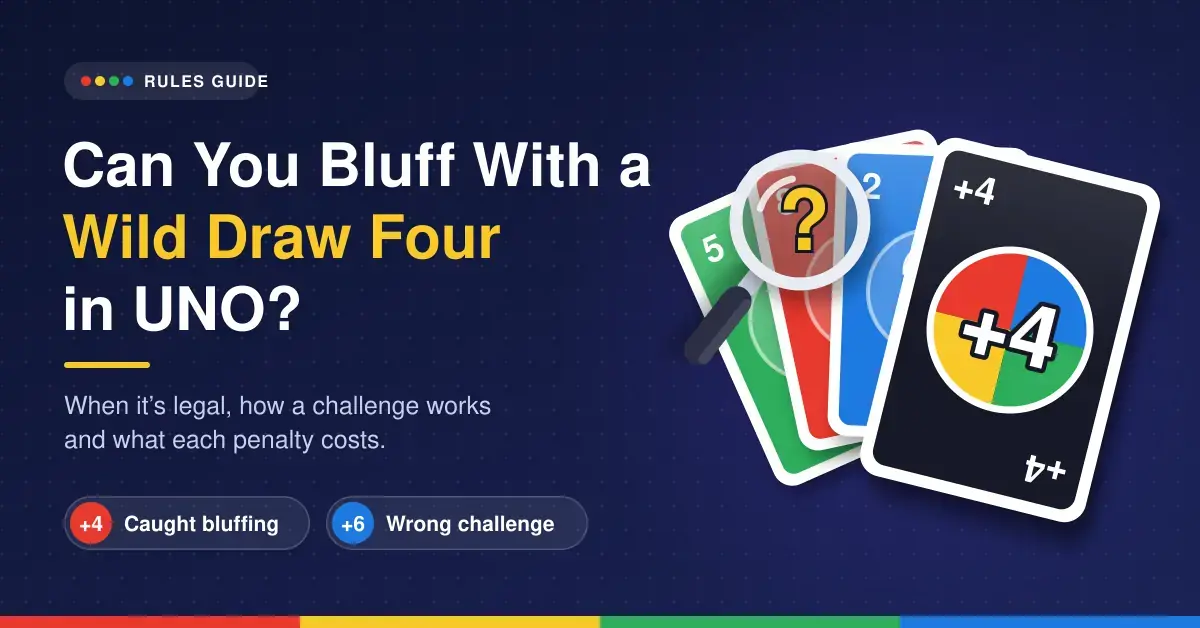
| Wild Draw Four played | May be challenged | Usually played without a challenge |
Scoring: First to Finish vs the 500-Point Game
Here is where an outdated assumption often creeps in. Many guides still say the “real” goal of UNO is to reach 500 points. In fact, Mattel updated the rules in 2022: the standard objective is now simply to be the first player to get rid of all your cards each round, and the classic 500-point scoring format is offered as an optional way to play. Both are legitimate — the point-scoring version just adds maths and long-term planning, which is why it suits adults and older children. Most young kids skip scoring entirely and treat the first empty hand as the win.
When you do keep score, the winner of a round collects points for the cards left in everyone else’s hands, using these values:
| Card | Points when left in an opponent’s hand |
|---|---|
| Number cards 0–9 | Face value (0–9) |
| Skip, Reverse, Draw Two | 20 each |
| Wild, Wild Draw Four | 50 each |
Counting up those points is a quiet way to practise addition with school-aged kids. If you want the full method, see our breakdown of how scoring works in UNO.
Stacking and Other House Rules
“Stacking” — answering a Draw Two with another Draw Two so the penalty piles up — is one of the most popular house rules in New Zealand, but it is not part of the official game. Officially you cannot stack; the player hit by a Draw Two must draw and lose their turn. Allowing stacking makes games longer and more volatile, which teenagers and adults often enjoy and small children often find overwhelming, so agree on it before you deal. Our article on whether stacking is allowed under official UNO rules explains the ruling in full.
The game has spread far beyond the kitchen table over the decades, turning up in unexpected corners of pop culture and music trivia — the kind of rabbit hole a quick hop to Wikipedia can send you down. On the table, though, the house rules you agree on matter far more than any of that.
UNO Junior and Adapting a Deck for Toddlers
For the youngest players, Mattel makes UNO Junior, a version designed for ages 3 and up that trades some complexity for animal illustrations, so children who cannot yet read numbers can still match by picture or colour. It also builds up in levels: simple matching first, then action cards, then penalty cards.
You can mimic this with a standard deck by starting simple and adding complexity in stages:
| Stage | Suggested rules | Focus |
|---|---|---|
| Ages 3–4 | Match colour or number only, no action cards | Recognition |
| Ages 5–7 | Full cards, relaxed penalties | Patterns & sequence |
| Ages 8–12 | Official rules with penalties | Strategy & fair play |
| Adults | Official rules, optional 500-point scoring | Competition |
Strategy and Hand Management for Older Kids and Adults
Adult UNO rewards patience. Instead of playing a Wild Draw Four the moment they draw it, experienced players save it to counter a leader or escape a colour they cannot match. They also shed high-value cards early to keep their potential score low, and they watch which colours opponents keep drawing as a clue to what those players are missing. Introducing this thinking to children around 10–12 is a natural way to teach basic probability and turn UNO into a genuine strategy game.
- Hold power cards (Wild and Wild Draw Four) for the moment they do the most damage.
- Play high-scoring cards early so you are not caught holding them if someone goes out.
- Track opponents’ colours to guess what they can and cannot play.
- Plan your last few moves, not just the current turn.
Keeping Mixed-Age Games Fair and Fun
When ages are mixed, the most experienced player often acts as an informal referee — making sure the agreed rules are applied consistently and that no one is being ganged up on. A few shared habits keep things friendly: be honest with the draw pile, be patient while younger players find a match, celebrate a well-timed Skip or Reverse, and win or lose graciously. Setting the house rules out loud before the first card is dealt prevents most mid-game disputes and lets every generation at the table have a fair go.
Sources
Frequently Asked Questions
What age can children start playing UNO?
Many children can join in from about age 3 or 4 using a simplified version that focuses only on matching colours and numbers. Mattel’s UNO Junior is also designed for ages 3 and up, using animal pictures so pre-readers can play.
Do I have to use the 500-point scoring with kids?
No. Since Mattel’s 2022 rules update, the standard goal is simply to be the first player to empty their hand each round. The 500-point scoring format is optional and is best kept for older children and adults who enjoy the extra maths and planning.
Is stacking Draw Two cards allowed?
Not under the official rules — the player who receives a Draw Two must draw the cards and lose their turn. Stacking is a common house rule that many families enjoy, but it makes games longer, so agree on it before you start.
How should I handle a child who forgets to say “UNO”?
For younger children, a gentle reminder usually works better than a penalty. Around age 8 and up you can start applying the official rule, where a missed “UNO” caught in time costs a 2-card draw.
Should we play with our hands open or closed?
Start with open hands for beginners so you can coach them through matching decisions. Once a child understands the mechanics, switch to closed hands to introduce the strategy and memory that adult play relies on.