Wild cards are the most flexible pieces in an UNO deck: they can be played on any colour or number, they let you steer the game, and they carry the highest point value if you get caught holding them. This guide explains the official UNO Wild card rules in plain language for New Zealand players — how the standard Wild and the Wild Draw Four work, how you change the colour, when a Wild Draw Four can legally be played, how the challenge works, what the cards are worth when scores are tallied, and how they behave in two-player games. Terms are explained the first time they appear so beginners can follow along.
Key Points
- Two wild types: 4 standard Wild and 4 Wild Draw Four cards in a 108-card deck.
- Colour choice: the player names red, blue, green or yellow when the wild is played.
- Wild Draw Four rule: play it only when you hold no card matching the current colour.
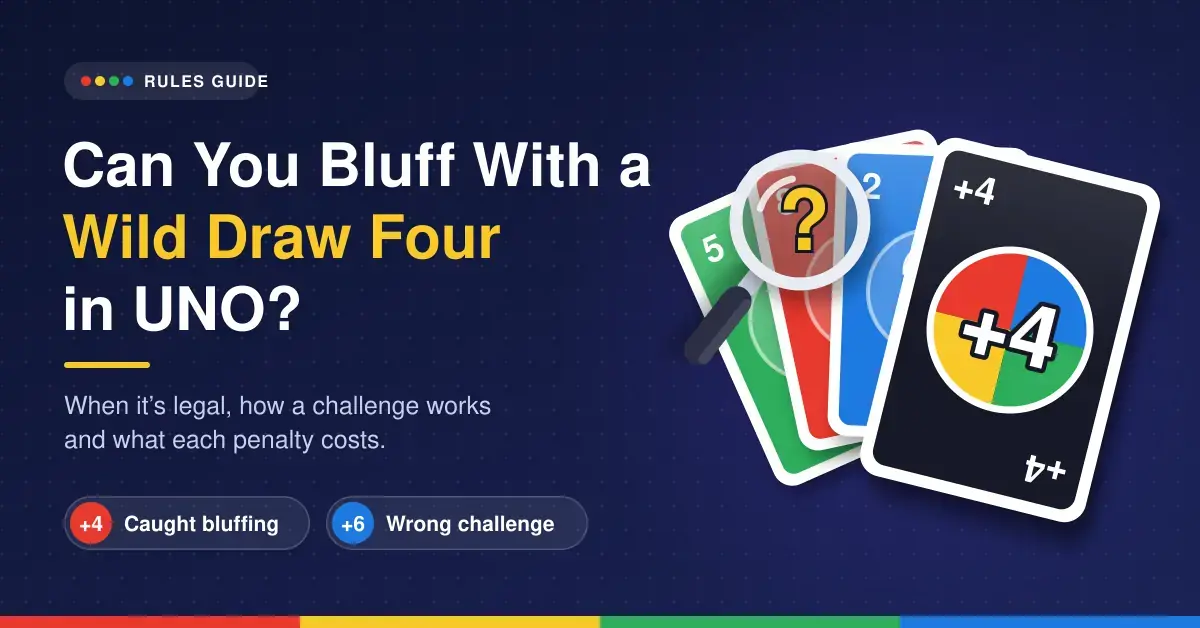
- Challenge: a caught player draws 4; a failed challenge means the challenger draws 6 and misses a turn.
- Scoring: every wild is worth 50 points if you are caught holding it.
- No stacking of draw penalties under official rules.
What Wild cards are and how they fit the deck
A standard UNO deck contains 108 cards. Eight of them are wild: four standard Wild cards and four Wild Draw Four cards. A wild card has no colour of its own, so it can be played on top of any card in the discard pile (the face-up pile you play onto). That universal playability makes wild cards useful for escaping a “colour lock” — a situation where the active colour does not match anything in your hand — and for setting up your final cards.
Because only 8 of 108 cards are wild, the chance that any single card you draw is a wild is roughly 7%. Since they are worth 50 points each, most players prefer to play them rather than hoard them, so a wild is rarely wasted.
How you choose a colour
When you play any wild card, you immediately name the colour that play must follow: red, blue, green or yellow. The next player must then match that chosen colour, play a card that otherwise matches (for a Wild Draw Four this is restricted — see below), or play another wild and pick again. Once you have named a colour it stays in force until someone changes it with a later wild. A good first-card habit is to name the colour you hold the most of. For a fuller breakdown of every card’s worth, see our guide to UNO card values.
The standard Wild card
The standard Wild has no penalty attached. You may play it at any point on your turn — even if you have other legal cards you could play instead — which makes it a clean way to switch the colour without any risk of being challenged. Players often use it as an “exit” card to move the game onto a colour where they hold a strong hand, or to shift away from a colour an opponent is comfortable in.
Comparison
| Feature | Standard Wild | Wild Draw Four |
|---|---|---|
| Changes the active colour | Yes | Yes |
| Forces opponent to draw | No | Yes — 4 cards |
| Next player misses a turn | No | Yes |
| Restriction on when it can be played | None | Only if you have no matching colour |
| Can be challenged | No | Yes |
| Point value if held at scoring | 50 | 50 |
Using a Wild to break a colour lock
If the table has been stuck on blue for several turns and your hand is mostly red, a standard Wild is your bridge: switch the colour to red and you can start emptying your hand while opponents who were relying on blue lose their momentum.
The Wild Draw Four and its challenge rule
The Wild Draw Four changes the colour and forces the next player to draw four cards and miss their turn. It is the most aggressive card in the deck, so its use is restricted by a legality rule: officially, you may only play a Wild Draw Four if you have no card in your hand that matches the current colour of the discard pile. You are still allowed to play it if your only matches are a number or action card of a different colour.
Because that rule is easy to break, the next player may challenge the play. When challenged, the player who used the Wild Draw Four privately shows their hand to the challenger to prove they had no matching colour:
- Challenge succeeds (a matching colour is found): the player who used the card draws the four cards instead, and play continues normally.
- Challenge fails (no matching colour): the challenger draws six cards — the original four plus two more — and misses their turn.
Only the challenger gets to see the hand; the other players do not. For a deeper look at this card on its own, read our Wild Draw Four rules explained guide.
Bluffing and the risk that comes with it
Some players deliberately play a Wild Draw Four when they do hold a matching colour, gambling that a cautious opponent will not risk the six-card penalty of a failed challenge. It can work, but if you are challenged and caught you draw the four cards yourself, so it is a genuine risk rather than a free move. We cover this in detail in can you bluff with a Wild Draw Four.
What Wild cards are worth when scoring
In the round-scoring version of UNO, the player who empties their hand first wins the round and collects points for the cards still held by everyone else. Wild cards are the most expensive to be caught with:
- Standard Wild — 50 points
- Wild Draw Four — 50 points
- Action cards (Skip, Reverse, Draw Two) — 20 points each
- Number cards — their face value
A common way to play is to keep going until one player reaches 500 points; since the 2022 rule refresh this target is an optional format rather than the only official objective. Either way, being stuck with two wilds hands your opponent 100 points, so late in a round it usually pays to play a wild rather than a low number card. See how scoring works in UNO for the full method, and UNO rules for tournament play if you are running a points-based competition.
Wild cards in two-player games
In a head-to-head game, cards that make an opponent miss their turn effectively give the turn straight back to you. A Wild Draw Four is especially strong here: your opponent draws four and is skipped, so you play again immediately — potentially playing your last card for the win before they can respond.
- A Wild Draw Four in a two-player game grants you an immediate second turn.
- A standard Wild does not skip the opponent; they simply play on the new colour.
- Challenges matter more here, because the six-card penalty from a failed challenge lands directly on your single opponent.
When a Wild is the first card flipped
After dealing, one card is turned up to start the discard pile. What happens if it is wild depends on the type:
- Standard Wild flipped first: the player to the dealer’s left chooses the starting colour and then plays as normal.
- Wild Draw Four flipped first: it is returned to the deck, the deck is reshuffled, and a new card is turned up in its place.
Blank and customisable Wild cards
Many modern UNO decks include blank “customisable” Wild cards. These are wild cards you assign a house rule to — for example “everyone draws two” or “swap hands.” Agree on the rule before you deal to avoid disputes, and note that if no rule is written they simply act as ordinary Wilds. Whatever house rule you attach, they still count as 50 points at scoring time. If you enjoy tinkering with the game this way, our UNO house rules collection has plenty of popular variations.
How Wilds interact with action cards
A wild card can be played on top of any card, including a Skip, Reverse or Draw Two, which makes it a reliable way to break out of a chain of action cards. Two points often cause confusion:
- No stacking: under official rules you cannot play a Draw Two or another Wild Draw Four to pass a Draw Four penalty along — the penalty must be resolved by the player it lands on. (Stacking is a popular house rule; see whether stacking is allowed in official UNO rules.)
- Colour, not symbol: after a wild resets the colour, the next player matches the new colour or number — they cannot answer with a Skip or Reverse unless it matches that chosen colour.
Playing a Wild as your final card
You are allowed to win a round by playing a wild as your last card. If that card is a Wild Draw Four, the next player still has to draw the four cards before scores are counted, which can add to the points you collect. As always, you must call “UNO” when you are down to your second-to-last card — that rule applies even when your remaining card is a wild.
For the wider history and international background of the game, the official UNO entry on Wikipedia gives useful context.
Sources
Ngā Pātai Auau (FAQ)
Can I play a Wild card even if I have a matching colour?
Yes. A standard Wild can be played on your turn at any time, even if you have other cards you could legally play instead.
When can I legally play a Wild Draw Four?
Officially, only when you have no card in your hand that matches the current colour of the discard pile. Matching numbers or action cards of a different colour do not count against you.
What is the penalty for a failed challenge?
If you challenge a Wild Draw Four and the player is proven innocent, you draw six cards — the four you already owed plus two more — and miss your turn.
How many points are Wild cards worth at the end of a round?
Both the standard Wild and the Wild Draw Four are worth 50 points each, the highest values in the deck.
Do I still have to say UNO if my last card is a Wild?
Yes. You must call “UNO” when you are down to one card, whatever that card is, including a Wild or Wild Draw Four.