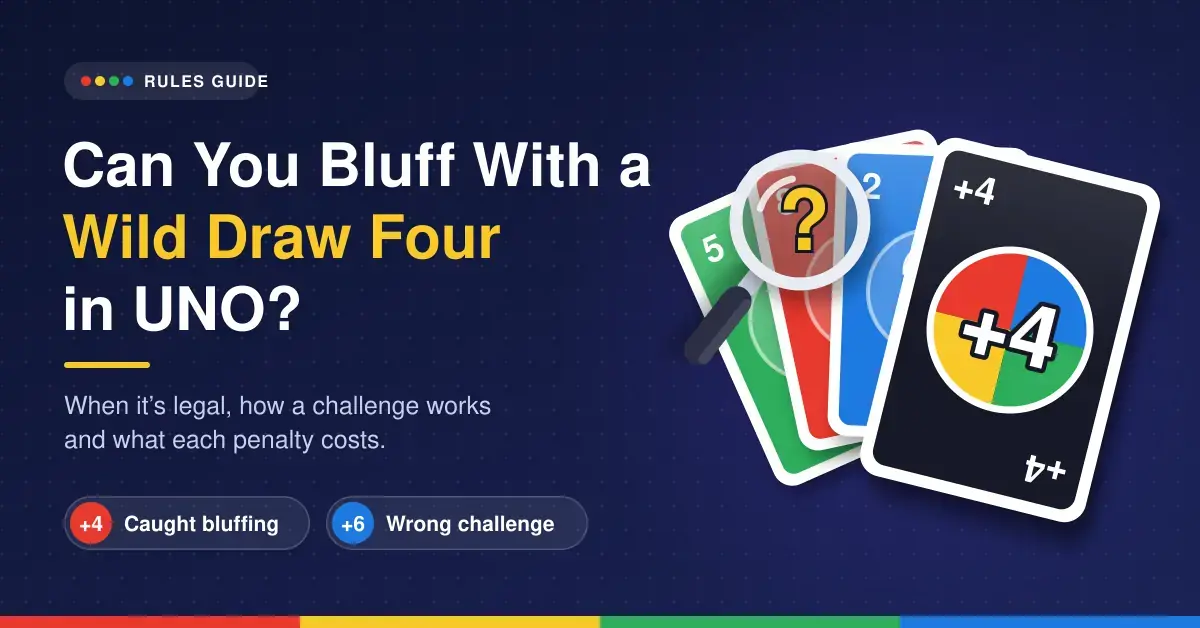
The Wild Draw Four is the strongest card in UNO, and the moment you play one you make a silent promise: that you had no card matching the colour in play. Playing it while you do hold a matching colour is what most players call a "bluff." This guide explains exactly when the card is legal, how the built-in challenge system polices a bluff, what each penalty costs, and how to weigh the odds before you accuse someone. For the plain card mechanics first, see our guide to the official Wild Draw Four rules.
Key Points
- A Wild Draw Four is legal only when you hold no card matching the current colour.
- Playing it with a matching colour is a bluff, and the challenge rule is the only check on it.
- Only the next player can challenge, and they must decide before drawing.
- Caught bluffing: you draw 4. Wrong challenge: you draw 6 and miss a turn.
- Colour is the only restriction — matching numbers or a plain Wild card do not count.
When a Wild Draw Four Is Actually Legal
Under the official Mattel rules, you may play a Wild Draw Four only when you have no card in your hand that matches the colour currently on the discard pile. Matching a number, matching a symbol or holding a plain standard Wild card does not block you — colour is the only thing that counts. If a Blue 7 is showing and your other cards are all Red, Green and Yellow, the play is completely legal. If you are still holding any Blue card, it is not.
| Your situation (Blue 7 in play) | Example card in hand | Playing a Wild Draw Four is |
|---|---|---|
| You still hold a matching colour | Blue 3 | A bluff (against the rules) |
| No matching colour at all | Red 2 | Legal |
| A matching number in another colour | Yellow 7 | Legal |
| You also hold a plain Wild card | Wild + no Blue | Legal |
What Counts as a Bluff
A bluff is simply playing the Wild Draw Four while you still hold a matching colour. Nothing physically stops you from doing it — the rules rely on the next player to police the move through a challenge, so you are effectively betting that nobody will call you out. As an aside, the word is common enough that "Wild Cat Bluff" is even a small community in Texas (Wikipedia), but in UNO the bluff is entirely about the card in your hand, not geography.
Because a caught bluff carries a real penalty, it is a calculated risk rather than a guaranteed advantage. Plenty of players never bluff at all and simply use the card when it is legal, which is always the safest choice.
Challenging a Wild Draw Four
The challenge is the only mechanism that keeps the card honest. When a Wild Draw Four is played, the next player — the one due to draw the four cards — can either accept the penalty or challenge before touching the deck. If challenged, the player who used the card must privately show their hand to the challenger to prove there was no matching colour. Only the challenger sees the hand; the rest of the table does not.
| Challenge result | What the hand shows | Who draws |
|---|---|---|
| Challenge is correct | A matching colour was there | The bluffer draws 4 instead; play continues with the challenger |
| Challenge is wrong | No matching colour | The challenger draws 6 (4 + 2) and misses their turn |
Who Can Challenge, and When
Only the next player in turn order may challenge, and the decision has to be made before they draw any cards. Once a card is drawn, the play stands. Because the reveal is private, even a caught bluff only gives information to a single opponent rather than the whole table.
Reading the Odds Before You Challenge
A standard UNO deck holds 108 cards, with 25 of each colour, which turns a challenge into a rough probability exercise. If very few cards of the current colour have appeared, an opponent is more likely to still be holding one — so a bluff is more plausible and a challenge is more tempting. If most of that colour is already on the table, a claim of "no match" is far more believable. Larger hands are also statistically more likely to contain a matching colour.
| Current colour already seen | Opponent’s hand size | Chance they are bluffing | Worth challenging? |
|---|---|---|---|
| Very little | Large (7+) | Higher | Maybe |
| A fair amount | Small (2–3) | Lower | Usually not |
| Most of it | Any | Very low | No |
Keep the stakes in mind: a correct challenge makes the other player draw four, but a wrong one costs you six cards and your turn. Because of that lopsided trade, a challenge is generally only worth it when you have a genuine reason to doubt the play rather than a hunch.
How House Rules Change the Bluff
The official rules do not allow stacking — you cannot answer a Draw Two or another Wild Draw Four by piling on your own card. Many groups add their own house rules, though, and these change how often the card appears and how a bluff plays out:
- Stacking: not part of the official rules, but where a house allows it, players may respond to a Draw card with another, which can make bluffing riskier and less common.
- Jump-in: some tables let you play an identical card out of turn, which shifts who ends up facing the Wild Draw Four.
- Seven-0: swapping or passing hands on a 7 or 0 reshuffles who holds which colours, changing the maths behind any bluff.
Agree on the rule set before the first card is dealt, and confirm everyone knows the challenge rule exists — without it, a bluff carries no risk at all and the balance of the card breaks down.
Quick Facts
| Copies in a standard deck | 4 Wild Draw Four cards (of 108) |
| Point value | 50 points each |
| Legal to play | Only when you have no card matching the current colour |
| Effect | Next player draws 4 and is skipped; you choose the new colour |
| Successful challenge | The player who bluffed draws 4 instead |
| Failed challenge | The challenger draws 6 (4 + 2) and misses a turn |
| Stacking | Not allowed under official rules |
Common Mistakes to Avoid
- Forgetting that colour is the only restriction, and mistakenly treating a matching number as illegal.
- Challenging on a hunch when most of the current colour is already on the table — usually a six-card loss.
- Bluffing against the player who has just called "UNO," who has little to lose by challenging.
- Assuming you can stack a Wild Draw Four in a game that is using official rules.
- Changing to a colour you cannot follow up on, which strands you on your next turn.
Used carefully, the Wild Draw Four lets you change the colour to suit your hand and force an opponent to draw. Used carelessly, it can hand a well-timed challenger a big lead. Knowing how scoring works helps you judge when that risk is actually worth taking.
Frequently Asked Questions
Can I play a Wild Draw Four if I only have a matching number?
Yes. A matching number or symbol does not stop you. The card is legal as long as you hold no card of the colour currently in play.
What happens if I am caught bluffing?
If a challenge proves you were holding a matching colour, you must draw four cards yourself instead of your opponent, and play then continues with the challenger.
What is the penalty for a wrong challenge?
If you challenge a play that turns out to be legal, you draw six cards in total — the original four plus two more — and you miss your turn.
Can a player other than the next one challenge?
No. Only the next player in turn order, the one required to draw the cards, may challenge a Wild Draw Four.
Can I stack a Wild Draw Four on a Draw Two?
Not under official Mattel rules. Stacking is a house rule only; officially you draw the cards you are dealt and take your turn where possible.