Playing UNO in a tournament is a very different experience from a relaxed game at home. Casual house rules are set aside, scoring becomes cumulative, and every penalty is enforced to the letter. This guide explains what “tournament play” actually means, which rules are genuinely official (and verified against Mattel’s published rules), and which parts are conventions that individual organisers choose. The aim is to give players and would-be organisers an accurate, no-nonsense picture of competitive UNO rather than a list of invented traditions.
Key Points
- No universal rulebook: events build on official Mattel rules and add their own conventions.
- Scoring decides it: games are usually played to a cumulative 500 points, not to most hands won.
- No stacking: Draw Two and Wild Draw Four penalties cannot be passed along under official rules.
- Wild Draw Four challenge: a wrong challenge costs you six cards.
- Say “UNO”: forgetting it, if caught before the next turn, means drawing two cards.
- Real example: Mattel’s UNO Championship Series (2026) shows competitive UNO at its highest profile.
What “tournament play” really means
It is worth being clear from the start: there is no single, universal rulebook that every UNO tournament must follow. Local and club events are run by the people who organise them, so they build on the official Mattel rules and then add their own conventions for timing, seating, and dispute handling. When you enter an event, always read that organiser’s rules sheet rather than assuming a fixed “tournament standard”.
The clearest example of organised competitive UNO is run by the game’s own publisher. In 2026 Mattel launched the UNO Championship Series, a competitive event with a US$50,000 grand prize that culminates in a live, Twitch-streamed final in Los Angeles, with qualifying rounds held in person and through the UNO! mobile app. Events like this show what high-profile competitive UNO looks like, but the everyday reality for most players is a club night or community tournament that uses the standard rules below.
Bracket structures are borrowed from other competitive scenes to decide who plays whom: round robins, where everyone plays a set number of games, and single- or double-elimination knockouts. These formats are used across many sports and games and are catalogued in general references such as Wikipedia; UNO simply plugs its scoring into whichever structure the organiser prefers.
The official rules every tournament is built on
Whatever conventions an organiser adds, the core game stays the same. Competitive UNO uses the standard 108-card deck, and each player is dealt seven cards at the start of a hand. The rest of the deck becomes the draw pile, and the top card is turned over to start the discard pile. On your turn you match the top card by colour, number, or symbol, or play a Wild card; if you cannot (or choose not to) play, you draw one card.
A hand ends the instant one player “goes out” by playing their last card. Two official points are especially important once games start to count:
- No stacking. Under Mattel’s official rules you cannot answer a Draw Two or Wild Draw Four with another draw card to pass the penalty along. Mattel has publicly confirmed this. If a draw card is played against you, you take the cards and forfeit your turn. Stacking is a popular house rule, not a tournament rule — see our explainer on whether stacking is allowed in official UNO rules.
- Say “UNO” on your second-to-last card. If you fail to and an opponent catches you before the next player takes their turn, you draw two cards as a penalty. Our guide on what happens if you forget to say UNO covers the timing in detail.
Because these baseline rules are fixed, most tournament disputes are about timing and procedure rather than the rules themselves. If you are new to the game, our breakdown of official rules versus house rules is a useful starting point before you compete.
Scoring to 500: how the points work
The single biggest shift from casual play is that tournaments are usually decided on points, not on who wins the most hands. When a player goes out, every other player totals the cards left in their hand, and those points are awarded to the winner of the hand. Play continues, hand after hand, until someone reaches the target — traditionally 500 points, though organisers can set a different figure.
Card Point Values
| Card type | Point value |
|---|---|
| Number cards (0–9) | Face value (0–9) |
| Skip, Reverse, Draw Two | 20 each |
| Wild, Wild Draw Four | 50 each |
| Target score to win | 500 (or an agreed total) |
This scoring system changes how you value your hand. A single Wild Draw Four left in your hand hands 50 points to an opponent, so experienced players often clear high-value cards earlier rather than clinging to them for a clever finish that may never come. For the full method, including how totals are tallied across hands, see how scoring works in UNO and our detailed look at UNO card values explained.
Penalties and the Wild Draw Four challenge
In a friendly game, a forgotten “UNO” or an out-of-turn play is usually laughed off. In a competitive setting the same slips carry fixed consequences, so it pays to know exactly how the official penalties work rather than relying on memory.
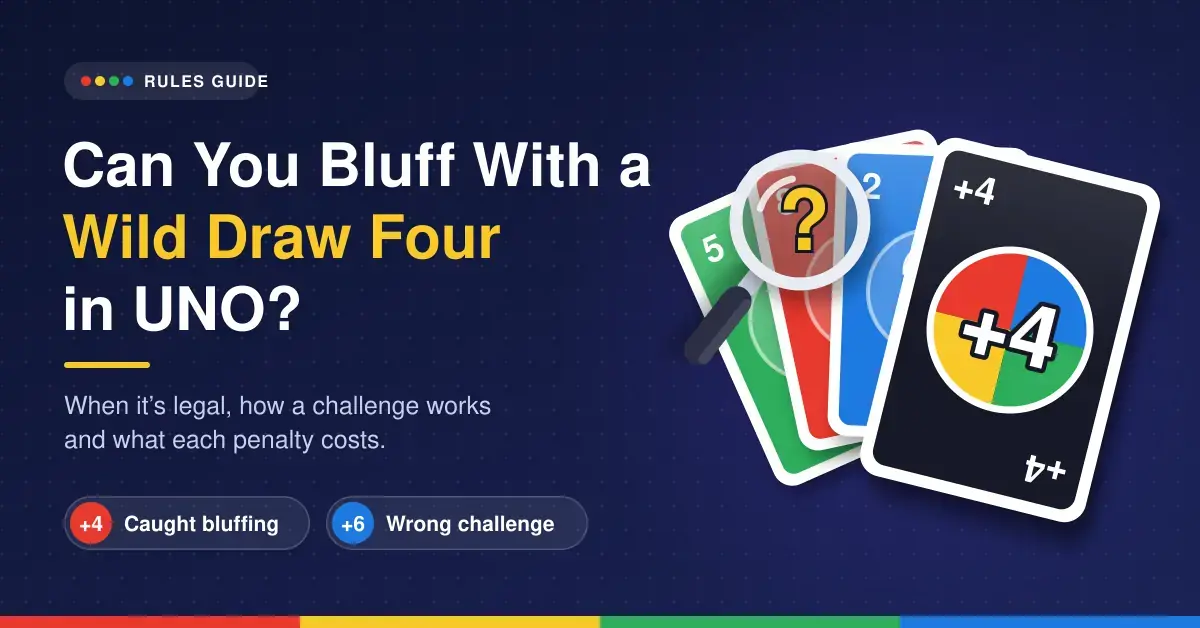
The Wild Draw Four is the card most likely to trigger a formal challenge. Officially, you may only play it when you have no card in your hand matching the colour of the current top card. The next player can challenge that. If the challenge is upheld — the player did hold a matching colour — that player draws the four cards instead. If the challenge fails, the challenger draws the original four plus two more, for six cards in total. Because a wrong challenge is costly, it is a genuine risk-versus-reward decision. Our guide to the UNO Wild Draw Four rules walks through when a challenge is worth making.
Common tournament conventions (organiser choices, not rules)
Beyond the official rules, organisers add procedures to keep events fair and moving. These vary from event to event, so treat the following as typical practices rather than universal law:
- Turn timing. Some events use a per-turn time limit or a shared clock to prevent long stalls. The exact limit is set by the organiser.
- Seating and shuffling. Seats are often assigned rather than chosen, and shuffling and cutting are done in full view of the table to reassure everyone the deck is fair.
- A judge or director. A non-playing official may resolve disputes and, where a Wild Draw Four is challenged, can check a hand privately so the challenger does not see the whole hand.
- Provided equipment. Larger events may supply fresh decks and score sheets so no one plays with a marked or worn set.
- Conduct. Coaching, discussing hidden hands, or distracting opponents is normally prohibited, and the director’s ruling is final for the duration of a game.
Knowing which of these apply before you sit down avoids surprises. When two players finish a match level on points, organisers also need a tie-break method; our article on UNO tie-breaker rules explains the common approaches.
Adjusting your strategy for competitive play
Cumulative scoring rewards consistency over flashy single-hand wins. A hand you lose by 10 points is a minor setback; one you lose by 150 can be very hard to claw back. That reality pushes competitive players towards steady, defensive habits: shedding heavy Wild and action cards when an opponent looks close to going out, tracking how many cards rivals hold, and avoiding needless risks late in a hand. If you want to build on the fundamentals, our advanced UNO strategy guide goes deeper into competitive decision-making.
Finding or running a tournament
Most everyday UNO tournaments are organised by board-game clubs, community groups, schools, or online communities rather than by any governing body. Entry fees, where they exist, are usually modest and cover the venue, decks, and prizes. If you would like to run your own event, the simplest reliable approach is to use the official Mattel rules for gameplay and scoring, publish a short rules sheet covering your own timing and dispute procedures, and pick a bracket format that suits the number of players and the time available. Being explicit about what is an official rule and what is a local convention keeps the day fair and friendly for everyone.
Sources
Frequently Asked Questions
Is there an official UNO tournament rulebook?
There is no single universal tournament rulebook for local play. Events use the official Mattel gameplay and scoring rules and then add their own conventions for timing and disputes. Mattel does run its own high-profile competitive event, the UNO Championship Series, but everyday club and community tournaments set their own procedures.
How does scoring to 500 work in a tournament?
When a player goes out, the other players total the cards still in their hands and that total is awarded to the winner of the hand. Number cards score their face value, Skip, Reverse and Draw Two score 20 each, and Wild and Wild Draw Four score 50 each. Play continues hand by hand until a player reaches the target score, traditionally 500.
Can you stack Draw Two or Wild Draw Four cards in tournament play?
No. Stacking is not part of the official rules, so it is not used in events that follow them. If a Draw Two or Wild Draw Four is played against you, you draw the cards and lose your turn rather than passing the penalty to the next player.
What happens if I challenge a Wild Draw Four and I am wrong?
A Wild Draw Four may only be played when you have no card matching the current colour. If you challenge and are correct, the player who played it draws four cards. If you challenge and are wrong, you draw six cards in total, so a failed challenge is a real risk.
What is the penalty for forgetting to say “UNO”?
You must say “UNO” when you play your second-to-last card. If an opponent catches you before the next player takes their turn, you draw two cards as a penalty. Once the next turn has begun, the penalty can no longer be applied.