In UNO, every card is worth a set number of points, and those points decide who wins over a full game rather than a single round. When a round ends, the player who emptied their hand collects the combined value of the cards still held by everyone else. Knowing what each card is worth helps you decide which cards to play early and which are safe to keep. This guide breaks down the point value of every UNO card, from a humble 0 to a 50-point Wild, and explains how the totals build toward the 500-point target.
Key Points
- Number cards (0–9): worth their face value.
- Skip, Reverse and Draw Two: 20 points each.
- Wild and Wild Draw Four: 50 points each.
- Wild Shuffle Hands and Customizable Wilds (112-card decks): 40 points each.
- Only the round winner scores, collecting the value of everyone else’s remaining cards.
- First player to 500 points wins the game.
How UNO Scoring Works
UNO can be played as single throwaway rounds, but the full game defined in Mattel’s official rules is a race to 500 points across multiple rounds. At the end of each round, only the winner scores: they add up the face value or point value of every card left in their opponents’ hands and add that total to their running score. The first player to reach 500 wins the game.
This is why card values matter. A hand full of low numbers costs you little if you lose the round, while being caught holding two Wild cards hands the winner 100 points. If you want the full round-by-round procedure, our guide to how scoring works in UNO walks through tallying a game step by step.
UNO Card Values
| Card type | Point value | Count in a 108-card deck |
|---|---|---|
| Number 0 | 0 points | 4 (one per colour) |
| Numbers 1–9 | Face value (1–9) | 72 (two per colour) |
| Skip | 20 points | 8 |
| Reverse | 20 points | 8 |
| Draw Two | 20 points | 8 |
| Wild | 50 points | 4 |
| Wild Draw Four | 50 points | 4 |
| Wild Shuffle Hands / Customizable Wild | 40 points each | 4 (112-card decks only) |
Number Card Values (0 to 9)
The numbered cards are the most common cards in the deck and the lowest scoring. Each one is worth its face value: a 3 is worth 3 points, a 7 is worth 7, and so on. A standard 108-card deck contains 19 number cards in each of the four colours (red, blue, green and yellow) — one 0 and two each of 1 through 9 — for 76 number cards in total.
Because there is only a single 0 in each colour, the 0 is the rarest number but also the safest card to be caught with, since it adds nothing to an opponent’s score. For a fuller look at how the numbers are laid out, see our explainer on UNO number cards.
Managing High Numbers
High numbers carry the most risk of the plain cards. Holding three 9s at the end of a round gives the winner 27 points — more than a Skip or Reverse. When your hand is heavy with 8s and 9s, it usually pays to play them early rather than sit on that liability.
Action Card Values: Skip, Reverse and Draw Two
The three coloured action cards — Skip, Reverse and Draw Two — are each worth 20 points. The deck holds two of each per colour, so eight of each across all four colours. Their higher value reflects the control they give you over the flow of play.
Skip and Reverse
A Skip forces the next player to miss their turn, while a Reverse flips the direction of play. In a two-player game a Reverse works just like a Skip, giving you an immediate second turn. Both are worth 20 points, so keeping one until the round suddenly ends can be a costly gamble. See our detailed notes on the Skip card rules and the UNO Reverse card for how to use them well.
Draw Two
The Draw Two also scores 20 points. When played, the next player draws two cards and forfeits their turn. Under official rules these cards cannot be stacked — you cannot answer a Draw Two with another Draw Two to pass the penalty along. If you play a Draw Two as your final card, the next player must still draw those two cards, and their value counts toward your winning total for the round.
Wild and Wild Draw Four: The 50-Point Cards
The two Wild cards are the highest-scoring cards in UNO, each worth 50 points. There are four standard Wild cards and four Wild Draw Four cards in the deck. A standard Wild can be played on any card and lets you name the colour that continues play, making it extremely flexible but expensive to be caught holding.
The Wild Draw Four and Its Challenge
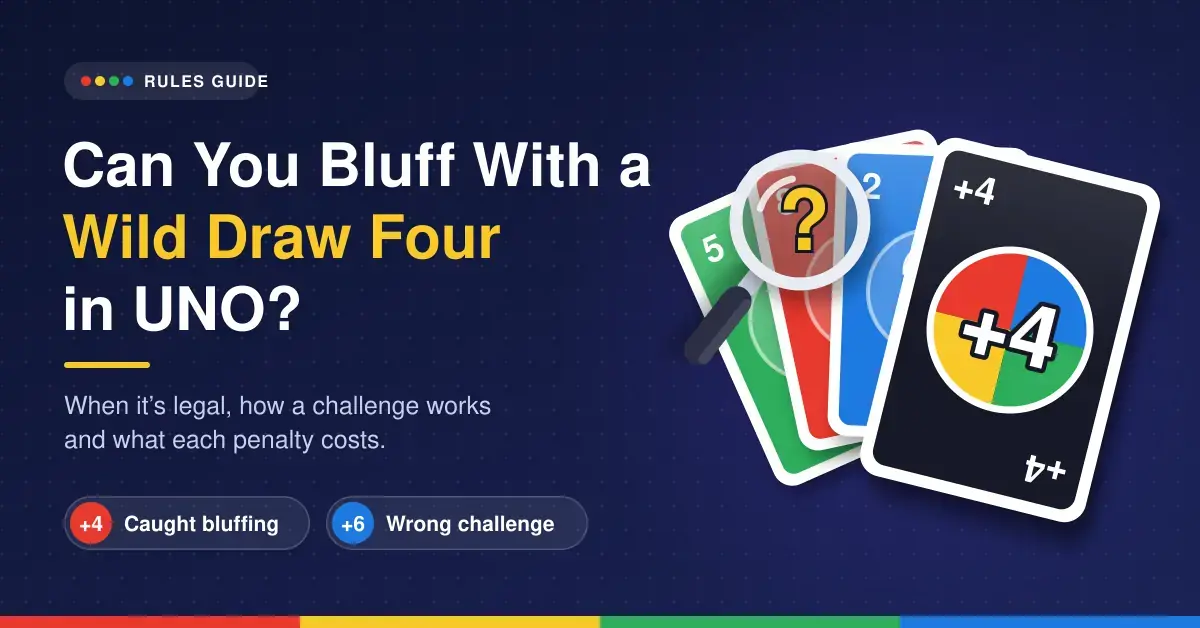
The Wild Draw Four changes the colour and forces the next player to draw four cards and skip their turn. Officially it may only be played when you have no card matching the current colour on the pile. If the next player suspects you broke that rule, they can challenge: you show your hand, and if the challenge succeeds you draw the four cards yourself. If the challenge fails, the challenger draws six cards instead — the four they owed plus two more. Our guides to the Wild card rules and the Wild Draw Four rules cover the bluffing and challenge mechanics in depth.
Specialty and Newer Card Values
Sets made since 2018 come with 112 cards, adding a Wild Shuffle Hands card and three Customizable (blank) Wild cards. Despite sometimes being described as ordinary Wilds, these carry their own printed value: the Wild Shuffle Hands and each Customizable Wild are worth 40 points, not 50. Always check the instruction sheet packed with a specific deck, because values for extra cards can vary between editions.
- Wild Shuffle Hands: 40 points.
- Customizable (blank) Wild: 40 points.
- Themed-deck action cards (Star Wars, Minecraft and similar): normally 20 points.
- Rule of thumb: numbers score face value, standard actions score 20, standard Wilds score 50.
Themed decks generally keep the same value structure, but a manual is the final word whenever a card is unusual.
Reaching the 500-Point Goal
Framing card values as a share of the 500-point goal makes their weight clear: a single Wild is 10% of everything you need to win. Points accumulate round after round, and one player is usually assigned to keep score. Some groups play a shorter game to 250 points, but 500 is the official target.
UNO belongs to the wider family of shedding-type card games, where the aim is to empty your hand before anyone else; the trick-and-penalty game Wikipedia documents as Mao is a distant relative with its own scoring conventions.
Alternative “Golf” Scoring
A popular house variation flips the scoring. In “Golf” style, the round winner scores 0 and every other player takes the points left in their own hand; the game still ends when someone reaches 500, but the lowest total wins. This makes every high card a personal liability and pushes players to discard Wilds and action cards early rather than hoard them.
Official vs Golf in Practice
Under official scoring you try to win the round to harvest opponents’ points; under Golf you simply try to lose each round as cheaply as possible. Deciding which method you are using before the first deal avoids arguments at the tally. For more on where the rulebook ends and table customs begin, see official UNO rules vs house rules.
Common Scoring Mistakes
Most scoring disputes come from a handful of avoidable errors. The 20-point action cards are miscounted more than any other card, usually because someone reads the small “+2” symbol on a Draw Two as two points. Penalties also inflate a losing hand: forgetting to say “UNO” when caught adds two cards, and an illegal play adds cards too — every extra card is potential points for whoever wins the round.
- A Draw Two is worth 20 points, not 2.
- A Wild Draw Four is worth 50 points, not 4.
- Penalty cards you are forced to draw increase the winner’s score if you lose the round.
- Agree on official or Golf scoring before you start.
Keeping the count on paper or a simple app removes almost all of these disputes. If you enjoy exploring less common formats, you can also check out alternative articles such as this look at what BB means in baseball.
Sources
Frequently Asked Questions (FAQ)
What is a 0 card worth in UNO?
A 0 card is worth exactly zero points, making it the lowest-value card in the deck and the safest number to be caught holding.
Are Skip and Reverse cards worth the same?
Yes. Skip, Reverse and Draw Two are all action cards worth 20 points each.
Does a Draw Two count as 2 points or 20?
In official scoring a Draw Two is worth 20 points. The “+2” on the card refers to the two cards the next player draws, not its point value.
How many points is a Wild card worth?
Both the standard Wild and the Wild Draw Four are worth 50 points each, the highest values in a standard deck.
What score do you need to win a game of UNO?
The official winning threshold is 500 points, reached by adding the value of opponents’ remaining cards to the winner’s total after each round.