UNO is one of the world’s most-played family card games, yet almost no two households play it the same way. The printed Mattel rulebook describes one balanced game with cumulative scoring, while kitchen tables across New Zealand run their own “house rules” — stacking penalties, hand-swapping sevens, jump-ins and more. This guide places the official rules beside the most common house variants so you know exactly what changes, and why it matters, before your next game night.
Key Points
- One game, many versions: the official Mattel rules and common house rules differ on penalties, drawing, scoring and turn order.
- Stacking is not official: a Draw Two or Wild Draw Four cannot be passed along under the printed rules.
- 7 and 0 are plain numbers officially; the hand-swap powers are a house rule.
- Winning means 500 points, not just emptying your hand once.
- You draw one card when stuck — not until you find a match.
- Agree the ruleset first so everyone at the table plays the same game.
What “official” UNO actually means
Throughout this guide, “official” refers to the rules printed on Mattel’s current instruction sheet — Mattel is the company that makes UNO. “House rules” are the informal changes players add at home. A quick vocabulary note before we start: number cards carry a value from 0 to 9, while action cards (Skip, Reverse and Draw Two) and Wild cards change the flow of play rather than simply matching a colour. The discard pile is the face-up stack you play onto. With those basics in place, here is where the two rule sets diverge. If you want the wider catalogue of variants, our overview of UNO house rules collects them in one place.
Stacking Draw Two and Wild Draw Four cards
The most-debated difference is “stacking” — responding to a Draw Two with another Draw Two so the penalty passes to the next player. Under the official rules, stacking is not allowed. When a Draw Two is played, the next player draws two cards and forfeits their turn without playing anything. A popular house rule instead lets that player add their own Draw Two and push the growing penalty along, which can leave one person drawing eight or more cards at once. Whether stacking is allowed in official UNO is probably the single most common rules dispute.
How the official game resolves penalty cards
Officially, an action card takes effect the moment it is played, so its penalty cannot be deflected. This keeps hand sizes manageable and prevents a single sequence from removing a player from contention early.
| Mechanic | Official Mattel rule | Common NZ house rule |
|---|---|---|
| Draw Two | Next player draws 2 and is skipped | Can be stacked with another Draw Two |
| Wild Draw Four | Next player draws 4 and is skipped | Often stacked with a Draw Two or Draw Four |
| Response options | None; you draw and forfeit the turn | Play a matching penalty card to pass it on |
Drawing: one card or draw until you can play
Another core difference is what happens when you have no playable card. The official rule is simple: you draw exactly one card. If it can be played you may play it immediately; if not, your turn ends. Many households use a “draw until you can play” rule, forcing you to keep taking cards until you find a match. That single change inflates hand sizes quickly and can strand an unlucky player with a very large hand.
Why the single draw matters
The one-card rule keeps turns short and rewards players who spread their colours well. It avoids the common house-game situation where one person draws a stack of cards while everyone else waits.
The 7-0 hand-swap variant
In many New Zealand homes the number cards 7 and 0 carry special powers that do not exist in the official rulebook. Under the “7-0” house rule, playing a 7 lets you swap your entire hand with another player, and playing a 0 makes everyone pass their hands around the table in the current direction of play. It adds chaos and swings, but it is a clear departure from the official game, where 7s and 0s are ordinary number cards worth only their face value.
| Card | Official function | House function (7-0) |
|---|---|---|
| 0 card | 0 points; no action | Everyone passes hands in the turn direction |
| 7 card | 7 points; no action | Player swaps hands with a chosen opponent |
Winning: one round or 500 points
Casual players usually treat the first person to empty their hand as the winner. Officially, that is only a round win. A full game is a race to 500 points: the winner of each round scores the value of the cards still held by everyone else. Because Wild cards are worth 50 points each, action cards 20 and number cards their face value, the scoring system rewards getting rid of high-value cards early. For a full breakdown, see how scoring works in UNO.
Why cumulative scoring changes strategy
Without the 500-point target there is no downside to hoarding a Wild Draw Four until the last moment. In official play, being caught holding that card hands the round winner 50 points, so late-game hoarding becomes a genuine risk.
The jump-in rule
The “jump-in” house rule lets any player play out of turn if they hold a card that is an exact match — same colour and same number or symbol — for the one on top of the discard pile. It rewards fast reflexes but is not part of the official game, where you always wait for your turn. Jumping in skips over the players who were due to go, which can reshape the turn order several times before a given player’s turn arrives.
Comparison
| Rule area | Official Mattel rule | Common house rule |
|---|---|---|
| Draw Two / Wild Draw Four | Cannot be stacked | Often stacked to pass the penalty |
| Drawing when stuck | Draw one card only | Draw until you can play |
| 7 and 0 cards | Number value only, no action | 7 swaps hands; 0 rotates all hands |
| Winning the game | First to 500 points | First to empty a hand once |
| Playing out of turn | Not allowed | “Jump-in” on an exact match |
| Wild Draw Four | Only if no matching colour; challengeable | Play any time, no challenge |
| Missed UNO call | Draw 2 cards if caught in time | Draw 5-7 cards |
| Maximum hand size | No limit | Mercy rule at 20-25 cards |
Challenging a Wild Draw Four
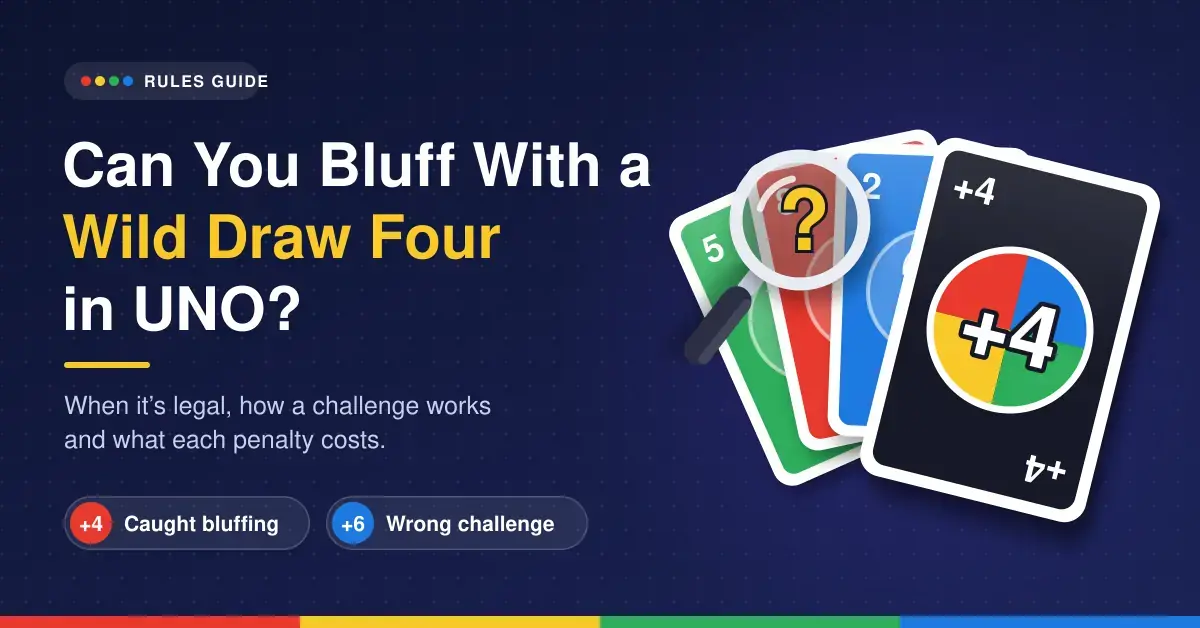
One of the most overlooked official rules is the Wild Draw Four challenge. Officially, you may only play a Wild Draw Four when you have no card matching the current colour on the discard pile. If the next player suspects you played it illegally, they can challenge you. If the challenge succeeds, the player who played the card draws 4 instead. If it fails, the challenger draws 6 cards (the original 4 plus 2 more) and misses a turn. Many house games skip challenges entirely and let the card be played at any time. For more detail, see our guide to Wild Draw Four rules.
The bluffing element
The challenge rule adds a poker-like layer: you must judge whether an opponent really was out of the matching colour. Removing challenges turns the Wild Draw Four into an unblockable attack and strips out that decision.
Two-player Skip and Reverse
Head-to-head play highlights another difference. Officially, in a two-player game the Reverse card works exactly like a Skip: your opponent misses their turn and you play again immediately. Some house games treat Reverse as a null card or a plain colour change in two-player mode, which wastes its tactical value.
| Card | Multiplayer (official) | Two-player (official) |
|---|---|---|
| Skip | Next player is skipped | Opponent skipped; you play again |
| Reverse | Direction of play changes | Opponent skipped; you play again |
| Draw Two | Next player draws 2 and is skipped | Opponent draws 2 and is skipped; you play again |
Starting card effects
When the first card is flipped to begin the discard pile, official rules apply its effect to the first player (the one to the dealer’s left). House games often ignore this. Under the official rules: a Draw Two makes that player draw two and lose the turn; a Skip skips them; a Reverse means the dealer goes first and play moves to the right; and a Wild lets the first player choose the starting colour. The only card that cannot start the game is the Wild Draw Four, which is returned to the deck and a new card is flipped.
Penalties: UNO calls and illegal plays
Official UNO has defined penalties. If you fail to call “UNO” as you play your second-to-last card and are caught before the next player takes their turn, you draw two cards. Many house games raise this to five, seven or even ten. Handling of an illegally played card also varies: official play generally has you take the card back and draw a penalty, while lenient tables simply let you swap it for a legal card.
| Situation | Official penalty | Common house penalty |
|---|---|---|
| Missed UNO call | Draw 2 cards (if caught in time) | Draw 5-7 cards |
| Wrong card played | Take it back and draw a penalty | Just take it back and play correctly |
| Late UNO catch | No penalty after the next turn begins | Sometimes penalised much later |
No maximum hand size
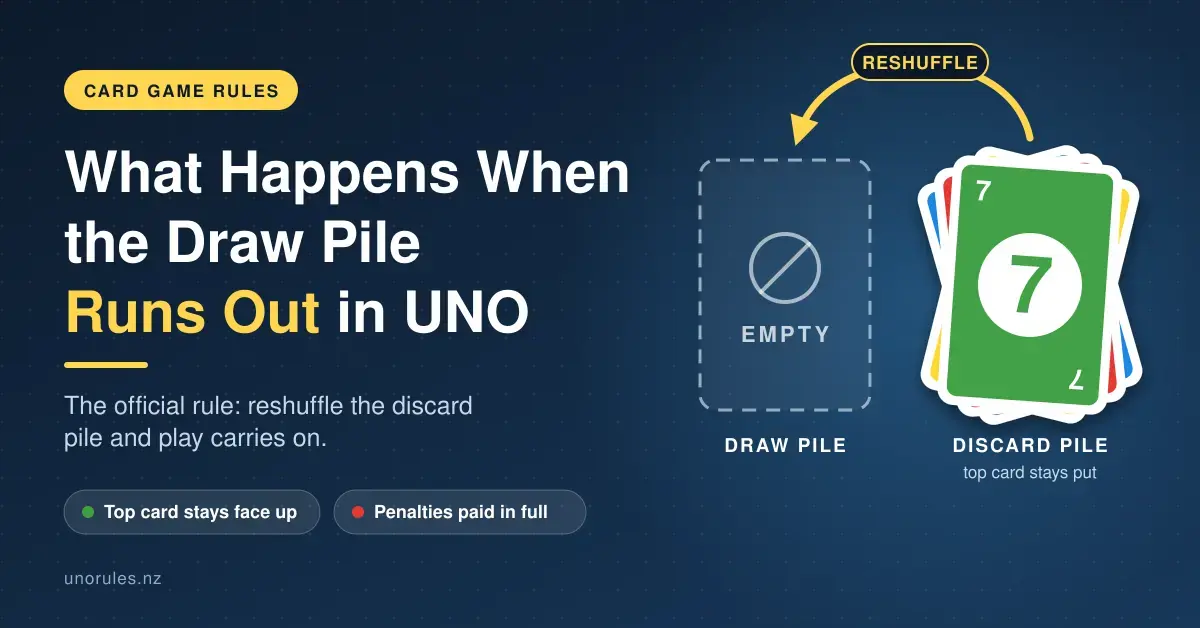
Some households add a “mercy rule” that eliminates a player once their hand reaches 20 or 25 cards. There is no such limit in official UNO — you keep playing however large your hand grows. This is consistent with the 500-point system, where a large losing hand simply hands the round winner more points. When the draw pile is empty, the discard pile (except the top card) is reshuffled to form a new draw pile.
Which rule set suits your table
Neither approach is objectively better; they serve different goals. House rules like stacking and 7-0 create louder, higher-variance games that suit relaxed social nights. The official rules produce a faster, more predictable game where scoring rewards planning, which is why they are used for structured events — see UNO rules for tournament play if you want a consistent standard. UNO has also expanded well beyond the card deck; the official UNO video game is documented on Wikipedia. The simplest advice is to agree on the ruleset before dealing, so everyone plays the same game.
Sources
Ngā Pātai Auau (FAQ)
Can you stack a Draw Two on a Draw Two in official UNO?
No. The official Mattel rules do not allow stacking. When a Draw Two is played, the next player draws two cards and forfeits their turn.
Is the 7-0 hand-swap rule official?
No. The 7-0 rule is a popular house variant. In the official game, 7s and 0s are ordinary number cards with no special action.
How many points do you need to win a match of UNO?
The official target is 500 points, scored across multiple rounds from the cards left in opponents’ hands. Emptying your hand only wins the round.
Do you have to keep drawing until you get a playable card?
No. Officially you draw exactly one card. If it is playable you may play it; if not, your turn ends. Drawing until you find a match is a house rule.
What happens if you play a Reverse in a two-player game?
Officially it acts like a Skip: your opponent misses their turn and you get to play again immediately.