Reaching the finish line at the same moment as a rival feels dramatic, but in UNO a genuine score tie is far rarer than most players assume. The confusion usually comes from a misunderstanding of how points are earned. This guide explains what the official rules actually say about winning, why two players almost never cross 500 points together, and the fair, agreed methods groups use to settle the occasional deadlock. Everything below separates the published rules from popular house customs, so you always know which is which.
Key Points
- UNO has no official Mattel tie-breaker rule — the rulebook only says first to 500 points wins.
- Only the round winner scores, so two players almost never reach 500 in the same round; exact ties are structurally rare.
- If two players do pass 500 together, the higher cumulative total normally wins.
- Genuine deadlocks are settled by agreed house methods: a sudden-death hand, fewest cards, or most rounds won.
- Card values: numbers = face value, action cards = 20, Wild and Wild Draw Four = 50, Swap Hands and Customizable = 40.
Why a True Tie Is Unusual in UNO
The single most important fact about UNO scoring is that only the winner of a round earns points. When one player empties their hand, every card left in the other players’ hands is added up and given to that round’s winner. Nobody else’s total moves. Because only one score rises each round, it is almost impossible for two players to arrive at 500 points during the same scoring step — the moment a player crosses the line, they cross it alone.
This is why the official rulebook never needed a formal tie-breaker: the structure of how scoring works in UNO normally produces a single, clear winner. Ties become possible only when a group changes the scoring — for example, by tracking cumulative points differently, running a knockout ladder, or using a lowest-score variant. In those situations the deadlock is a house-rule problem, so the solution is a house-rule decision too.
The One-Scorer-Per-Round Principle
Keep this in mind whenever a finish looks close: the player who goes out takes all the points on the table for that round, and everyone else stays where they were. If your scoresheet ever shows two players gaining points in the same round, someone has tallied it incorrectly rather than discovered a genuine tie.
What the Official Rules Say About Winning
Under Mattel’s standard rules, the first player to reach 500 points wins the game. Groups may agree on a different target, but 500 is the default. There is no published Mattel procedure for breaking a tie, and the game is designed so a tie should not occur in normal play. If you see a source describing an “official tie-breaker,” treat it as a house rule rather than a rule from the manufacturer — a distinction covered well in guides on official UNO rules versus house rules.
Points are the whole story, so it helps to know exactly what each card is worth when it is caught in someone’s hand. These values are standardised across most modern UNO decks and are explained in more detail in our breakdown of UNO card values.
| Card type | Point value |
|---|---|
| Number cards 0–9 | Face value (0 to 9 points) |
| Skip, Reverse, Draw Two | 20 points each |
| Wild, Wild Draw Four | 50 points each |
| Wild Swap Hands, Wild Customizable | 40 points each |
What Counts Toward the 500 Total
Only cards left in opponents’ hands when a round ends are counted, and they are always awarded to the round winner. Holding low-value number cards near the end of a round therefore limits how many points you hand over if someone else goes out first. A single Wild left in your hand can swing a close game by 50 points on its own.
Common House Methods for Settling a Deadlock
If your group has genuinely created a tie — usually through a modified scoring format or a two-way finish where both players pass the target in the same round — the fairest fix is a method everyone agrees to in advance. None of these is “official,” but all are widely used and easy to apply:
- Highest total wins: if two players both pass 500, the one with the higher cumulative score is declared the winner.
- Sudden-death hand: the tied players play one extra hand under normal rules; the first to go out wins.
- Fewest cards or lowest hand value: compare the cards each tied player held in the deciding round.
- Most rounds won: the player who went out most often across the game is ranked ahead.
- Replay the round: void the tied round entirely and play it again.
Comparison
| Method | How it works | Best suited to |
|---|---|---|
| Highest total wins | If both players pass 500, the higher cumulative score takes it | Standard cumulative scoring |
| Sudden-death hand | Tied players play one extra hand; first to go out wins | Quick, casual finishes |
| Fewest cards / lowest hand value | Compare the cards each tied player held in the deciding round | Groups tracking hand sizes |
| Most rounds won | The player who went out most often ranks ahead | Longer sessions and ladders |
| Replay the round | Void the tied round and play it again | Formal or disputed results |
Agree on a Method Before You Play
The only rule that really matters here is that the group settles on an approach before the game reaches its climax, not in the heat of a disputed finish. Clubs that run structured events fold this into their format so results are never argued after the fact; you can see how organised events handle scoring in our overview of UNO rules for tournament play.
The Golf (Lowest-Score) Variant
A popular house format flips the goal: instead of racing to 500, players try to stay low, and reaching 500 knocks you out. The last player standing — or the one with the lowest score when the target is breached — wins. Because this is a house variant rather than an official mode, ties are more likely, and groups usually break them with a single head-to-head hand between the lowest-scoring players. Whoever empties their hand first takes the game.
Two-Player and Partnership Finishes
Two-player UNO has its own quirks: a Reverse acts like a Skip, and playing a Skip lets you immediately take another turn. Games are fast and scores climb quickly, but the winning condition is unchanged — first to the agreed target wins. If both players somehow reach the target together under a modified count, the cleanest resolution is a single deciding hand, since two-player UNO is naturally winner-takes-all. For more on the head-to-head format, see our guide to card games for two players.
Partnership Play
In team formats, points from both opponents’ hands are pooled for the winning side when any player goes out. Deadlocks between teams are rare, but a common house fix is to compare how many times each team “went out” during the game, or to play one extra deciding hand. As with everything else here, this is an agreed convention, not a manufacturer rule.
Penalties That Can Decide a Close Finish
Because every extra card in a hand can become points for an opponent, penalties often matter more at the end of a tight game than anywhere else. The most common is forgetting to call “UNO”: if you are caught with one card before the next player takes their turn, you draw two cards. Those two cards can be the difference between winning a round and handing points away — more detail in our note on what happens if you forget to say UNO.
| Situation | Penalty | Why it matters at the finish |
|---|---|---|
| Caught not saying “UNO” | Draw 2 cards | Adds cards that may be counted against you |
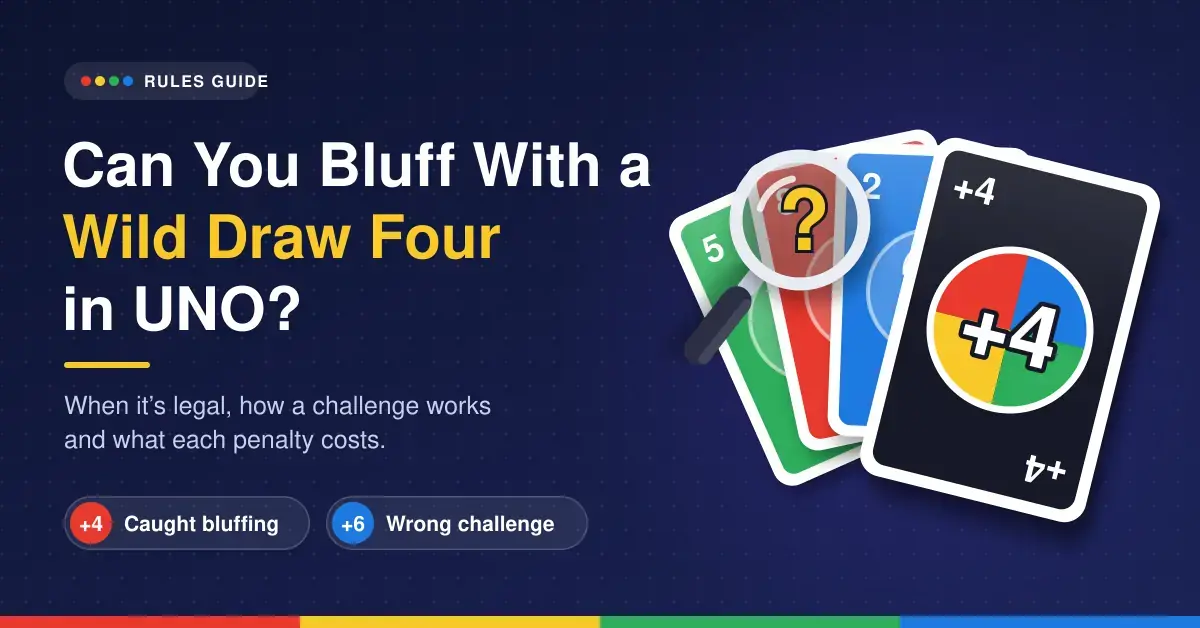
| Successful Wild Draw Four challenge (play was illegal) | Player who played it draws 4 cards | Shifts a big point swing back to the offender |
| Unsuccessful challenge (play was legal) | Challenger draws 6 cards (4 + 2) | Can end a close round outright |
Resolving the Last Action Card
If the final card played is a Draw Two or Wild Draw Four, the next player still draws those cards before the round is scored. Counting them first prevents a close result from being decided incorrectly, and it reflects the standard rule that all opponents’ cards are counted when the round ends.
Practical Tips to Avoid a Deadlock Entirely
The easiest tie-breaker is the one you never need. A few habits keep finishes clean:
- Shed high-value cards (Wilds and action cards) early when the score is tight.
- Keep an accurate running scoresheet so totals are never in dispute.
- Decide your winning target and any deadlock method before the first card is dealt.
- Recount opponents’ hands out loud when a round ends near the target.
Deciding contests by a clear, agreed rule is standard practice well beyond card games; broader background on how sporting deadlocks are settled can be found through general references such as Wikipedia. For UNO specifically, though, the manufacturer’s answer is simpler than most players expect: keep an accurate score, and the winner usually settles it by themselves.
Sources
Frequently Asked Questions (FAQ)
Does UNO have an official tie-breaker rule?
No. Mattel’s rules simply state the first player to reach 500 points wins, and there is no published tie-breaker. Any tie-breaking method you see described is a house rule rather than an official procedure.
Can two players really reach 500 points at the same time?
It is almost impossible in standard play, because only the winner of each round earns points. Since only one score rises per round, a player normally crosses 500 on their own. Ties usually appear only when a group changes the scoring format.
What is the fairest way to break a tie if one happens?
Play one extra sudden-death hand between the tied players, with the first to empty their hand winning. Groups also compare the higher cumulative total, the fewest cards held, or the most rounds won — whatever was agreed before the game.
How do you break a tie in the lowest-score (Golf) variant?
Because that format is a house variant, ties are more common. The usual fix is a single head-to-head hand between the lowest-scoring players, and the first player to go out wins the game.
Can penalties change a close result?
Yes. Drawing cards for a missed “UNO” call or a failed Wild Draw Four challenge adds cards that may be counted as points for an opponent, which can decide a tight round before any tie is even reached.