The Skip card is one of UNO’s action cards, and its job is simple: it makes the next player miss their turn. That single effect gives you a surprising amount of control over a game — who plays next, how long a colour stays on the table, and whether an opponent who is close to winning gets another chance to act. This guide explains how the Skip card works under the official Mattel rules, how it behaves at different player counts, what it costs you in scoring, and how experienced players decide when to use it.
Key Points
- Effect: the next player loses their turn — no drawing, no playing.
- Colour match: play it on the same colour, or on another Skip of any colour.
- Two-player games: skipping your opponent gives you an immediate extra turn.
- Points: worth 20 points if it is left in your hand when a round ends.
- Frequency: 8 Skip cards per 108-card deck — two each in red, yellow, green and blue.
What the Skip Card Does
When you play a Skip card, the next player in the current direction of play is bypassed completely. They do not draw a card, they do not play a card, and the turn moves straight to the player after them. It is a “turn-ender” aimed at one specific person.
A Skip can only be played when it matches the card on top of the discard pile. That means you can play it on any card of the same colour (for example, a blue Skip on a blue card), or on top of another Skip card of any colour. If it does not match, you cannot play it and must draw instead.
You Cannot Block a Skip
A common point of confusion in casual games is whether the person being skipped can “deflect” it by playing a card of their own. Under the official rules they cannot. Once the Skip is on the pile, the targeted player has already lost their turn and takes no action until play comes back around to them. That makes the Skip an unblockable way to hold a colour or protect a lead.
Skip Card Rules in a Two-Player Game
In a head-to-head game the Skip is unusually strong. With only two players, skipping your single opponent sends the turn straight back to you — so playing a Skip effectively gives you an immediate second turn. That lets you play two cards in a row without your opponent doing anything in between.
Because of this, Skips (and, in the same way, Reverse cards, which also bounce the turn back to you in a two-player game) are among the most useful non-wild cards to hold when you are down to a final duel. If you can match the colour, you can sometimes empty a large part of your hand before your opponent gets another move.
Stacking Skip Cards: House Rule vs Official Rule
A popular house rule lets a player who is about to be skipped play their own Skip so the skip “passes on” to the next person. The official Mattel rules do not include this. Once a Skip is played, the next player is simply skipped and the turn continues — there is no chance to respond with a card of their own.
This is the same principle that applies to other action cards, and it is worth knowing before you sit down at a new table, because stacking rules are one of the most common sources of mid-game arguments. If your group wants to allow passing skips along, that is fine — just agree on it in advance. For more on where the official line sits, see our guide to whether stacking is allowed in official UNO rules.
Starting a Round With a Skip Card
To begin a round, the top card of the draw pile is turned over to start the discard pile. If that first card is a Skip, the player who would normally go first — the player to the dealer’s left — loses their turn, and the next player along starts the game instead. The card’s effect applies immediately, right from the opening of the round.
It is a minor detail, but a useful one to get right, because it changes who takes the first meaningful action of the hand.
How Many Points Is a Skip Card Worth?
Under UNO’s standard scoring, the player who empties their hand scores the value of the cards still held by everyone else, and the first player to reach 500 points wins. A Skip card is worth 20 points if it is caught in your hand at the end of a round.
That makes a Skip more than twice as costly as most number cards, which score their face value from 0 to 9. Holding several action cards can therefore hand the round winner a large points swing. Where the choice exists, many players prefer to use a Skip during the round rather than sit on it and risk the penalty. If you want the full breakdown of card values and how a round is tallied, see how scoring works in UNO.
Skip Cards and the Direction of Play
Because a Skip always targets the “next” player, the direction of play decides who that is. If a Reverse card has just flipped the order, the Skip now affects the player on the opposite side of you compared with a moment earlier. In a game running clockwise, your Skip hits the player on your left; reverse the direction first and the same Skip hits the player on your right.
Keeping track of this is mostly about spatial awareness in larger games. Playing a Reverse and then a Skip is a familiar combination for targeting a specific opponent, but it only works if the colours in your hand line up.
Skip Cards and the “UNO” Call
You must call “UNO” when you play your second-to-last card; if another player catches you before the next player takes their turn, you draw a penalty (commonly two cards). Playing a Skip as that second-to-last card gives you a small edge, because the person who would be watching you most closely is the one being skipped. Even so, any player at the table can call you out, so the safest habit is simply to say “UNO” clearly and on time. Our guide on what happens if you forget to say UNO covers the penalty in detail.
How the Skip Compares to Other Action Cards
People often ask whether a Draw Two or a Wild Draw Four also “skips” the next player. In effect they do — the targeted player draws the cards and then loses their turn. The difference is that the Skip removes a turn without adding cards to anyone’s hand, which is useful when you want to keep the current colour on the table rather than hand an opponent new cards. The table below sets the action cards side by side.
Action Card Comparison
| Card | Cards the target draws | Main effect | Points value |
|---|---|---|---|
| Skip | 0 | Next player misses their turn | 20 |
| Reverse | 0 | Reverses the direction of play | 20 |
| Draw Two | 2 | Next player draws two and misses their turn | 20 |
| Wild | 0 | Choose the next colour of play | 50 |
| Wild Draw Four | 4 | Choose the colour; next player draws four and misses their turn | 50 |
How Many Skip Cards Are in a Deck?
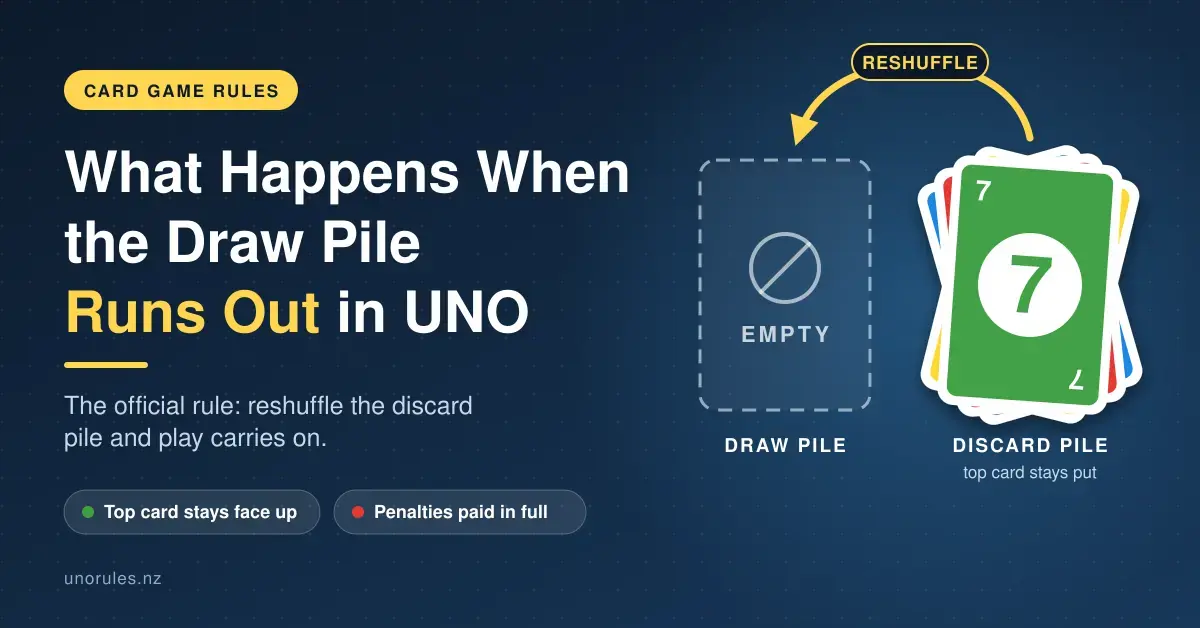
A standard UNO deck has 108 cards, and 8 of them are Skips — two in each of the four colours (red, yellow, green and blue). That is roughly 7% of the deck. Some players keep a rough count of how many Skips have been played; if both yellow Skips and both green Skips are already on the pile, only red and blue Skips remain in play. Note that when the draw pile is exhausted and the discard pile is reshuffled, most of those cards return, so any tally effectively resets.
Some editions change the mix. In faster or novelty versions — UNO Attack, for example, which is described on Wikipedia — the deck size and some card effects differ from the classic game, so always check the rules sheet for the set you are playing.
Simple Ways to Use a Skip Well
- Use a Skip on a player who is down to one or two cards to deny them the turn they need to go out.
- Prefer a Skip over a Draw Two when you want to keep a colour the leader is short of, rather than giving them fresh cards.
- Avoid sitting on Skips late in a round if the score is close — the 20-point value can decide the game.
- In a two-player duel, save a Skip to chain an extra move when you are ready to finish.
The Skip is not just a way to annoy the next player. Used deliberately, it is a clean tool for controlling tempo and defending a lead.
Sources
Frequently Asked Questions (FAQ)
Can you play a Skip card on any colour?
No. A Skip must match the colour of the card on top of the discard pile, or you can play it on top of another Skip card of any colour. If neither applies, you draw instead.
What does a Skip card do in a two-player game?
It skips your only opponent, so the turn comes straight back to you. In practice that gives you an immediate second turn.
Can you stack Skip cards to skip more than one player?
Not under the official rules. Once a Skip is played the next player loses their turn and play continues; passing the skip along is a house rule that groups can agree to use if they want.
How many points is a Skip card worth at the end of a round?
A Skip left in your hand scores 20 points for the player who wins the round.
What happens if a Skip is the first card turned up?
The player who would normally start — the one to the dealer’s left — is skipped, and the next player begins the game.