
UNO Disney Frozen brings the characters of Arendelle — Elsa, Anna, Olaf, Kristoff and Sven — to the familiar colour-and-number matching of UNO, with one twist of its own: the Force of Nature card. If you have picked up a Frozen-themed box and want to know exactly how it plays, this guide to the UNO Frozen rules walks through the deck, the setup, every action card, scoring, the all-important UNO call, and the special rule that sets this edition apart. The core game is standard UNO, so anyone who already knows the classic UNO rules can start in minutes, while newcomers get a clear, step-by-step explanation of each stage.
What UNO Disney Frozen Is
UNO Disney Frozen is an officially licensed Mattel edition of UNO that wraps the standard game in artwork from the Frozen films. It has appeared in more than one printing — an earlier Frozen release (item CJM70) and the widely sold Frozen 2 version (item GKD76) that adds the Force of Nature rule card. Whichever box you own, the underlying game is ordinary UNO: the Frozen theme changes the pictures, not the mechanics.
One point worth clearing up straight away: you match cards by colour or number only. The Frozen characters printed on the cards are decorative — there is no rule that lets you “match by character.” A card showing Elsa is still, mechanically, just a Red 5 (or whatever colour and value it carries). The game is designed for 2 to 10 players and is recommended for ages 7 and up, though younger children can join in with a little help.
Quick Facts
| Game | UNO Disney Frozen (themed edition of UNO) |
|---|---|
| Publisher | Mattel |
| Players | 2 to 10 |
| Recommended age | 7 and up |
| Deck | Listed at 112 cards (standard 108-card UNO structure plus instructions and the Force of Nature rule card) |
| Special card | Force of Nature — locks play to one chosen colour until the player’s next turn |
| Objective | Be first to play all your cards; optional scoring to 500 points |
What Is in the Deck
Retailers typically list the UNO Disney Frozen set at 112 cards, a figure that includes the instructions insert and the special Force of Nature rule card. The playing deck itself follows the standard UNO structure that has been used across editions for years: four colours — red, blue, green and yellow — made up of number cards and action cards, plus the colourless Wild cards. The table below shows the classic 108-card playing breakdown that the Frozen deck is built on.
| Card type | Per colour | Total |
|---|---|---|
| Number 0 | 1 of each colour | 4 |
| Numbers 1–9 | 2 of each colour | 72 |
| Skip | 2 of each colour | 8 |
| Reverse | 2 of each colour | 8 |
| Draw Two | 2 of each colour | 8 |
| Wild | — | 4 |
| Wild Draw Four | — | 4 |
| Total playing cards | — | 108 |
On top of these, the Frozen 2 box supplies the Force of Nature card, and modern retail UNO packs often add a few blank or extra Wild cards, which is why the printed total on the box can read higher than 108. The instruction sheet packed with your particular copy is always the authoritative source for its exact contents.
Setting Up a Game
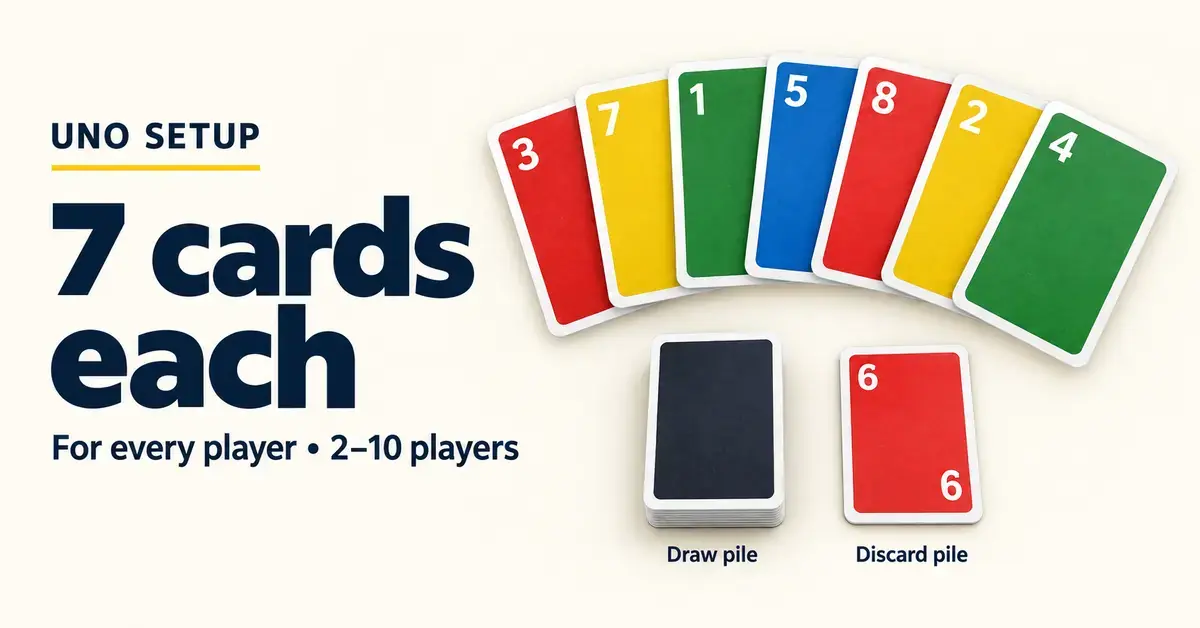
Setup is identical to standard UNO. Pick a dealer (a common method is for each player to draw a card, with the highest number dealing). The dealer shuffles and deals seven cards face down to every player. The rest of the cards form the draw pile in the centre of the table, and the top card is turned over to start the discard pile, setting the opening colour and number.
If that first flipped card is an action card, it takes effect before the first player’s turn:
- Draw Two: the first player draws two cards and is skipped.
- Skip: the first player is skipped.
- Reverse: the direction of play reverses, so the dealer effectively takes the first turn.
- Wild: the first player chooses the starting colour.
- Wild Draw Four: this card is returned to the deck, which is reshuffled, and a new top card is turned over.
How a Turn Works
On your turn you play one card that matches the top card of the discard pile by colour or by number, or you play a Wild card (which can go on anything). For example, if the discard shows a Blue 5, you may play any blue card, any colour 5, or a Wild. If you cannot — or choose not to — play a matching card, you draw a single card from the draw pile. If that drawn card is playable you may put it down immediately; otherwise your turn ends and play passes on.
The official rule is to draw only one card per turn. “Draw until you can play” is a popular house rule, not the published rule, so agree on it before you start if your group likes it. Keeping to a single draw keeps the game moving and stops the draw pile from emptying too quickly.
Action Cards Explained
Action cards are how you disrupt opponents and control the flow of the round. They work exactly as they do in classic UNO.
| Card | Effect |
|---|---|
| Skip | The next player in turn order misses their turn. |
| Reverse | Reverses the direction of play; in a two-player game it acts like a Skip, so you take another turn. |
| Draw Two | The next player draws two cards and is skipped. |
| Wild | You choose the colour that play continues in. |
| Wild Draw Four | You choose the colour and the next player draws four cards and is skipped. |
Under the official Mattel rules, a Draw Two cannot be “stacked” onto another Draw Two to pass the penalty along — the player who is hit simply draws and loses their turn. Stacking is a common house rule, so it is worth confirming before the first hand. The Draw Two card rules go into this in more detail.
The Force of Nature Card: the Frozen Twist
The one mechanic unique to the Frozen 2 edition is the Force of Nature rule card. When you play it, you name a single colour, and that becomes the only colour anyone may play until your next turn — even if another player holds a matching number or action card. Any player who cannot follow the locked colour must draw from the pile instead of playing.
That makes Force of Nature a strong tempo and defensive tool: naming a colour you know an opponent is short on can force them to draw just as they close in on their last card. Used at the right moment it can stall a leader, much as a well-timed Skip does, but across every player rather than only the next one.
A note on accuracy: some online guides describe an “Olaf’s Summer” Wild card for UNO Frozen. There is no such card in the official product — the Frozen-specific rule is the Force of Nature card described above. Because contents vary between printings, always check the instruction sheet in your own box for the exact wording.
Wild and Wild Draw Four
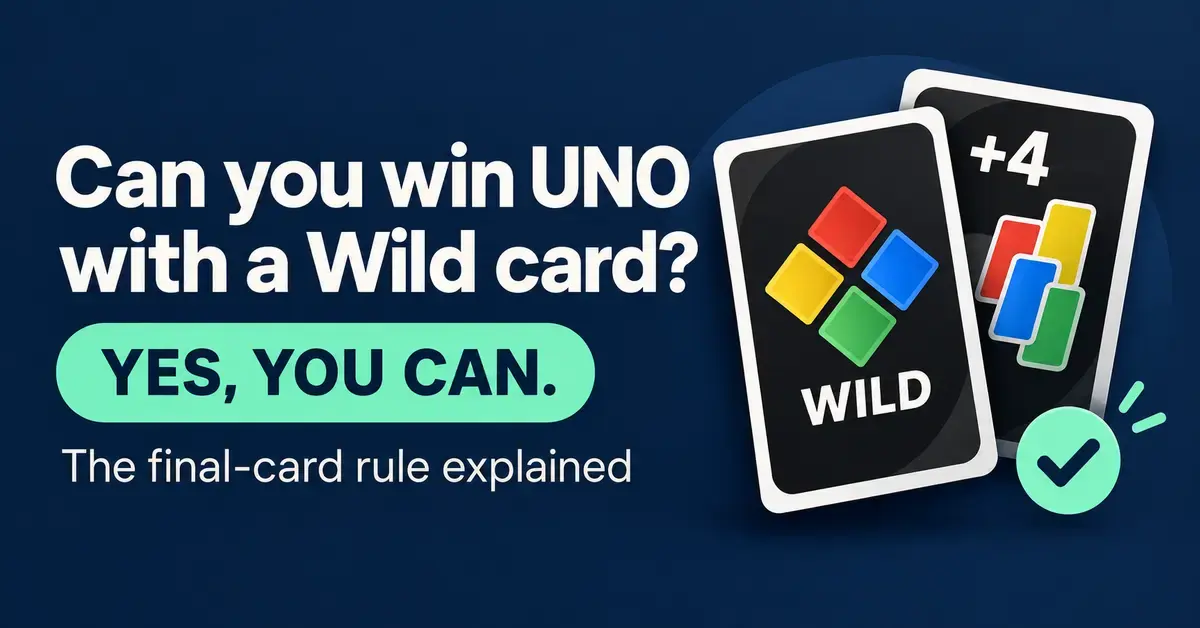
The two Wild types are the deck’s most powerful cards. A plain Wild lets you change the active colour to any of the four, and can be played at any time. The Wild Draw Four changes the colour and forces the next player to draw four cards and skip their turn — but it may only be played legally if you have no card matching the current colour in your hand.
If an opponent suspects you played it illegally, they can challenge you and you must show your hand. If you were bluffing and did hold the current colour, you draw the four cards yourself; if the challenge was wrong, the challenger draws the four cards plus a two-card penalty (six in total). This bluff-and-challenge tension is explained fully in our guide to the Wild Draw Four rules.
Scoring and Winning
You win a round by being the first to get rid of all your cards. In the classic, multi-round format the winner of a round scores points for every card still held by the other players, and the first player to reach 500 points wins the game overall. This rewards playing high-value cards early so they are not counted against you if someone else goes out first.
| Card | Points |
|---|---|
| Number cards 0–9 | Face value |
| Skip, Reverse, Draw Two | 20 each |
| Wild, Wild Draw Four | 50 each |
Mattel updated UNO’s published rules in 2022 so that the headline objective is simply to win rounds, with the 500-point tally offered as an optional way to play a longer match; many households still use the point system. Either way the card values above are unchanged — you can see the full picture of how UNO scoring works in our dedicated guide.
Saying “UNO”
The franchise’s signature rule applies here too: when you play your second-to-last card and are down to a single card, you must call out “UNO.” If another player catches you before the next player takes their turn, you draw a penalty of two cards. Say it as you play, not after, to stay safe. If your last card is an action card such as a Draw Two, the next player still resolves that effect before the round ends. For the exact timing window and the myths around it, see what happens if you forget to say UNO.
Key Points
- UNO Disney Frozen plays exactly like classic UNO — only the artwork and the Force of Nature card are new.
- Match by colour or number; there is no matching by Frozen character.
- The Force of Nature card lets you name the only colour that can be played until your next turn.
- Action cards score 20 points and Wild cards score 50; number cards score face value.
- Call “UNO” when you are down to one card or risk a two-card penalty.
- There is no “Olaf’s Summer” card — that is a common online myth.
Playing with Younger Children
Frozen UNO is a friendly first card game for young fans because the theme keeps them engaged while they practise colour recognition, number sequencing and turn-taking. For players below the recommended age of 7, you can simplify the game: drop the running score and just play single rounds, skip the Wild Draw Four challenge, and focus on matching by colour and number. Encouraging children to name the character on each card they play adds a storytelling element without changing the rules.
Common Mistakes and Rule Clarifications
- There is no “Olaf’s Summer” card and no character matching. Match by colour or number; the Frozen-specific card is Force of Nature.
- Two-player Reverse acts as a Skip. Play a Reverse in a 1-v-1 game and you immediately take another turn.
- A Draw Two ends your turn. You draw the two cards and are skipped; you do not then get to play.
- Wild Draw Four is restricted. It is only a legal play when you hold no card of the current colour.
- The UNO penalty has a window. You can only be caught between playing your second-to-last card and the next player starting their turn.
How It Compares to Other UNO Editions
Themed UNO decks almost always keep the core game intact and add a single twist card. Frozen’s is the Force of Nature colour-lock. If you enjoy that style of one-card variation, the site covers several similar releases: the UNO Angry Birds edition adds its King Pig card, and UNOcorns introduces a Wild Narwhal rule. Because the base rules are shared, learning any one themed set makes the rest quick to pick up.
Sources
Frequently Asked Questions (FAQ)
What does the Force of Nature card do in UNO Frozen?
When you play it, you name one colour, and that is the only colour any player may put down until your next turn — even if they hold a matching number or action card. Anyone who cannot play the locked colour must draw a card instead.
How many cards are in UNO Disney Frozen?
Retail sets are usually listed at 112 cards, which includes the instructions and the Force of Nature rule card. The playing deck is built on the standard 108-card UNO structure of number, action and Wild cards.
Can you match cards by Frozen character?
No. UNO matching is by colour or number only. The Elsa, Anna, Olaf, Kristoff and Sven artwork is decorative and does not create an extra way to match.
How many players can play UNO Frozen?
The game is designed for 2 to 10 players and recommended for ages 7 and up. In a two-player game the Reverse card works like a Skip.
How do you win UNO Frozen?
You win a round by being first to play all your cards. In the optional point game, the round winner scores the value of the cards left in opponents’ hands, and the first player to reach 500 points wins the match.