UNO is one of the world’s best-known family card games, first released in 1971 and now published by Mattel. It is popular for a simple reason: the rules are easy to pick up in a few minutes, yet each round mixes luck with just enough strategy to stay interesting. This guide walks new players through everything you need to start a game — how to set up, how a turn works, what every special card does, when to shout “Uno”, and how the official 500-point scoring decides the winner.
Quick Facts
| Players | 2–10 |
|---|---|
| Recommended age | 7 and up |
| Deck size | 108 cards (four colours plus Wild cards) |
| Cards dealt each | 7 |
| Designer | Merle Robbins |
| First released | 1971 |
| Publisher | Mattel |
| Goal | Empty your hand each round; first to 500 points wins |
What Is UNO?
UNO is a shedding-type card game, which means the goal is to be the first to get rid of every card in your hand. It is designed for 2 to 10 players and is recommended for ages 7 and up, making it a common choice for family game nights, parties and casual play. Games are quick, so most sessions run several short rounds rather than one long game.
A standard UNO deck contains 108 cards in four colours — red, yellow, green and blue — plus a set of colourless Wild cards. Each colour has number cards and a few action cards, and the Wild cards can be played on top of any colour. You do not need anything except the deck to play.
UNO Setup and Dealing
Before the first round, choose a dealer. The dealer shuffles the deck and deals seven cards face down to each player. The remaining cards are placed face down in the middle of the table to form the draw pile. The top card of the draw pile is then turned over and set beside it to start the discard pile, which is the card players first try to match.
If the first flipped card is an action card, most groups simply apply its effect or reshuffle it; if it is a Wild card, the starting player usually chooses the colour. The objective is straightforward: reduce the number of cards in your hand to zero before anyone else does.
How to Play a Turn
Play begins with the player to the left of the dealer and normally moves clockwise. On your turn you must play a card that matches the top card of the discard pile in at least one way:
- by colour (for example, any red card on a red card),
- by number (a 7 on a 7 of a different colour), or
- by symbol (a Skip on another Skip, and so on).
Wild cards can be played at any time, on any colour. If you cannot — or choose not to — play a matching card, you draw one card from the draw pile. If that drawn card can be played, you may play it immediately; otherwise your turn ends and play passes on. Under official rules you only ever play one card per turn.
UNO Action and Wild Cards
Most cards are plain numbers, but the deck also holds action cards and Wild cards that change the flow of the game. Learning what each one does is the key to playing well.
Skip Card
When you play a Skip, the next player in turn order loses their turn entirely and play jumps to the player after them. It is a handy way to slow down an opponent who is close to winning.
Reverse Card
The Reverse card flips the direction of play — clockwise becomes counterclockwise and vice versa. In a two-player game a Reverse acts like a Skip, giving you another turn. You can read more about the popular UNO Reverse card and its quirks in our dedicated guide.
Draw Two Card
A Draw Two forces the next player to draw two cards from the pile and forfeit their turn. Note that stacking a Draw Two onto another Draw Two is not part of the official rules — it is a widely used house rule. If you want the details, see our explainer on whether stacking is allowed before you agree on it at the table.
Wild Card
A Wild card can be played on any card, and the player who lays it chooses which colour play continues in. It is the most flexible card in the deck because it lets you steer the game toward the colours you are holding.
Wild Draw Four Card
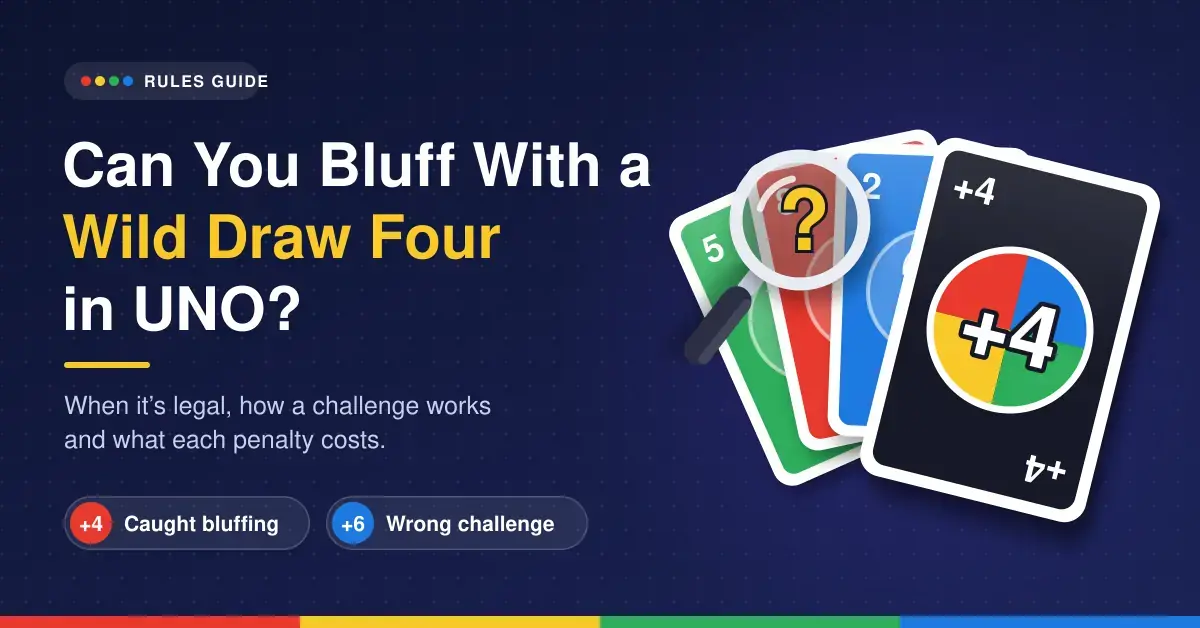
The Wild Draw Four lets you choose the next colour and forces the next player to draw four cards and skip their turn. Officially it may only be played when you have no card matching the current colour. A player who suspects an illegal play can challenge you: if the challenge is correct you draw the four cards yourself, but if it is wrong the challenger draws six cards instead. Our full breakdown of the Wild Draw Four rules covers the challenge step in detail.
Saying “Uno” and the Penalty
When you play your second-to-last card and are left holding just one, you must call out “Uno” to warn the other players. If an opponent catches you before the next player takes their turn, you draw two cards as a penalty. Forget to call it and get caught, and that small slip can cost you the round — here is exactly what happens if you forget to say UNO.
How UNO Scoring Works
UNO is usually played to 500 points across several rounds. When one player empties their hand, that round ends and the winner scores points based on the cards still held by everyone else. The card values are fixed:
- Number cards (0–9): face value — a 7 is worth 7 points.
- Skip, Reverse and Draw Two: 20 points each.
- Wild and Wild Draw Four: 50 points each.
Add up the points from every opponent’s remaining cards and give that total to the round’s winner. The first player to reach 500 points across the rounds wins the game overall. (Some groups play an alternative version where reaching 500 eliminates you and the last player standing wins — agree on which method you are using before you start.) For worked examples, see our guide on how scoring works in UNO.
Key Points
- Deal 7 cards to each player; match the top discard by colour, number or symbol.
- Draw one card if you cannot play; you play only one card per turn.
- Skip, Reverse and Draw Two change the turn order or force draws; Wild and Wild Draw Four also let you pick the colour.
- Wild Draw Four is only legal with no matching colour; a wrong challenger draws 6 cards.
- Call “Uno” at one card or draw 2 if caught.
- Numbers score face value, action cards 20, Wilds 50 — first to 500 points wins.
Common Mistakes and House Rules
Because UNO is so simple, many groups play a mix of official rules and homemade ones without realising it. The most common examples are stacking Draw Two and Draw Four cards, playing a matching Draw Two “instantly” out of turn, and requiring the loser of a round to add up their own cards. None of these are in the official rulebook. There is nothing wrong with house rules — they are half the fun — but it helps to know the difference so a game does not stall in an argument. Our comparison of the official rules and popular house rules lays them out side by side.
Who UNO Is For
UNO suits almost anyone: it is simple enough for young children who can match colours and numbers, quick enough for a party filler, and flexible enough for adults who enjoy adding tactics and house rules. With support for up to ten players it works well for large groups, and its many themed and rule-variant editions mean there is nearly always a version to match a table’s taste. If you can match a colour or a number, you already know enough to sit down and play.
Sources
Frequently Asked Questions (FAQ)
How many cards do you start with in UNO?
Each player is dealt seven cards at the start of a round. The rest of the deck becomes the draw pile, and its top card is flipped over to begin the discard pile.
How many players can play UNO?
UNO is designed for 2 to 10 players and is recommended for ages 7 and up. It works for a quick two-person game as well as a large family or party group.
Can you stack Draw Two cards in official UNO?
No. Under the official Mattel rules you play only one card per turn, so stacking a Draw Two onto another Draw Two is not allowed. Many groups use stacking as a house rule, but it should be agreed on before the game.
What happens if you forget to say “Uno”?
If you drop to one card without calling “Uno” and an opponent catches you before the next player takes their turn, you must draw two cards as a penalty. If no one catches you in time, there is no penalty.
How do you win a game of UNO?
You win individual rounds by being the first to play all your cards. The overall game is usually won by the first player to reach 500 points, scored from the cards left in opponents’ hands at the end of each round.