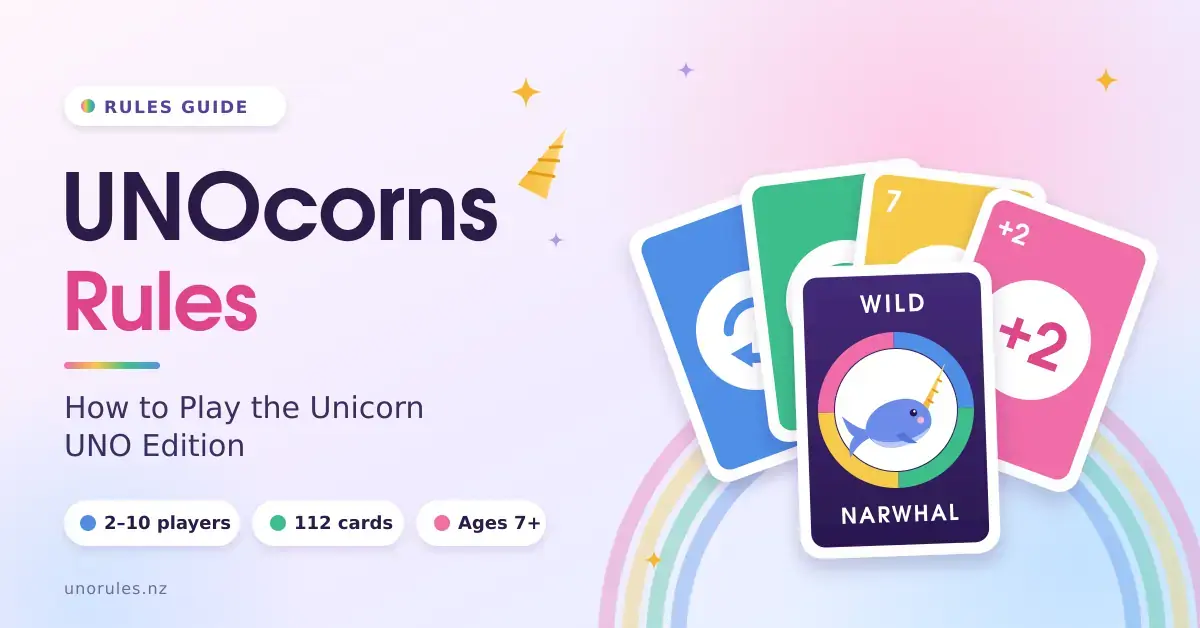
UNOcorns is Mattel’s unicorn-themed take on the classic UNO card game, released in 2017 and easy to recognise by its pastel artwork and one genuinely original card: the Wild Narwhal Rule card. The play still revolves around matching cards by colour or number and racing to empty your hand, but the deck swaps UNO’s usual red suit for a pink one and adds a loud, laughter-friendly guessing twist. This guide walks you through the full 112-card deck, setup, every action card, the correct Narwhal rule (which is widely misreported online), scoring and a few tactics that help you win.
Quick Facts
| Publisher | Mattel (item FNC46) |
| Released | 2017 |
| Format | Physical card game |
| Players | 2–10 |
| Recommended age | 7+ |
| Cards in deck | 112 |
| Colours | Blue, green, yellow, pink (no red) |
| Signature card | Wild Narwhal Rule card |
| Winning score | 500 points |
What UNOcorns Is
UNOcorns (sold as “UNO-CORNS”, item number FNC46) is an officially licensed UNO edition made by Mattel. It plays almost exactly like standard UNO, so anyone who already knows the classic UNO rules can pick it up in a minute. The difference is cosmetic and one special card: every card is decorated with colourful unicorn illustrations, and the deck adds four “Wild Narwhal Rule” cards that introduce a party-style guessing round. It is built for 2 to 10 players and recommended for ages 7 and up, which makes it a friendly choice for family game nights and mixed-age groups.
What Is in the Deck
A UNOcorns deck contains 112 cards. Unlike the standard game, the four colours are blue, green, yellow and pink — there is no red suit, which trips up players who expect the usual UNO palette. Each colour has 19 number cards (one 0 and two each of 1 through 9) plus its share of action cards. The table below shows the exact make-up straight from Mattel’s instruction sheet.
| Card type | Quantity | Notes |
|---|---|---|
| Number cards (0–9) | 76 | 19 per colour: one 0 and two each of 1–9 |
| Draw Two | 8 | 2 in each colour |
| Reverse | 8 | 2 in each colour |
| Skip | 8 | 2 in each colour |
| Wild | 4 | Choose any colour |
| Wild Draw Four | 4 | Choose colour + next player draws 4 |
| Wild Narwhal Rule | 4 | The edition’s signature card |
Setting Up a Game
Setup is identical to standard UNO. Each player draws a single card, and whoever draws the highest number is the dealer (any action card counts as zero for this draw). The dealer shuffles and deals seven cards face down to every player. The rest of the cards form a face-down Draw pile, and the top card is flipped over to start the Discard pile. If that first flipped card is an action card, its effect applies to the start of play; a Wild Draw Four flipped at the start is returned to the deck and a new card is drawn.
Keep the Draw and Discard piles in the centre where everyone can reach them, and sort your hand by colour or number so the busy unicorn artwork does not distract you from the number and colour markers in each card’s corner. Play begins with the person to the dealer’s left and moves clockwise until a Reverse card changes the direction.
How a Turn Works
On your turn you play one card that matches the top card of the Discard pile by colour, number or symbol. For example, if the top card is a blue 7, you can play any blue card, any colour 7, or a Wild card. If you cannot match, you draw one card from the Draw pile; if that drawn card is playable you may put it down straight away, otherwise your turn ends. You may also choose to draw rather than play a card you are holding, but once you draw you cannot then play a different card from your hand that turn.
UNOcorns uses the official “draw one” rule, not the popular “draw until you can play” house rule. Sticking to a single draw keeps rounds moving and stops the Draw pile from emptying too quickly. If you enjoy comparing the printed rules with the way most families actually play, our overview of how the simpler UNO Junior rules work is a helpful companion for younger players.
The Action Cards
The coloured action cards behave exactly as they do in standard UNO. The Skip card makes the next player lose their turn; the Reverse card flips the direction of play; and the Draw Two forces the next player to pick up two cards and miss their turn. A Draw Two or Reverse can only be played on a matching colour or on another card of the same type.
| Action card | Effect | How to play it |
|---|---|---|
| Skip | Next player misses their turn | Match by colour or on another Skip |
| Reverse | Direction of play flips | Match by colour or on another Reverse |
| Draw Two | Next player draws 2 and misses their turn | Match by colour or on another Draw Two |
| Wild | You choose the next colour | Play any time |
| Wild Draw Four | Choose colour; next player draws 4 | Only when you have no card matching the current colour |
Wild and Wild Draw Four cards
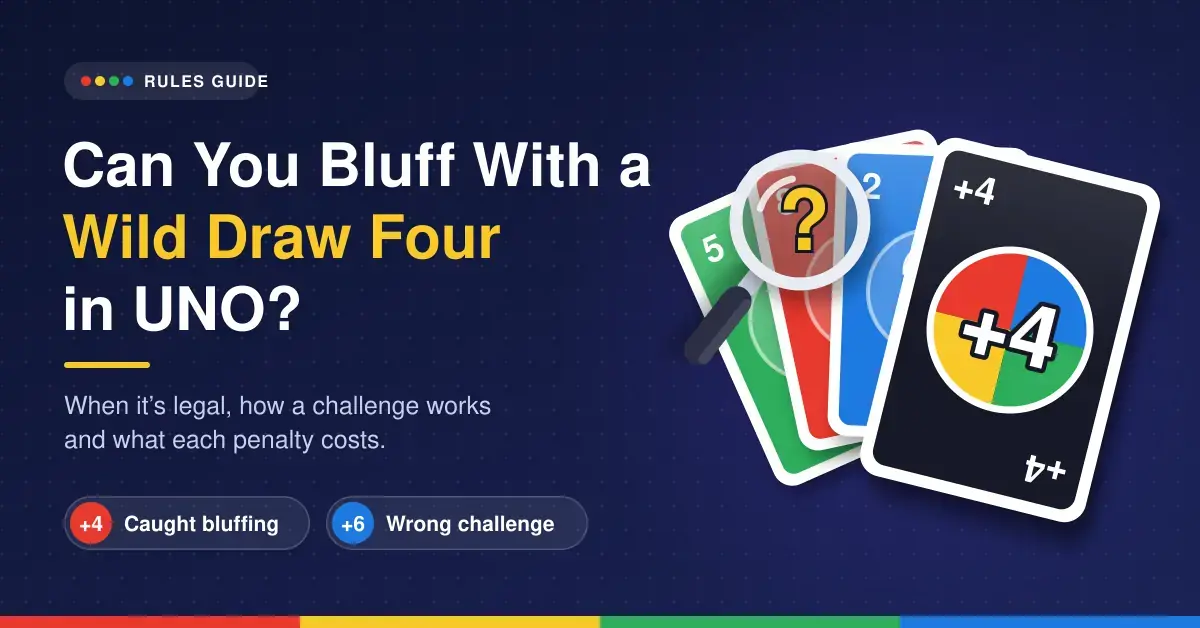
A standard Wild card can be played on any turn and lets you set the next colour, which is handy when you are stuck with a single colour. The Wild Draw Four does the same and forces the next player to draw four cards and lose their turn, but there is a catch: you may only play it when you have no other card matching the current colour on the Discard pile. If an opponent suspects you played it illegally, they can challenge you and you must show your hand. If you were bluffing, you draw the four cards yourself; if the challenge is wrong, the challenger draws the four cards plus two extra, six in total. Our detailed guides to Wild Draw Four rules and to playing Wild cards well cover the bluffing maths in full.
The Wild Narwhal Rule Card
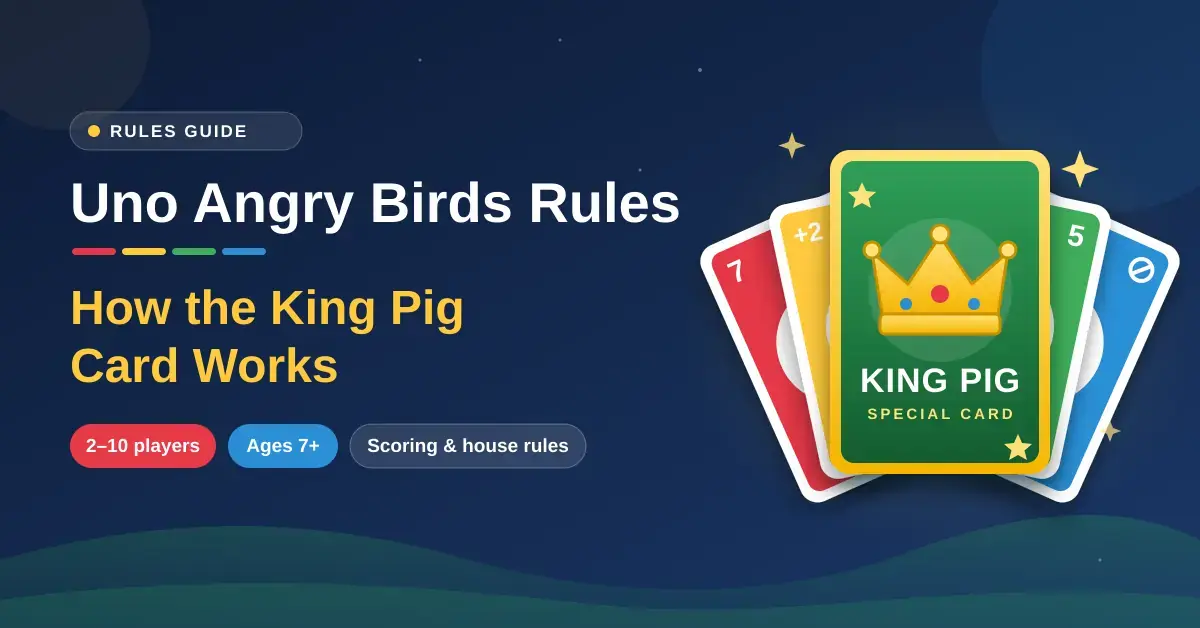
This is the card that makes UNOcorns different from every other edition, and it is almost always described incorrectly online. When you play a Wild Narwhal Rule card, every player draws one card from the Draw pile and holds it against their own forehead facing outwards, without looking at it — so everyone can see your card except you. From that moment, on each of their turns, every player must correctly guess the colour of the card on their own forehead before they can do anything else. Guess right and you discard that card and take your turn as normal; guess wrong and your turn ends, and you try again next time it comes around. You cannot resume normal play until you have guessed correctly. If the card on your forehead is any wild card, any colour you name counts as correct. Because the Narwhal card is itself a wild, the player who played it also chooses the colour that resumes the round.
The narwhal is a real Arctic whale often nicknamed the “unicorn of the sea”, which is where the card gets its name; general reference sites such as Wikipedia are a starting point for wider trivia. Within the game, the card is prized because it can slow leaders down: a player who keeps guessing wrong is effectively frozen out of the round while everyone else keeps playing.
Tips for the Narwhal round
- Watch the other players’ faces and the order of guesses — it is your only clue to your own colour.
- Since there are four colours, an unlucky player might need up to three attempts before guessing right.
- Play it when you are close to going out, so opponents are stuck guessing while you empty your hand.
Scoring and Winning
You win a round by being the first to get rid of all your cards, and you then score points for the cards left in everyone else’s hands. Number cards are worth their face value, coloured action cards are worth 20 points each, and every wild card — including the Wild Narwhal Rule card — is worth 50 points. The first player to reach 500 points across multiple rounds wins the game. Mattel also lists an alternative method where you keep a running total and, when someone hits 500, the player with the fewest points wins instead. Because high-value cards cost you when someone else goes out, it usually pays to play Wilds and action cards rather than hoard them; our guide to how scoring works in UNO explains the maths behind that choice.
Card Point Values
| Card category | Point value |
|---|---|
| Number cards (0–9) | Face value |
| Draw Two | 20 points |
| Reverse | 20 points |
| Skip | 20 points |
| Wild | 50 points |
| Wild Draw Four | 50 points |
| Wild Narwhal Rule | 50 points |
Saying “UNO”
When you play your second-to-last card, you must call out “UNO” to signal that you have only one card left. If you forget and another player catches you before the next player begins their turn, you draw two cards as a penalty. Once you play your final card the round is over — but if that last card is a Draw Two or Wild Draw Four, the next player still has to draw those cards before scores are tallied. If you want the finer points, we cover exactly what happens if you forget to say UNO in its own article.
Common Mistakes and Clarifications
The biggest misunderstanding is the Narwhal card. Many online summaries claim that everyone has to shout “Narwhal!” and that the slowest shouter draws a penalty card. That is not the official rule — there is no shouting race. The real card is the forehead colour-guessing round described above. The second common slip is expecting a red suit: UNOcorns has no red, so a card that would be red in standard UNO is pink here. Finally, avoid playing a Wild Draw Four when you are holding a card that matches the current colour; if you are challenged and caught, the penalty falls on you.
- Narwhal card: no shouting — it is a forehead colour-guessing round.
- Colours: blue, green, yellow and pink; there is no red.
- Wild Draw Four: only legal when you have no matching colour in hand.
- Two-player games: as in standard UNO, a Reverse simply acts like a Skip.
Who UNOcorns Is For
UNOcorns suits families, unicorn fans and casual groups who already enjoy UNO and want a lighter, sillier version for game night. The rules are gentle enough for children around age seven, while the Narwhal round adds enough chaos to keep older players entertained. If you like themed UNO decks, it sits comfortably alongside the many other branded editions covered on this site, and it works just as well as an icebreaker as it does a competitive round.
Reference sources
Frequently Asked Questions
How many cards are in a UNOcorns deck?
There are 112 cards: 76 number cards across four colours, 24 coloured action cards (Draw Two, Reverse and Skip), 4 Wild, 4 Wild Draw Four and 4 Wild Narwhal Rule cards.
What does the Wild Narwhal Rule card actually do?
Every player draws a card and holds it to their forehead without looking. On their turn each player must correctly guess the colour of their own card before playing; a wrong guess ends the turn and they retry next time. As a wild card, it also lets the player who played it choose the next colour.
Does UNOcorns have a red colour?
No. The four colours are blue, green, yellow and pink. A card that would be red in standard UNO is pink in UNOcorns.
How do you win at UNOcorns?
Be the first to play all your cards each round to score points for the cards left in opponents’ hands. Number cards score face value, action cards 20 points and wild cards 50 points. The first player to reach 500 points wins.
How many players can play UNOcorns?
UNOcorns is designed for 2 to 10 players and is recommended for ages 7 and up.