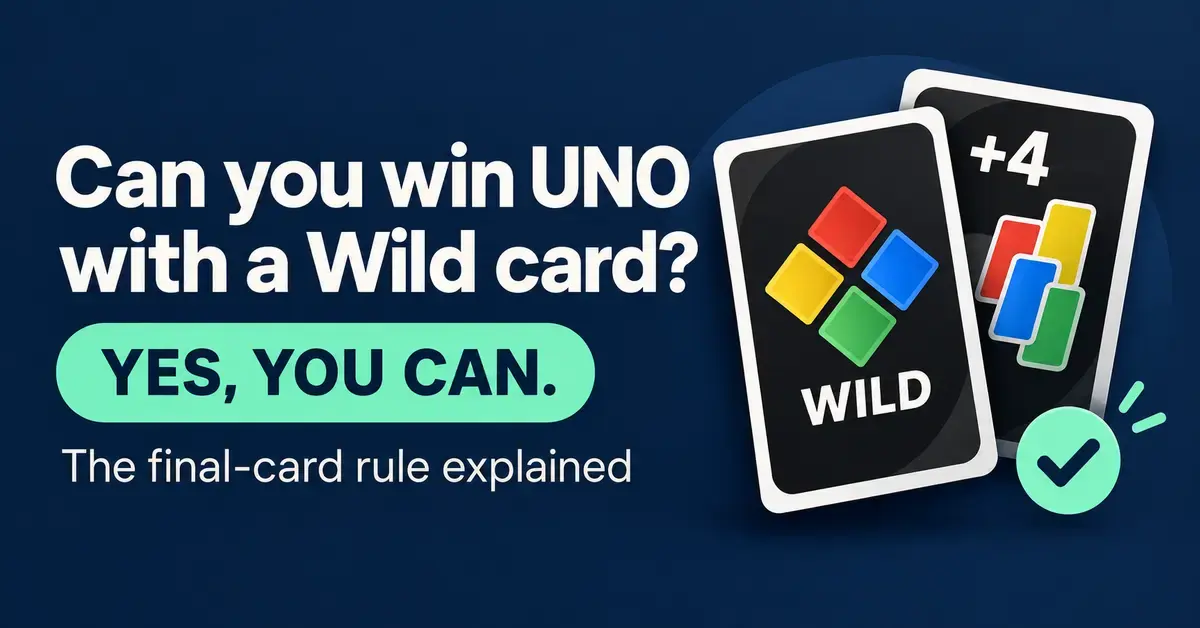
It is one of the most argued-over moments in a game of UNO: you are down to a single Wild card, you slap it on the pile to empty your hand — and someone at the table insists that doesn’t count as a win. So can you actually win UNO with a Wild card? Under the official rules the answer is a clear yes. You are allowed to end the round by playing a Wild, a Wild Draw Four or any action card as your final card. This guide explains the official final-card rule, what happens to the next player, how the leftover penalty cards are scored, and why so many households play it differently.
Key Points
- Official rule: yes, you can win UNO by playing a Wild or Wild Draw Four as your last card.
- The twist: a Draw Two or Wild Draw Four still forces the next player to draw, but they never take a turn — the round is over.
- Scoring: those drawn cards count against the next player when points are totalled.
- Still required: you must call “UNO” on your second-to-last card, even if the last one is a Wild.
- House rule: many tables ban ending on an action or Wild card — agree on it before you play.
The short answer: yes, a Wild card can be your winning card
According to the rules published by Mattel, the makers of UNO, there is no restriction on which card you use to go out. When you play your last card and your hand is empty, you win the round — regardless of whether that card is a number, a Skip, a Reverse, a Draw Two, a Wild or a Wild Draw Four. UNO’s own support channels have confirmed this directly in response to players: you can end the game with an action card.
So if your final card is a Wild, you place it down, declare the colour you would have chosen (more on that below), announce your win, and the round is over. The colour you name has no real effect because nobody gets to play after you — but naming it keeps the play clean and avoids arguments if a dispute forces the hand to be replayed.
What the official final-card rule actually says
The final-card rule is short, but it has one twist that causes most of the confusion: some cards still make the next player draw, even though the game has already ended. Here is how each type of last card behaves.
Ending on a plain Wild card
A standard Wild lets you change the colour in play. As your last card it is the cleanest possible finish: you play it, state a colour for form’s sake, and you win. There is no penalty for anyone and nothing else happens. If you want the full breakdown of how the colour-change card works during normal play, see our guide to Wild card rules.
Ending on a Wild Draw Four or a Draw Two
This is where players trip up. If your final card is a Draw Two or a Wild Draw Four, you still win the moment your hand is empty — but the next player must still draw the required cards (2 or 4). Crucially, they do not then take a turn, because the round is already over. Those drawn cards matter only for one reason: scoring. They are added to that player’s hand and counted when everyone totals up their leftover points at the end of the round.
Officially, a Wild Draw Four is meant to be played only when you have no card matching the current colour, though bluffing this is part of the game. If you want to understand challenges and the honesty rule, read our explainer on the Wild Draw Four rules and whether you can bluff with a Wild Draw Four.
Ending on a Skip or a Reverse
A Skip or Reverse as your last card is completely legal and completely harmless. The would-be effect — skipping the next player or reversing direction — never comes into play because the round ends the instant your hand is empty. You simply win.
Final-Card Outcomes
| Your last card | Do you win? | Effect on the next player |
|---|---|---|
| Number card (0–9) | Yes | None |
| Skip | Yes | None — the skip never applies |
| Reverse | Yes | None — the reverse never applies |
| Draw Two | Yes | Draws 2 cards; counted in scoring, no turn taken |
| Wild | Yes | None |
| Wild Draw Four | Yes | Draws 4 cards; counted in scoring, no turn taken |
You still have to say “UNO”
Winning on a Wild card does not exempt you from the most famous rule in the game. The moment you play your second-to-last card and are left holding just one, you must call “UNO” — even if that last card is a Wild or an action card. If an opponent catches you failing to say it before the next player begins their turn, the standard penalty is to draw two cards, and your chance to win on that Wild card can slip away. It is worth knowing exactly what happens if you forget to say UNO before you rely on a Wild to close out the round.
How the penalty cards affect scoring
When a round ends, the winner scores points based on the cards still held by everyone else. That is why a Wild Draw Four finish can actually be a strong, aggressive way to win — you not only empty your own hand, you also load extra high-value cards into an opponent’s pile. The standard point values are:
- Number cards (0–9): face value.
- Skip, Reverse and Draw Two: 20 points each.
- Wild and Wild Draw Four: 50 points each.
Because Wild cards are worth the most, the four cards a player is forced to draw on a Wild Draw Four finish can noticeably swell the loser’s total. In the common scoring format the first player to reach 500 points wins the whole game, so those extra points count. For a fuller walkthrough, see how scoring works in UNO.
The house rule that bans it — and why it exists
If you grew up being told you cannot win on an action or Wild card, you were playing a house rule, not the official one. This variant — sometimes phrased as “you must go out on a number card” — is one of the most widespread unofficial rules in the game. Under it, if your only remaining card is a Wild or action card, you are not allowed to play it to win; you must draw instead and keep going.
People adopt it because it feels less abrupt and stops a game ending on a penalty that a losing player can never respond to. There is nothing wrong with playing this way if your table agrees to it in advance — the key is to settle on it before the game starts, not mid-argument. Our comparison of the official rules versus house rules covers where these two traditions diverge.
Should you save a Wild card to win?
Holding a Wild until the end can be smart, but it is a trade-off. A Wild guarantees you a playable final card no matter what colour is showing, which removes the risk of being stuck unable to go out. A Wild Draw Four goes further by dumping cards on an opponent as you win. The downside is that Wild cards are your most flexible get-out-of-trouble tools during the game, so hoarding one can leave you unable to change the colour when you most need to earlier on. As a rule of thumb: keep a Wild in reserve when you are close to going out and the colour in play is working against you, but do not cling to it so long that it becomes dead weight in a long round.
Sources
Frequently Asked Questions
Can you win UNO by playing a Wild card as your last card?
Yes. Under the official Mattel rules there is no restriction on which card you finish on, so a Wild card is a perfectly legal winning card. You play it, name a colour for form, announce your win, and the round ends with your empty hand.
What happens to the next player if you win on a Wild Draw Four?
They must still draw four cards, but they do not get to take a turn because the round is already over. Those four cards are simply added to their hand and counted against them when the round’s points are totalled.
Do you still have to say “UNO” if your last card is a Wild?
Yes. You must call “UNO” when you are down to one card, whatever that card is. If an opponent catches you not saying it before the next player starts their turn, you draw two cards as a penalty.
Why do some people say you can’t win on an action card?
That is a popular house rule, not the official rule. Many households require players to go out on a number card so the game does not end on a penalty. It is fine to play that way as long as everyone agrees before the game begins.
How many points is a Wild card worth in scoring?
Both the Wild and the Wild Draw Four are worth 50 points each when counting the cards left in losing players’ hands. Skip, Reverse and Draw Two are worth 20 each, and number cards are worth their face value.