Drawing a card is the mechanic that keeps UNO moving: it stops the game stalling when nobody can play, and it is the source of most of the arguments that break out around a kitchen table. This guide sets out exactly how drawing works under the official Mattel rules — when you draw, how many cards you take, what the Draw Two and Wild Draw Four force on you, why “stacking” is not part of the real game, what happens when the pile runs out, and how every drawn card feeds into the final score. Terms are explained the first time they appear, so it works whether you are new to UNO or just settling a house dispute.
Key Points
- One card only: when you can’t play, you draw a single card — not until you find a match.
- Play it or keep it: a drawn card that is legal may be played straight away; otherwise your turn ends.
- No official stacking: you cannot pile a Draw Two onto a Draw Two, or a Wild Draw Four onto a Wild Draw Four.
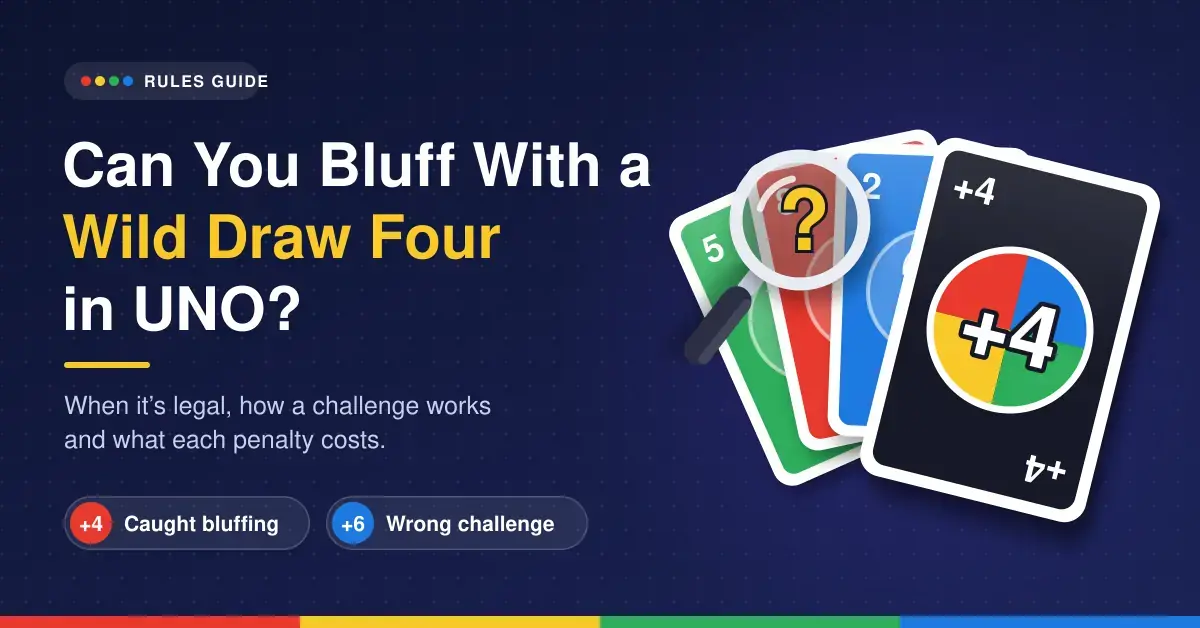
- Wild Draw Four challenge: a guilty player draws 4 cards; a wrong challenger draws 6.
- Missed the “UNO” call: if caught in time, you draw 2 penalty cards.
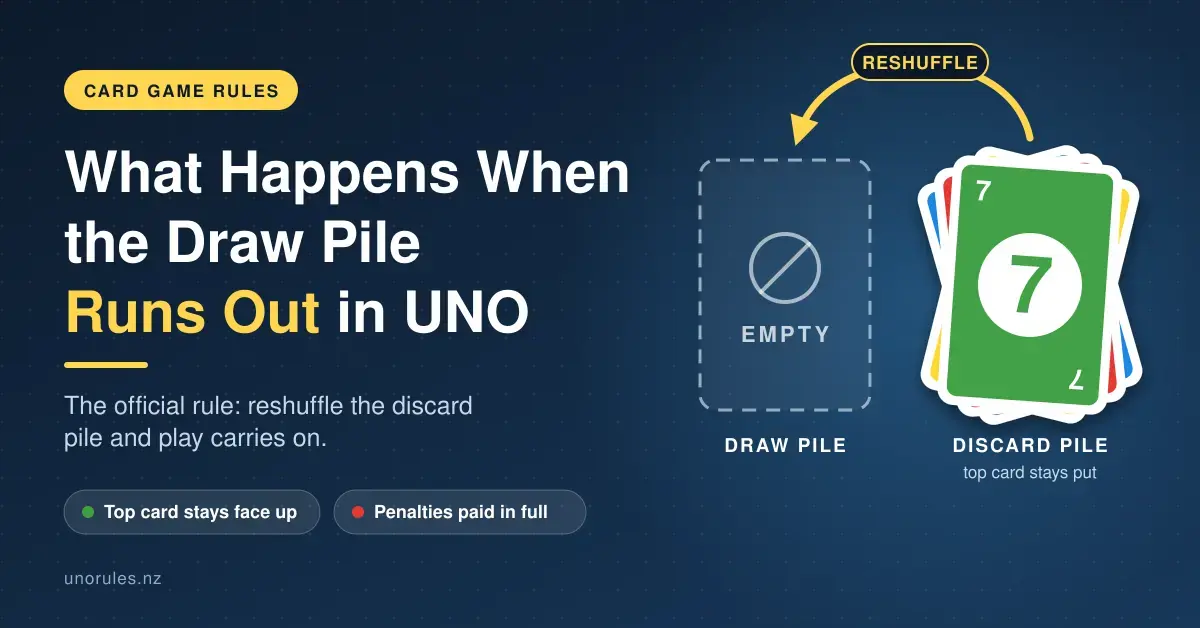
- Empty draw pile: reshuffle the discard pile (keeping its top card) to make a new one.
How the Standard Draw Works
When it is your turn and you have no card that matches the top of the discard pile by colour, number or symbol, you take one card from the top of the face-down draw pile. A common misunderstanding is that you must keep drawing until you find something playable. You do not. Under the official rules you draw a single card. If that card can be played, you may play it straight away; if it cannot, your turn simply ends and play passes to the next person. Drawing one card at a time keeps hands from ballooning and keeps the game moving quickly.
| Action | Result | Turn status |
|---|---|---|
| Drew a playable card | You may play it immediately | Turn ends after you play |
| Drew an unplayable card | You keep the card | Turn ends immediately |
| Chose to draw anyway | You take one card despite having a legal move | Turn ends after the draw or play |
When a Drawn Card Is Playable
If the card you draw matches the current colour or number, or is a Wild, you have the option to play it, but you are never forced to. Some players hold on to a freshly drawn Wild for a more useful moment and simply end their turn by adding it to their hand.
The Draw Two Penalty
The Draw Two is an action card that forces the next player in turn order to take two cards from the pile and forfeit their turn. This is where a lot of house-rule friction starts. Officially, a Draw Two ends the exchange: the player who is hit cannot play a card to “bounce” the penalty on to somebody else. The two cards are taken, that player is skipped, and play continues. If a Draw Two happens to be the very first card flipped at the start of a game, the first player draws the two cards and is skipped. For a deeper look at edge cases, see our dedicated guide to the Draw Two card rules.
How the Draw Two Affects Scoring
Each Draw Two is worth 20 points to whoever holds it when the round ends. Being forced to take two of them late in a round is costly: the extra cards stay in your hand, and if an opponent goes out immediately afterwards those points are counted against you.
Wild Draw Four and the Challenge Rule
The Wild Draw Four is the most involved drawing card in UNO. It lets you choose the next colour and forces the following player to draw four cards and miss their turn. Crucially, it may only be played legally if you have no card in hand matching the current colour of the discard pile. Because that condition is hidden, the official rules include a challenge: if you suspect the card was played illegally, you can challenge, and the player must privately show you their hand.
| Challenge outcome | Player who played the card | Challenger |
|---|---|---|
| Challenge succeeds (played illegally) | Draws 4 cards instead of the challenger | No penalty; plays their normal turn |
| Challenge fails (played legally) | No penalty | Draws 6 cards — the original 4 plus 2 more — and misses their turn |
The Risk of Bluffing a Wild Draw Four
Playing a Wild Draw Four when you actually do hold a matching colour is a gamble on your opponents not challenging you, because a failed challenge costs them six cards. Full detail on legal play and challenges is in our guide to the Wild Draw Four rules.
Can You Stack Draw Cards?
“Stacking” means answering a Draw Two with your own Draw Two so the total passes to the next player, or piling Wild Draw Fours the same way. It is extremely common in social play, but it is not part of the official rules. Mattel has confirmed that when a Draw Two or Wild Draw Four is played, the very next player must take the cards and lose their turn — they cannot play another draw card to deflect it. If you enjoy stacking, treat it as an agreed house rule rather than the standard game. We cover the debate in full in whether stacking is allowed in official UNO.
Draw Penalties Compared
| Situation | Cards drawn | Turn effect |
|---|---|---|
| No playable card on your turn | 1 | Turn ends if the card can’t be played |
| A Draw Two is played against you | 2 | You draw and are skipped |
| A Wild Draw Four is played against you | 4 | You draw and are skipped |
| Your Wild Draw Four challenge fails | 6 | You draw (4 + 2) and are skipped |
| Caught not saying “UNO” | 2 | Cards added to your hand |
Drawing When the Draw Pile Runs Out
In a long round the draw pile can empty before anyone wins. The official fix is simple: leave the top card of the discard pile where it is to keep the game going, gather every other discarded card, shuffle them thoroughly, and place them face down as a new draw pile. This recycling means a game can, in theory, continue indefinitely until someone empties their hand. Our article on what happens when the draw pile runs out walks through the reshuffle step by step.
The Penalty for Forgetting to Say “UNO”
When you play your second-to-last card, leaving you with one, you must call “UNO”. If you forget and another player catches you before the next player takes their turn, you draw two penalty cards. The catch has to be made in that short window: once the next player has started their turn — by playing a card or beginning to draw — you are safe and no penalty can be applied. More on the timing is in what happens if you forget to say UNO.
Drawing During Setup
UNO uses a small draw at the very start. One common method is for each player to draw a card, with the highest number becoming the dealer. The dealer shuffles and deals seven cards to each player, and the remaining cards form the draw pile. The top card is turned over to start the discard pile. If that first card is an action card, its effect applies to the first player — with one exception: if a Wild Draw Four is turned up first, it is returned to the deck, the cards are reshuffled, and a new card is flipped.
Voluntary Drawing
The official rules allow a subtle option that surprises many players: you may choose to draw a card even when you already hold a card you could legally play. Some players use this to disguise how strong their hand is, or to avoid revealing that they still have a particular colour. It costs you a card, so it is a trade-off, but it is a legal move rather than a house rule. You are not required to show a voluntarily drawn card unless you decide to play it.
Draw Rules in Two-Player UNO
Head-to-head UNO changes how a few cards behave. A Reverse works exactly like a Skip, and playing a Skip lets you immediately take another turn. A Draw Two makes your single opponent draw the cards, after which play returns straight to you. Chaining these can force one player to draw several times in a row, which empties the draw pile quickly — so the reshuffle rule above matters even more in a two-player game.
How Drawing Affects Your Final Score
Every card you are forced to draw is a potential point for whoever wins the round, because the winner scores the value of all the cards left in the other players’ hands. A single Wild Draw Four late in the round can hand the winner 50 points at once, and the round total counts toward the 500 points needed to win the match. Understanding these values is central to good play; see how scoring works in UNO for the full method.
| Card type | Point value |
|---|---|
| Number cards 0–9 | Face value |
| Skip, Reverse, Draw Two | 20 points each |
| Wild and Wild Draw Four | 50 points each |
Final Thoughts
Sticking to the official draw rules — one card per draw, no stacking, and the correct Wild Draw Four challenge penalties — keeps UNO fair and predictable whether you are playing in Auckland, Christchurch or at home. House rules are fine when everyone agrees to them in advance; the trouble only starts when players assume their own version is the official one. If you enjoy rules-heavy card games, the trick-taking game Mao, documented on Wikipedia, takes the idea of unspoken and evolving rules even further.
Reference sources
Frequently Asked Questions (FAQ)
Do you keep drawing until you get a playable card in UNO?
No. Under the official rules you draw only one card when you cannot play. If that card is not playable, your turn ends and play moves to the next person.
Can you stack a Draw Two on top of another Draw Two?
Not in the official game. The player who is hit must take the two cards and miss their turn; they cannot add a Draw Two to pass the penalty along. Stacking is a popular house rule only.
How many cards do you draw if you forget to say “UNO”?
If you are caught before the next player takes their turn, you draw two penalty cards. If nobody catches you in time, there is no penalty.
What happens when the draw pile runs out?
Leave the top card of the discard pile in place, shuffle all the other discarded cards, and turn them face down to form a new draw pile so the game can continue.
Can you draw a card even if you have one you could play?
Yes. The official rules let you choose to draw a single card voluntarily, often as a bluff, instead of playing a legal card from your hand.