UNO Wilderness is an outdoor-themed version of the classic Mattel card game, published in 2016 with illustrations of forests, mountains and wildlife in place of the usual plain colour blocks. Despite the adventurous packaging, it plays exactly like standard UNO: a 108-card deck, two to ten players, and the familiar goal of being first to empty your hand. This guide to the UNO Wilderness rules explains what is really in the box, how to set up and play, how the action and Wild cards work, how scoring to 500 points is counted, and — importantly — it clears up a widely copied myth about a special “Wild Bear” card that this edition does not actually contain.
Quick Facts
| Publisher | Mattel |
| Edition | UNO Wilderness (product code DMM63) |
| Released | 2016 |
| Theme | Outdoor / wilderness artwork (forests, mountains, wildlife) |
| Deck size | 108 cards (standard UNO deck) |
| Players | 2–10 |
| Age | 7 and up |
| Playing time | About 30 minutes |
| Rules | Identical to classic UNO — no edition-specific cards |
What UNO Wilderness Actually Is
UNO Wilderness is a licensed re-skin of the standard UNO deck. Mattel released it in 2016 (product code DMM63) as a travel-friendly edition aimed at camping trips and family holidays, marketing it with the line that “UNO is on a new adventure — in the great outdoors.” The cards show nature scenes, but the numbers, colours and symbols underneath follow the ordinary UNO layout.
This is the single most important thing to understand about the edition: the rules are identical to classic UNO. There are no wilderness-only cards and no extra matching rules. If you already know how to play UNO, you already know how to play UNO Wilderness. If you are new to the game, the same beginner-friendly logic applies, and you can read the full ruleset in our guide to the official UNO rules.
The game suits 2 to 10 players, is recommended for ages 7 and up, and a round typically lasts around 30 minutes. Because the artwork is more detailed than a plain coloured card, the main practical difference is simply that players need to glance at the colour and number rather than relying on a solid block of colour — useful to remember with younger children.
What Is in the Box
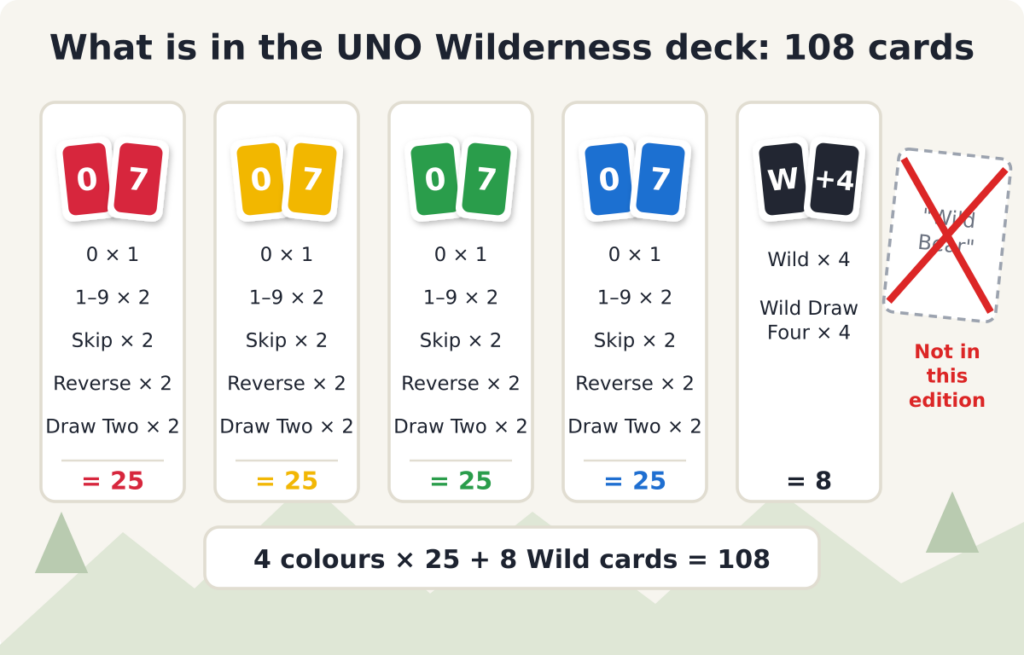
UNO Wilderness contains a standard 108-card UNO deck. The breakdown is the same as a normal UNO pack, so nothing here is unique to the wilderness theme.
- 100 coloured cards split across four colours — red, yellow, green and blue — with 25 cards in each colour.
- Within each colour: one 0, two each of 1 through 9, and two each of Skip, Reverse and Draw Two.
- 8 Wild cards that belong to no colour: four plain Wild cards and four Wild Draw Four cards.
That adds up to 108 cards in total — not 112. Any guide that lists 112 cards, or a special “Wild Bear” or “animal” card, is describing something that is not in this product.
Setting Up a Game
Setup follows the normal UNO procedure and takes less than a minute once everyone is seated in a circle.
- Choose a dealer. Each player draws one card; the highest number deals (action and Wild cards count as zero for this draw).
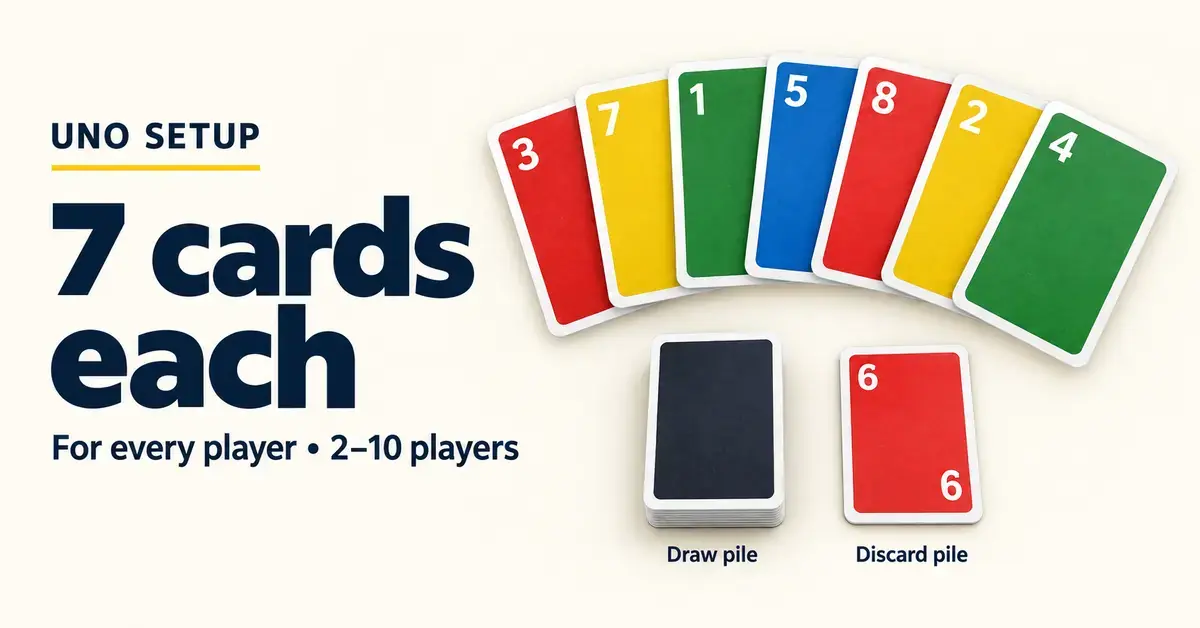
- Shuffle and deal. The dealer shuffles the 108 cards and deals seven cards face down to each player, regardless of how many are playing.
- Form the piles. The remaining cards go face down in the middle as the draw pile. Turn the top card face up beside it to start the discard pile.
- Handle a Wild starter. If the first turned-up card is a Wild Draw Four, return it to the deck and turn over a new one. Other action cards take effect immediately on the first player.
Play then begins with the person to the dealer’s left and moves clockwise until a Reverse changes the direction. In a two-player game the setup is the same, but turn order matters less, since play simply passes back and forth between the two of you.
How to Play
On your turn you must play a single card that matches the top card of the discard pile by colour or by number (or symbol, for action cards). You can also play a Wild card at any time. There is no extra “animal” or “species” match — matching works only on colour and number, exactly as in standard UNO.
For example, if the top card is a green 6, you may play any green card, any colour of 6, or a Wild. If you cannot or choose not to play, you draw one card from the draw pile. If that drawn card is playable you may put it down straight away; otherwise your turn ends and play passes on. You draw only one card — you do not keep drawing until you find a match.
- Match by colour — play a card of the same colour as the top card.
- Match by number — play the same number in any colour.
- Match the action — a Skip can be played on another Skip, a Reverse on a Reverse, and so on.
- Draw one — if you have no legal play, take a single card and play it if you can.
The Action and Wild Cards
UNO Wilderness uses the same five special cards as every standard deck. Learning their timing is where most of the strategy lives.
Skip, Reverse and Draw Two
The Skip makes the next player miss their turn. The Reverse switches the direction of play; in a two-player game it behaves like a Skip, returning the turn to you. The Draw Two forces the next player to pick up two cards and lose their turn. Each of these is worth 20 points if left in a hand at the end of a round, and you can read more about how the UNO Reverse card behaves in different player counts.
Wild and Wild Draw Four
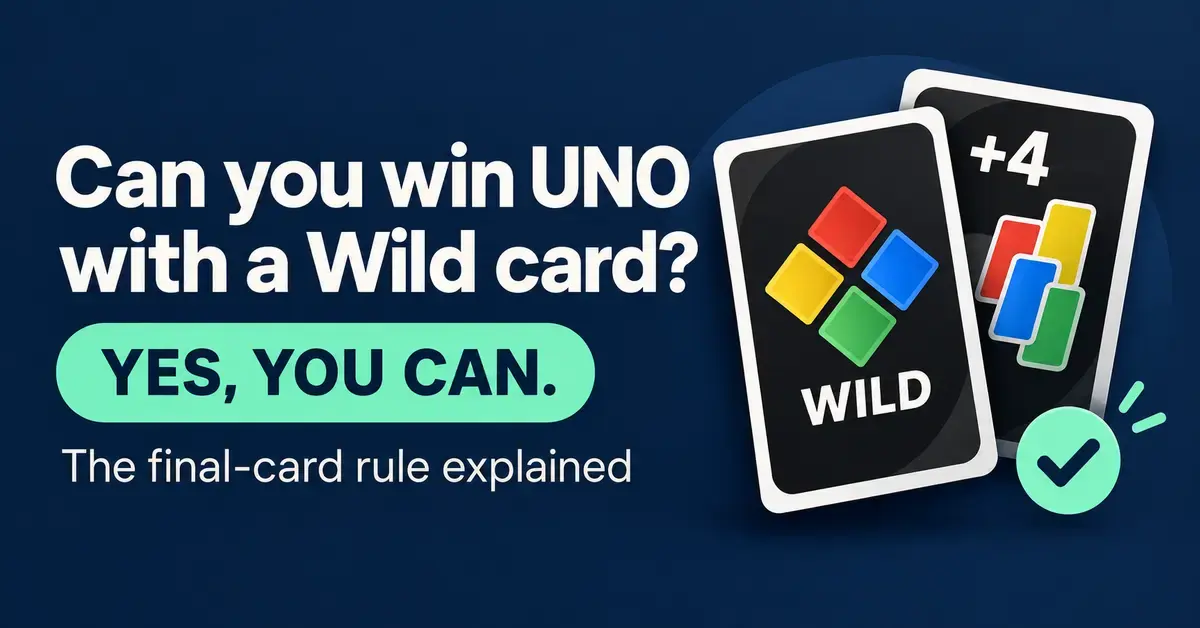
A Wild card can be played on any turn and lets you choose the colour that play continues in. A Wild Draw Four does the same but also forces the next player to draw four cards and skip their turn. Under the official rules you may only play a Wild Draw Four when you have no card matching the current colour in your hand. If an opponent suspects you broke that rule they can challenge you: if you were bluffing you draw the four cards yourself, and if the play was legal the challenger draws six instead. We cover this in detail in our guide to the Wild Draw Four rules.
Saying “UNO” and Running Out of Cards
When you play your second-to-last card — leaving you with just one — you must call out “UNO!” before the next player takes their turn. If an opponent catches you staying silent in time, you draw two cards as a penalty. More detail on the timing window is in our explainer on what happens if you forget to say UNO.
If the draw pile is emptied before anyone wins, take the discard pile (except the current top card), shuffle it, and turn it face down to form a fresh draw pile. The game simply continues. Our article on what happens when the draw pile runs out walks through the full procedure and some common house variations.
Scoring and Winning
A round ends the moment one player discards their last card. That player wins the round and scores points based on the cards still held by everyone else. Most groups play to a cumulative target of 500 points across several rounds; the first player to reach it wins the overall game. You can set a lower target for a quicker session.
- Number cards (0–9): face value.
- Skip, Reverse, Draw Two: 20 points each.
- Wild and Wild Draw Four: 50 points each.
Because the Wild cards carry the heaviest penalty, it is risky to hold them too long — if an opponent goes out first, those 50-point cards count against you. For a full worked example of tallying a round, see how UNO scoring works.
Clearing Up the “Wild Bear” Myth
Several online guides claim UNO Wilderness contains a special “Wild Bear” card that makes every other player draw one card, and that the deck holds 112 cards. Neither claim is accurate. Retailer listings, the BoardGameGeek database entry and the standard-deck breakdown all describe an ordinary 108-card UNO set with the usual Wild and Wild Draw Four cards and nothing else.
If you enjoy editions that genuinely add a signature card, those do exist elsewhere in the UNO range — for instance the Force of Nature card in UNO Frozen. UNO Wilderness, however, keeps the gameplay completely standard, and the appeal is purely in the outdoor artwork.
How UNO Wilderness Compares to Standard UNO
The comparison below shows just how close the two are. The theme is the only meaningful difference.
Comparison
| Feature | Standard UNO | UNO Wilderness |
|---|---|---|
| Total cards | 108 | 108 |
| Deck composition | 100 coloured + 8 Wild | 100 coloured + 8 Wild |
| Artwork | Plain colour blocks | Outdoor / nature scenes |
| Special cards | Skip, Reverse, Draw Two, Wild, Wild Draw Four | Same — none unique to the edition |
| Players | 2–10 | 2–10 |
| Scoring target | 500 points | 500 points |
| Gameplay | Standard rules | Identical to standard rules |
Tips for New Players
Because the mechanics are standard UNO, the usual tactics apply, with one small adjustment for the busier artwork.
- Read the colour first. The detailed illustrations can make a quick glance harder than a plain deck, so sort your hand by colour to avoid missing a legal play.
- Save a Reverse or Skip for when an opponent is down to one or two cards, to deny them a turn.
- Play high-value Wilds earlier rather than hoarding them, so you are not caught with 50-point cards if someone goes out.
- Keep the game fair for children. Younger players can take a little longer to spot numbers against the scenery, so allow a moment before moving on.
Playing UNO Wilderness on the Move
The whole point of the wilderness theme is portability, and the format backs it up. A single UNO deck is light, needs no board, batteries or screen, and sets up anywhere flat — a picnic blanket, a tent floor or a bach table. For families travelling with children around the recommended age of seven, that makes it an easy choice for long drives, campgrounds and rainy afternoons.
A few practical points help outdoors. Wind is the main enemy of any card game, so play on a sheltered surface and consider weighing down the draw and discard piles with a small stone or cup. Keep the deck complete: UNO relies on an exact 108-card count for scoring and pacing, so a lost card gradually unbalances the game. If you are missing cards or the deck is worn, any current standard UNO pack is a direct replacement, because the rules and card mix are the same.
Key Points
- UNO Wilderness is a 2016 Mattel edition that re-skins classic UNO with outdoor artwork.
- The deck has 108 cards — not 112 — made up of 100 coloured cards and 8 Wilds.
- There are no edition-specific cards; the rules are identical to standard UNO.
- The widely repeated “Wild Bear” card does not exist in this product.
- It plays with 2–10 players, ages 7+, scoring to 500 points over several rounds.
Sources
Frequently Asked Questions (FAQ)
How many cards are in UNO Wilderness?
The deck has 108 cards, the same as standard UNO: 100 coloured cards (25 in each of red, yellow, green and blue) plus eight Wild cards, which are four plain Wilds and four Wild Draw Fours.
Does UNO Wilderness have a special “Wild Bear” card?
No. UNO Wilderness contains only the standard UNO cards. There is no “Wild Bear” card and no rule forcing every player to draw. Claims about a 112-card deck or an animal-themed special card are incorrect; only the artwork changes.
How many people can play, and what age is it for?
UNO Wilderness is designed for 2 to 10 players and recommended for ages 7 and up. A typical round takes around half an hour.
How do you win at UNO Wilderness?
You win a round by being the first to discard all your cards. In a full game, players add up the points from cards left in opponents’ hands each round, and the first to reach an agreed total — usually 500 points — wins overall.
Is UNO Wilderness still available to buy?
It was a 2016 release and is now largely out of print, so it is mostly found second-hand or in collector listings. Since the gameplay is identical to classic UNO, a current standard UNO deck plays exactly the same way.