
UNO Power Grab is a Mattel edition of the classic card game that adds four physical "Power Towers" you can steal from your opponents. You still play by matching cards by colour or number, but special cards let you grab a tower that cancels an action card played against you — and whoever manages to hold all four towers at once can empty almost their entire hand in a single move. This guide explains the official UNO Power Grab rules: what comes in the box, what each tower does, how grabbing works, how scoring runs to 500 points, and the small details that cause the most arguments at the table.
Quick Facts
| Game | UNO Power Grab (Mattel) |
| Players | 2–6 |
| Age | 7+ |
| Deck | 112 cards (number cards 1–9, no zero) |
| Extra components | 4 Power Towers (U, N, O, !) and a play tray |
| Core twist | Grab towers to block action cards; collect all four for an Instant UNO |
| Win condition | First player to reach 500 points |
What Is UNO Power Grab?
UNO Power Grab keeps the familiar goal of every UNO game: be the first player to get rid of all the cards in your hand. On your turn you match the top card of the discard pile by colour, by number, or by symbol, exactly as in standard UNO. What makes this edition different is a set of four plastic Power Towers that sit beside a central play tray. Holding a tower gives you a defensive power, and a group of special cards lets you take towers away from other players.
The result is a more combative, back-and-forth game than ordinary UNO. Towers change hands constantly, so even a player with a large hand stays dangerous. The edition is designed for 2 to 6 players and recommended for ages 7 and up, which makes it a comfortable fit for family game nights as well as faster, more competitive sessions.
What Comes in the Box
A Power Grab set contains a 112-card deck plus the physical components that drive the stealing mechanic. The four Power Towers are marked with the letters U, N, O and an exclamation mark (!), and each one is a different colour. The play tray has two slots that hold the draw pile and the discard pile so the deck stays tidy in the middle of the table.
| Card type | Count | Notes |
|---|---|---|
| Number cards (1–9) | 72 | Two of each number per colour; some carry a U/N/O/! Power Icon |
| Draw One | 8 | Next player draws 1 and is skipped |
| Draw Two | 8 | Next player draws 2 and is skipped |
| Skip | 8 | Next player loses their turn |
| Reverse | 4 | Changes the direction of play |
| Grab-2-Towers | 4 | Take any two towers |
| Wild Grab-A-Tower | 4 | Take one tower and choose the colour |
| Wild Draw Four | 4 | Next player draws 4; you choose the colour |
Note that there is no zero card in this edition — number cards run from 1 to 9 — and the Draw One card is specific to Power Grab. The four towers and the play tray are separate components and are not counted among the 112 cards.
The Four Power Towers Explained
The towers are the heart of the game, but their job is simple: each tower cancels one particular action card when it is played against the holder. If you are holding the matching tower, you ignore that card's effect and play continues. The towers do not let you look at hands, draw extra cards or swap cards — they are purely defensive shields against a single action each.
- U tower (red): blocks a Draw One played against you.
- N tower (blue): blocks a Draw Two played against you.
- O tower (green): blocks a Wild Draw Four played against you.
- ! tower (yellow): blocks a Skip played against you.
Because each tower only stops one type of card, which tower matters most shifts as the round develops. Early on, blocking a Draw Two or Wild Draw Four keeps your hand small; near the end, the ability to ignore a Skip or a penalty card can be the difference between winning and being stuck for another lap.
Power Towers
| Tower | Colour | Blocks | How it is grabbed |
|---|---|---|---|
| U | Red | Draw One played against you | Play a U Power Icon card, or a grab card |
| N | Blue | Draw Two played against you | Play an N Power Icon card, or a grab card |
| O | Green | Wild Draw Four played against you | Play an O Power Icon card, or a grab card |
| ! | Yellow | Skip played against you | Play a ! Power Icon card, or a grab card |
Setting Up the Game
Setup is close to standard UNO with one extra step for the tray and towers:
- Place the play tray in the middle of the table and set the four Power Towers beside it, within reach of everyone.
- Choose a dealer: each player draws a card, and the highest number deals (action cards count as zero).
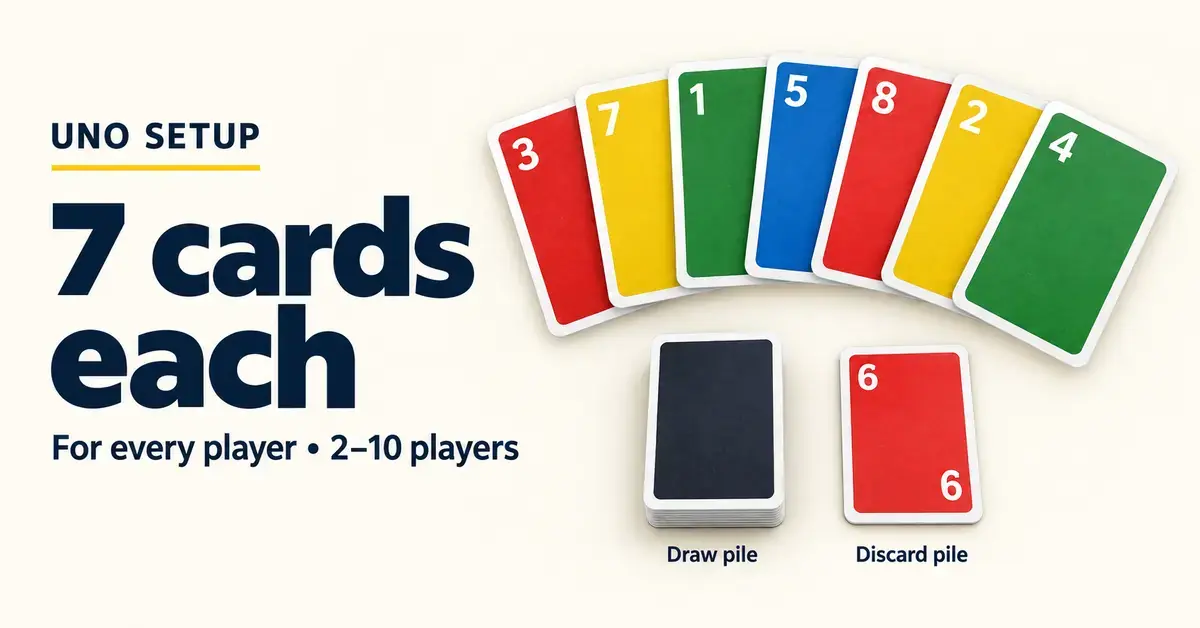
- The dealer shuffles and deals 7 cards face-down to each player.
- Put the rest of the deck face-down in the draw slot, then turn the top card face-up into the discard slot to start play.
The player to the dealer's left goes first and play proceeds clockwise. If the first card turned up is an action card, its normal effect applies to the first player; a Grab-2-Towers starting card only matches by colour and grabs nothing, a Wild Grab-A-Tower lets the first player choose the colour but grabs nothing, and a Wild Draw Four is returned to the deck and a new card is drawn. These rules mirror the way the standard game handles special starting cards, which you can read more about in our guide to the core UNO mechanics.
How a Turn Works
On your turn you play one card that matches the top of the discard pile by colour, by number, or (for action cards) by symbol. If you cannot or do not want to play, you draw one card from the pile; you may play that card immediately if it matches, or keep it and pass. Action cards resolve the same way they do in regular UNO — a Skip loses the next player their turn, a Reverse flips the direction, and the Draw cards force the next player to pick up and miss a turn.
The Wild Draw Four carries the same legal-play restriction as in standard UNO: you may only play it when you have no card matching the current colour, and an opponent can challenge you if they suspect a bluff. If you want the full detail on when it is legal and what a challenge costs, see our explainer on the Wild Draw Four rules.
Grabbing Towers and the "Instant UNO"
Towers move around the table through three kinds of cards:
- Power Icon cards: ordinary number cards that carry a U, N, O or ! symbol. They match only by number or colour (never by the symbol). When you play one, you take the tower whose symbol matches the card from another player. The card's colour does not have to match the tower's colour.
- Grab-2-Towers: lets you take any two towers at once, from other players or from the unclaimed towers beside the tray. It can only be played on another Grab-2-Towers card or on a card of the same colour.
- Wild Grab-A-Tower: lets you take any one tower from anywhere and choose the next colour. It has no play restriction and can be played on your turn at any time.
The most powerful move in the game is collecting all four towers. The moment you hold U, N, O and ! together, you may trigger an Instant UNO: discard your entire hand except one card, call "UNO", and then return all four towers to their place beside the tray. It is the fastest route to winning a round, which is exactly why other players will fight to take a tower off you before you can complete the set.
Scoring and Winning
A round ends the moment one player plays their last card. That player scores points for every card still held in the other players' hands, and points build up over several rounds. The first player to reach 500 points wins the match, though groups can agree on a different target. Mattel also offers an alternative where you keep a running total for each player and, once anyone hits 500, the player with the lowest score wins.
| Card | Points |
|---|---|
| Number cards 1–9 | Face value |
| Draw One, Draw Two, Skip, Reverse, Grab-2-Towers | 20 each |
| Wild Grab-A-Tower, Wild Draw Four | 50 each |
Because Wild and grab cards are the most expensive to be caught holding, it pays to play them before an opponent looks ready to go out. If you would like the broader picture of how points are tallied across editions, our guide on how UNO scoring works covers the standard system in detail.
Saying "UNO" and the Penalty
The signature rule still applies: when you play your second-to-last card and are down to one card, you must call "UNO". If another player catches you before the next player takes their turn, you draw two cards as a penalty. Holding a tower does not protect you here — towers only cancel action cards played against you, not penalties you incur by breaking a rule. A final Draw One, Draw Two or Wild Draw Four still forces the next player to pick up, and those cards still count toward scoring. For more on the timing and the common myths around it, see what happens when you forget to say UNO.
Playing With Two Players
UNO Power Grab is tense and fast in a two-player game. As in standard UNO, the Reverse card acts like a Skip, so playing one gives you another turn immediately. That opens up strong combinations — for example grabbing a tower and then taking a second turn before your opponent can respond. With only one rival to take towers from, the power swings are sharper, and holding the right defensive tower at the right moment can shut down half of your opponent's attacking cards. Many two-player groups play to a lower target, such as 250 points, to keep matches short.
Common Mistakes and Clarifications
- Towers are not multi-use powers. Each tower blocks only its one matching card (U–Draw One, N–Draw Two, O–Wild Draw Four, !–Skip). They do not let you peek at hands or draw extra cards.
- Power Icon cards match on number or colour, not the symbol. You play them like any number card; the symbol only decides which tower you grab.
- Grab-2-Towers has a play restriction. It can only follow another Grab-2-Towers card or a card of the same colour, while Wild Grab-A-Tower can be played freely.
- Instant UNO returns the towers. After emptying your hand to one card, the four towers go back beside the tray — you do not keep them.
- There is no zero card. Number cards run 1 to 9 only.
How It Compares to Other UNO Editions
Power Grab sits alongside several other physical-component UNO editions. Like UNO Attack, it uses a central device — here a simple tray rather than a card launcher — to add a tactile twist to the standard game. If you enjoy editions that bolt new mechanics onto the classic deck, our overview of UNO gameplay variations compares the main twists, from Flip to No Mercy, so you can pick the version that suits your group. At its core, though, Power Grab is still UNO: match a card, manage your hand, and remember to call it when you are down to one.
Sources
Frequently Asked Questions (FAQ)
What do the Power Towers actually do in UNO Power Grab?
Each tower cancels one action card played against its holder: U blocks Draw One, N blocks Draw Two, O blocks Wild Draw Four and ! blocks Skip. That is their only function — they do not grant any offensive or hand-viewing ability.
How do you grab a tower from another player?
Play a Power Icon number card and take the tower whose symbol matches it, or play a Grab-2-Towers card to take any two towers, or a Wild Grab-A-Tower to take one tower from anywhere. Towers can be taken from other players or from the unclaimed set beside the tray.
What happens if you collect all four towers?
You may trigger an Instant UNO: discard your whole hand except one card and call "UNO". You then return all four towers to their place beside the play tray, so they become available to grab again.
How many cards are in UNO Power Grab and is there a zero?
The deck has 112 cards. Number cards run from 1 to 9 with two of each per colour, so there is no zero card. The set also includes Draw One, Draw Two, Skip, Reverse, Grab-2-Towers, Wild Grab-A-Tower and Wild Draw Four cards, plus four Power Towers and a play tray.
How do you win a match of UNO Power Grab?
You score points for the cards left in opponents' hands each time you empty your hand first. Points carry over between rounds, and the first player to reach 500 points wins the match, unless the group agrees on a different target.