The number of people at the table changes how a game of UNO feels far more than most players expect. The official rules stay the same whether three, five or seven people sit down, but odd-numbered groups shift the pace of play, the value of action cards and the speed at which the draw pile empties. This guide explains what actually changes with uneven player counts, what stays fixed by the official Mattel rules, and how to keep an odd-numbered game fair and enjoyable.
Key Points
- UNO’s official rules are identical for 2–10 players: deal seven cards each from the 108-card deck.
- Uneven counts change tempo and card value, not the rulebook.
- In a three-player game the Reverse card behaves almost like a Skip.
- More players means the draw pile empties faster and needs reshuffling more often.
- Adjusted win thresholds, stacking and hand caps are house rules, not official rules.
What stays the same when the player count is odd
A common myth is that odd numbers force you to change the setup. They do not. The classic UNO deck has 108 cards, the game is designed for 2 to 10 players, and every player is dealt exactly seven cards no matter how many are playing. The top card of the remaining deck is turned over to start the discard pile, and the player to the left of the dealer takes the first turn. Scoring also stays the same: the first player (or team) to reach 500 points wins the match. If you want a refresher on the basics, our definitive guide to the official UNO rules covers the full setup.
- Deck: 108 cards, dealt seven to each player.
- Player range: 2 to 10 people are officially supported.
- First turn: always the player to the left of the dealer.
- Winning: the first to 500 points ends the match.
What genuinely changes with an uneven count is not the rulebook but the experience — how quickly your turn comes around, how much of the deck is hidden in hands, and how strongly a single action card swings the round.
How the deck stretches across 3, 5 and 7 players
Because everyone gets seven cards, the number of cards removed from the draw pile at the deal grows with each extra player. With three players, only 21 cards are in hands and 87 remain in the draw pile; with seven players, 49 cards are dealt and just 59 are left. That single difference explains most of what feels different at each table size.
| Players | Cards dealt (7 each) | Cards left in draw pile | Practical effect |
|---|---|---|---|
| 3 | 21 | 87 | Long-lasting draw pile; slow, controllable rounds |
| 5 | 35 | 73 | Balanced pace; steady flow of action cards |
| 7 | 49 | 59 | Draw pile empties fast; frequent reshuffling |
The more players you add, the sooner you will need to reshuffle the discard pile back into a new draw pile — see the section on running out of cards below.
Reverse and Skip in a three-player game
Three players is where an action card feels most different from the four-player norm. In a larger game, the Reverse card simply flips the direction of play. In a three-player game it behaves almost like a Skip: play bounces straight back past the middle player to the person who last went, so that player effectively loses their upcoming turn. Two players can even trade Reverses back and forth, which keeps the third player waiting longer between turns.
Avoiding a three-player freeze-out
Using Reverse repeatedly to keep one person from playing is legal, but it can sour a friendly game, so many groups treat it as a courtesy not to overdo it. Tactically, though, reversing away from a player who has called “UNO” is a fair and sensible defensive move — you are simply delaying the turn of the person closest to winning.
Five players: the balanced middle ground
Many players find five to be the most enjoyable odd count. There are enough hands in play to keep colours varied and to make bluffing worthwhile, but not so many that rounds drag. A single Skip only removes one of four opponents from your immediate path, so power cards feel less decisive than in a three-player game and timing them matters more. With five hands on the table, the odds that someone can match the current colour are high, so play tends to move at a brisk, steady tempo.
Seven players and a shrinking draw pile
With seven players, you are near the practical limit of a single deck. Nearly half the deck is hidden in hands from the very first turn, which makes tracking cards almost impossible and gives every draw more weight. Rounds run longer, more penalty cards are in circulation, and you are far more likely to be hit by a Draw Two or Wild Draw Four before your next turn comes around.
Reshuffling when the draw pile runs out
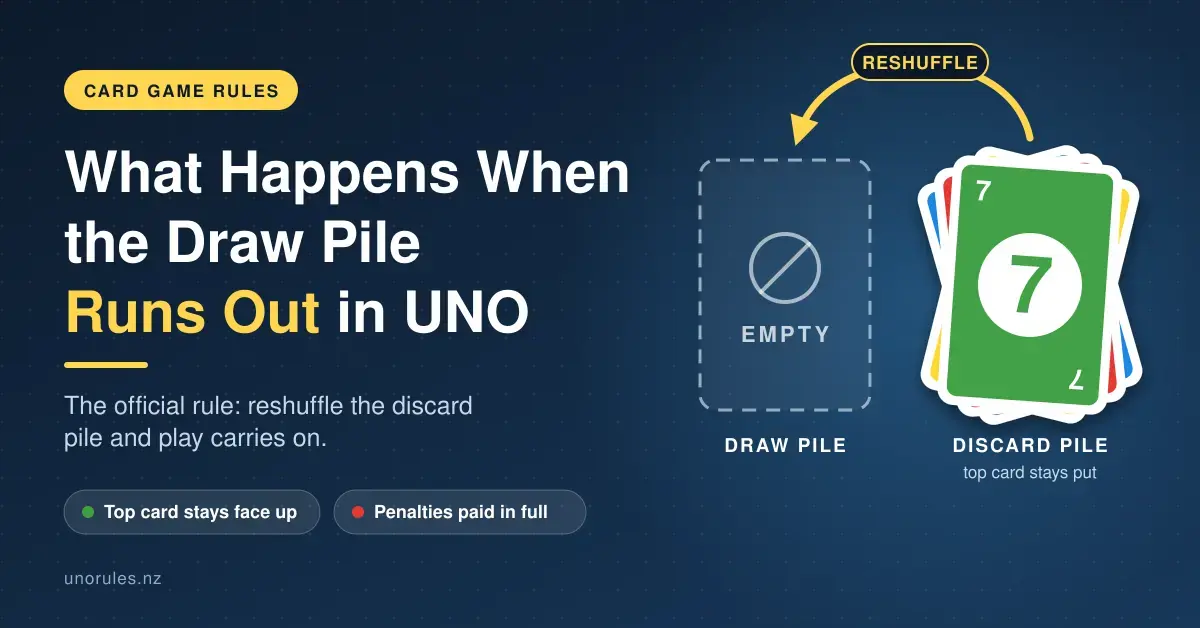
The official fix is simple and applies at any player count: when the draw pile is exhausted, set aside the top card of the discard pile, shuffle the rest, and turn it face down as the new draw pile. At seven players you may do this several times in a single round, so it helps to keep the discard pile tidy. Our guide on what happens when the draw pile runs out walks through the procedure in detail.
Scoring across different player counts
Official UNO is played to 500 points, with the round winner scoring the value of every card still held by their opponents. That total naturally grows with the number of players, so a single win in a seven-player round can be worth far more than one in a three-player round. Some groups adjust the target — for example, a lower threshold for a quick three-player game or a higher one for a big group — but these are optional house rules, not part of the official system. For the exact card values, see how scoring works in UNO.
Wild Swap Hands and Wild Shuffle Hands in bigger groups
Modern UNO decks made since 2018 contain 112 cards, adding either a Wild Swap Hands card or a Wild Shuffle Hands card plus three blank customisable Wild cards. The Swap Hands card lets you change the colour and exchange your entire hand with one player of your choice; the Shuffle Hands card gathers every hand, shuffles them and redistributes the cards. In an uneven game these cards scale in impact: with three players a swap is nearly a coin flip between two opponents, while with seven you can pick from six hands and effectively steal a win from someone about to go out. If you own a classic 108-card deck, you will not have either card at all.
Keeping turn order clear in odd-numbered games
In four-player games people naturally remember who sits opposite them, but in five- or seven-player rotations there are no tidy pairs, and a run of Reverses and Skips can leave the table unsure whose turn it is. A few simple habits keep things moving: play your card face up where everyone can see it, say the active colour out loud, and use a small token to mark the current direction of play if arguments start.
Stacking and house rules for uneven groups
Under the official rules you cannot “stack” a Draw Two on a Draw Two to pass the penalty along — the targeted player simply draws and forfeits their turn. Many households allow stacking anyway, and in an uneven game it can be brutal: in a three-player game an unlucky player may draw four or more cards and sit out a large chunk of the round. If you enjoy stacking, agreeing a cap (say, a maximum of +6) keeps it competitive rather than punishing. Our explainer on whether stacking is allowed in official UNO rules lays out both versions. As an aside, UNO’s counting theme has even reached pop culture — the Spanish words uno, dos and tré inspired a Green Day album trilogy, as documented on Wikipedia.
A quick comparison by player count
The table below summarises how the three most common odd counts differ so you can set expectations before you deal. It works whether you are hosting a family night or a larger group get-together.
Player Count Comparison
| Player count | Cards dealt | Draw pile at start | What changes most | Suggested feel |
|---|---|---|---|---|
| 3 players | 21 (7 each) | 87 cards | Reverse acts like a Skip; turns come around fast | Controlled and tactical |
| 5 players | 35 (7 each) | 73 cards | Balanced action; more hands to read and bluff against | Brisk and varied |
| 7 players | 49 (7 each) | 59 cards | Frequent reshuffles; higher round scores; longer games | Chaotic party pace |
Sources
Frequently Asked Questions
How many cards do you deal in UNO with an odd number of players?
Exactly seven cards to each player, the same as any other game. The player count does not change the deal; it only changes how many cards remain in the draw pile afterwards.
Does the Reverse card work differently with three players?
Yes. With three players the Reverse card behaves almost like a Skip: play returns to the person who went before you, so the middle player misses their upcoming turn rather than the direction simply flipping around a larger circle.
What is the best number of players for UNO?
Officially any number from 2 to 10 works. Many players find four or five the most balanced, as there are enough hands to keep the game varied without rounds becoming long or the draw pile emptying too quickly.
What happens when the draw pile runs out with lots of players?
Set the top card of the discard pile aside, shuffle the remaining discards, and place them face down as a new draw pile. With six or seven players you may need to do this more than once per round.
Can you play UNO with just two players?
Yes. The setup is identical, but under the official two-player rules the Reverse card acts as a Skip, so playing one gives you an immediate second turn.