UNO’s official rulebook explains how to win, how the action cards work and how to score a round — but it says nothing about what to do when someone gets up and leaves before the hand is over. Because there is no official Mattel ruling on a mid-game exit, the table itself decides how to handle it. This guide walks through the fair, practical options: what to do with the leaver’s cards, how turn order and any pending action cards resolve, how the exit affects scoring, what changes if only two players remain, and when it is simply better to reshuffle and start again.
Key Points
- No official rule: UNO’s printed rules do not cover a player quitting mid-game — the table decides.
- The cards: shuffle the leaver’s hand back into the draw pile to keep the deck complete, or set it aside in a casual game.
- Turn order: play continues in the same direction to the next active player.
- Pending action cards: a Skip or Draw Two aimed at the leaver is usually voided or passed to the next active player — agree which.
- Scoring: finish and score the remaining hands normally; any penalty for the person who left is a house rule, not an official ‘forfeit score’.
- Down to two: official two-player rules kick in — Reverse acts as Skip, and Skip or Draw Two returns the turn to you.
Does UNO have an official rule for quitting?
No. The published Mattel rules cover gameplay, action cards and scoring, but they do not address a player leaving partway through a round. That means every question below is a house-rule decision — an agreement the players make at the table rather than a printed rule. The cleanest way to avoid arguments is to settle a couple of these points before you deal, especially if you are playing a long, points-based match. If you want to compare printed rules with common table variations, see the site’s overview of UNO house rules.
What to do with the leaver’s hand
The first practical question is what happens to the physical cards the departing player was holding. Those cards are part of the deck, and some of them may be Wild or Draw Four cards that other players still need. There are two common approaches, and neither is ‘official’ — pick one and apply it consistently.
- Shuffle the cards back into the draw pile. This keeps the deck complete so no colour or action card is permanently missing. It is especially helpful in a long game, because a fuller draw pile means you are less likely to run short.
- Set the hand aside. In a quick, casual game some groups simply remove the cards. This is faster, but it thins the deck and can make certain cards scarce for the rest of the round.
| Option | What you do | Trade-off |
|---|---|---|
| Recycle | Shuffle the hand back into the draw pile | Keeps every card in play; best for long games |
| Remove | Set the hand aside for the rest of the round | Faster, but reduces card variety in the deck |
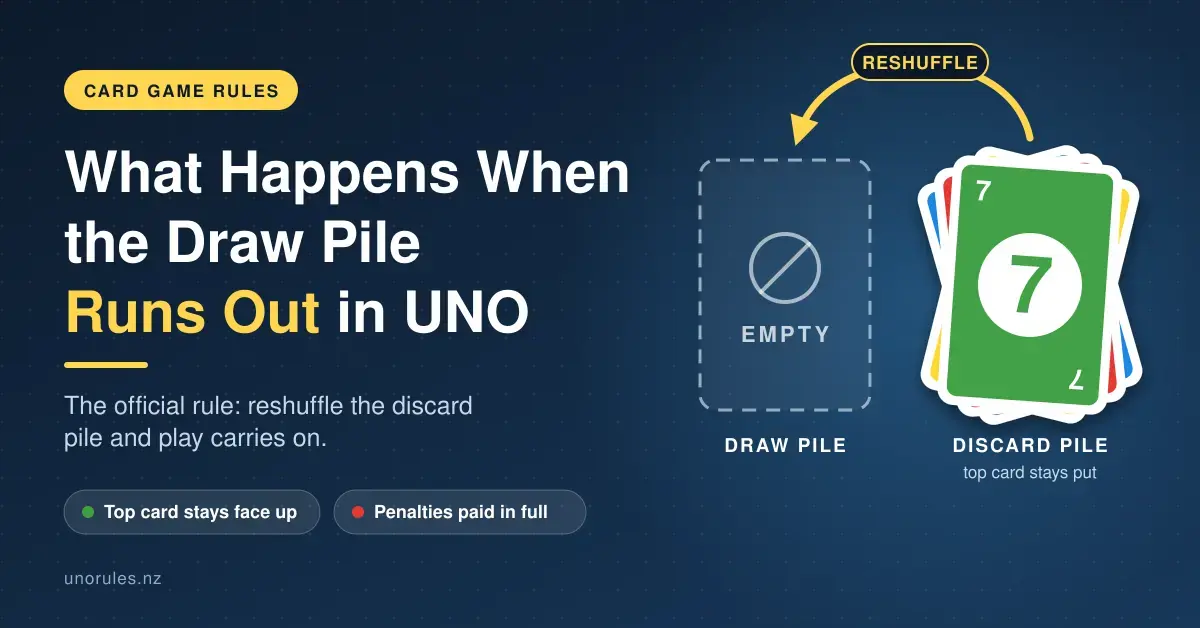
If you recycle the cards and the draw pile later empties anyway, fall back on the standard rule for when the draw pile runs out: shuffle the discard pile (leaving the current top card in place) to form a fresh draw pile.
Turn order and pending action cards
UNO moves in a set direction, so when a seat empties the turn simply passes to the next active player in that direction — the person who would have gone after the leaver now takes their turn as normal. Keep the direction of play the same; nothing about an exit reverses it.
The trickier case is an action card aimed at the player who just left — for example a Skip, a Draw Two card or a Wild Draw Four that was about to hit them. Again, there is no official ruling, so agree on one of these before you continue:
- Void the effect. The card’s penalty disappears because its target is gone, and play carries on from the next active player. This is the simplest option.
- Pass it to the next active player. The penalty rolls onto whoever is next in line, so the card still ‘does something’. This keeps the stakes up but can feel harsh on an innocent player.
Whichever you choose, state it out loud so everyone continues from the same understanding.
How a mid-game exit affects scoring
UNO’s scoring is straightforward: when a player goes out, the winner scores the value of the cards still held by everyone else. Number cards count their face value, the action cards (Skip, Reverse and Draw Two) count 20 each, and Wild and Wild Draw Four cards count 50 each. In a full match, the first player to reach 500 points wins. For a full breakdown, see how scoring works in UNO.
A mid-round exit creates a gap because the leaver never had their hand counted. How you handle it is entirely a house choice — there is no official ‘forfeit score’:
- Ignore the leaver’s hand. Finish the round and score only the cards still held by the players who stayed. Simple and fair when someone leaves for a genuine reason.
- Count their hand to the winner. If you want the departure recorded, some groups add the value of the leaver’s cards to whoever wins the round, using the same face-value / 20 / 50 scale.
- Redeal. If the exit happens in the opening turns, it is usually fairest to reshuffle and start the round again (see below).
Assigning a fixed penalty such as 500 points to the person who left is sometimes done to discourage quitting while losing, but it is a table agreement, not a printed rule — decide it up front rather than inventing it mid-argument.
When only two players remain
If enough people leave that only two players are left, the game becomes a duel, and UNO’s official two-player rules change how the action cards behave. This shift is real (not a house rule), so apply it straight away.
Two-Player Rules
| Card | Effect with three or more players | Effect once only two players remain |
|---|---|---|
| Reverse | Changes the direction of play | Acts like a Skip — the turn comes back to you |
| Skip | Skips the next player | Your opponent is skipped, so you play again immediately |
| Draw Two | Next player draws two and misses their turn | Opponent draws two and misses their turn, then play returns to you |
The short version: Reverse behaves like a Skip and sends the turn back to you, a Skip lets you play again immediately, and after you play a Draw Two your opponent draws two cards and misses their turn, so play returns to you. If your group often ends up head-to-head, the guide to card games for two players covers the format in more depth.
Leaving gracefully: table etiquette
Most exits are harmless — someone has an early start, a lift arrives, or life gets in the way. A little courtesy keeps the night friendly:
- Flag a stop time before dealing. If you know you have to leave by a certain point, say so up front so the group can plan the match length.
- Treat emergencies as no-fault. If someone has to go suddenly, void their hand and carry on for fun rather than penalising them.
- Avoid rage-quitting. Walking out purely because you are losing is what sours a game night; agree in advance how a loss is scored so no one is tempted to bail.
House rules also tend to be informal and specific to each group — a bit like the saying that Wikipedia records, whatever you agree at your table stays at your table. The point is simply that everyone knows the plan before play starts.
When to reset instead of continuing
Sometimes an exit breaks the round rather than just interrupting it — for instance if it happens on the first few turns, or if the person who owned the cards is the one leaving. In those cases a clean redeal is usually the fairest fix.
- Redeal from scratch. Reshuffle the full deck and deal seven cards to each remaining player to reset the balance.
- Record the round as incomplete. If you stop rather than replay, agree not to award the round to anyone.
- Get consensus. The choice to continue, redeal or stop should be one everyone at the table is happy with.
Deciding how to redeal also depends on how many players you have left; the guide to uneven player counts is useful once your group size changes.
Sources
Frequently Asked Questions (FAQ)
Does UNO have an official rule for a player quitting mid-game?
No. Mattel’s published rules do not cover a player leaving partway through a round, so how you handle it is a house-rule decision the table agrees on.
What should we do with the cards the player leaves behind?
The most common approach is to shuffle them back into the draw pile so the deck stays complete. In a quick, casual game you can set them aside instead if everyone agrees it will not affect the outcome.
What happens to a Skip or Draw Two that was aimed at the player who left?
There is no official ruling. Most groups either void the effect, or pass it to the next active player — agree which before play continues so everyone is on the same page.
How do we score a hand that ends after someone leaves?
Score it normally by the cards still held in the remaining hands (face value for numbers, 20 for action cards, 50 for Wilds). There is no official forfeit score, so any penalty for the person who left is a house rule you set in advance.
What changes when only two players are left?
Official two-player rules apply: Reverse acts like a Skip, playing a Skip lets you go again, and after a Draw Two your opponent draws two cards and misses their turn, so play returns to you.