Basic UNO rule sheets cover the number cards, Skip, Reverse, Draw Two and the two Wilds — but modern retail decks and spin-offs such as UNO All Wild and UNO Show ‘Em No Mercy add special cards that those summaries skip entirely. This guide explains the cards experienced players actually run into: the Wild Shuffle Hands and Customizable Wilds in today’s standard deck, the popular 7-0 house rule, and the powerful action cards in the All Wild and No Mercy editions. For each one you get the verified rule, its correct point value, which deck it belongs to, and how it changes the way a round plays out.
Key Points
- Modern deck: Since 2018 the standard retail deck holds 112 cards — the classic 108 plus one Wild Shuffle Hands and three Customizable Wilds.
- Correct values: Shuffle Hands and each Customizable Wild are worth 40 points, not 50.
- 7-0 is a house rule: Optional on standard decks; built in to UNO Show ‘Em No Mercy.
- Editions differ: UNO All Wild has all-Wild cards and no stacking; No Mercy uses a 168-card deck with stacking and a 25-card knockout rule.
- Golden habit: Read the instruction sheet in your box and agree on any optional cards before the first deal.
What changed in the modern UNO deck
The original 1971 deck holds 108 cards: 25 in each of four colours plus four Wild and four Wild Draw Four cards. Since 2018, standard retail decks ship with 112 cards — the same 108 plus one Wild Shuffle Hands card and three blank Customizable Wild cards. Because the extra cards have changed over the years, the most reliable move is always to read the instruction sheet inside your specific box. If you want a refresher on how every card is tallied at the end of a hand, our guide to how scoring works in UNO covers the point system these values feed into.
The Wild Shuffle Hands card
The Wild Shuffle Hands card resets the state of the whole table. When you play it, you collect every card from every player’s hand, shuffle them together, and re-deal them one at a time starting with the player to your left. It is a Wild, so you also choose the colour that play resumes on. It replaced the older Wild Swap Hands card around 2017 and is worth 40 points if it is left in an opponent’s hand at the end of a round.
When to play Shuffle Hands
Because a re-deal wipes out any lead, the card is most valuable when you are holding a large, high-point hand and an opponent is close to going out. Shuffling forces that leader to take fresh cards while cutting your own point liability. If Shuffle Hands is your very last card, treat it like a normal Wild and use it to end the round — receiving a new hand from everyone else would only put you back in the game.
Customizable (blank) Wild cards
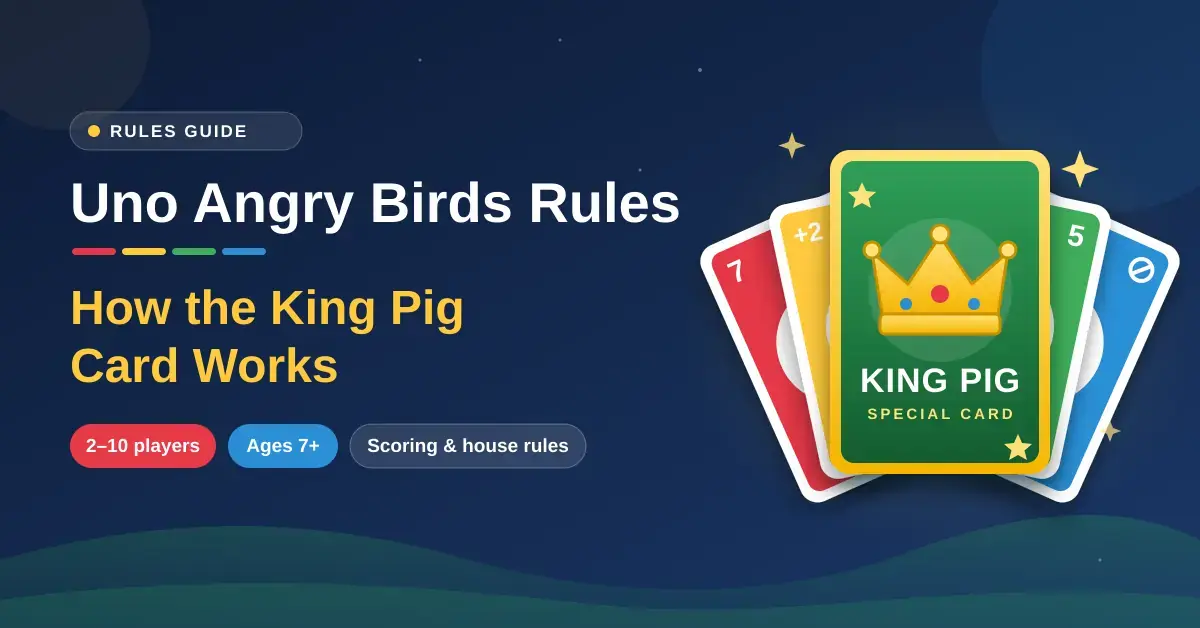
The three blank Customizable Wild cards let a group write its own house rule on the card in pencil. When the card is played, that written effect happens and the player also chooses the next colour, exactly like a normal Wild. Everyone should agree on the effect — and on how many of the three cards are in play — before the first deal. Each Customizable Wild is worth 40 points, and if a card is left blank it simply acts as a standard Wild.
Keeping custom rules fair
A good custom rule shifts the tactical picture without handing anyone an instant win. Popular examples include “everyone draws until they hold five cards” or “the next penalty card does not affect you.” Avoid anything that ends the game outright, and write the rule clearly so there is no mid-round argument. For more ideas on balancing added effects, see our rundown of common UNO house rules.
The 7-0 rule: swapping and passing hands
The 7-0 rule is one of the best-known variations, but it is a house rule, not part of the official rulebook. Under it, whenever a 7 is played the player who played it swaps their entire hand with a player of their choice, and whenever a 0 is played every player passes their whole hand to the next player in the current direction of play. Mattel lists it as a suggested optional rule and builds it directly into UNO Show ‘Em No Mercy, but on a standard deck you should agree to use it before the game starts. The 7 and 0 keep their normal face values (7 and 0 points) for scoring.
The 7-0 scoring trap
With this rule active, a fat hand of high-value cards is a liability that can be dumped onto you at any moment. You might be lining up a 7 to hand off your heavy cards, only for another player to drop a 0 first and rotate a worse hand into your seat. Track roughly how good each hand is as it moves around the table, and do not sit on a Wild Draw Four longer than you have to.
UNO All Wild: when every card bends the rules
In UNO All Wild, the 112-card deck contains only Wild cards, so colour matching does not exist — any card can be played on any other. Regular Wilds are worth 20 points, while the special Wild action cards are worth 50 points each. Two of those specials, the Wild Reverse and the Wild Skip, work like their classic counterparts but can be dropped at any time; the Wild Skip Two skips the next two players instead of one. Note that stacking is not allowed in this edition — if a Wild Draw Two is played on you, you draw and lose your turn rather than passing the penalty along. For the wider family of Wilds, our UNO Wild card rules guide gives the full picture.
Wild Targeted Draw Two
The Wild Targeted Draw Two lets you choose any player at the table — not just the next one — to draw two cards. That freedom adds a political layer: in a larger game you can reach across the table to load cards onto whoever is closest to going out or holds the highest running score, rather than being stuck penalising your left-hand neighbour.
Wild Forced Swap
The Wild Forced Swap makes two players trade their entire hands, and the person playing it picks which two (they can include themselves). It is a mid-round rescue or sabotage tool: you can pull yourself out of a bad hand, or force a struggling opponent to take on a leader’s slim hand. The only real defence is to go out before someone can play it.
UNO Show ‘Em No Mercy: Skip Everyone and Discard All
UNO Show ‘Em No Mercy uses a larger 168-card deck and leans on high-impact colours. Two coloured action cards stand out. Skip Everyone skips every other player and hands you an immediate second turn — brutal at a full table. Discard All lets you play the card and then immediately discard every remaining card in your hand that matches its colour, so a monochrome hand can vanish in one move. This edition also stacks draw penalties (Draw Two, Four, Six and Ten can be piled up and passed on) and enforces the Mercy Rule: any player whose hand reaches 25 or more cards is knocked out of the game. Scoring here runs on elimination rather than the classic 500-point race, so treat the point values below as the standard-scoring reference.
Card Comparison
| Card | Edition / deck | Effect | Points |
|---|---|---|---|
| Wild Shuffle Hands | Standard 112-card deck | Collect, shuffle and re-deal every hand; choose the next colour | 40 |
| Customizable Wild (blank) | Standard 112-card deck | Applies the house rule written on it; choose the next colour | 40 |
| Wild Targeted Draw Two | UNO All Wild | Any chosen player draws two cards | 50 |
| Wild Forced Swap | UNO All Wild | Two chosen players trade entire hands | 50 |
| Skip Everyone | UNO Show ‘Em No Mercy | Skips all other players; you take another turn | 20 (colour action) |
| Discard All | UNO Show ‘Em No Mercy | Discard all cards matching the played card’s colour | 20 (colour action) |
Setting up a Discard All
Because Discard All only clears cards of its own colour, its payoff scales with how one-sided your hand is. Advanced players will sometimes draw voluntarily, or hold back off-colour plays, to build toward a single dominant colour before dropping the Discard All to empty most of their hand at once. Remember you must still call “UNO” the moment a play leaves you with one card.
Common mistakes with special cards
- Assuming a value: Shuffle Hands and Customizable Wilds are 40 points, not 50 — check your instruction sheet rather than guessing.
- Treating 7-0 as official: it is a house rule outside of No Mercy, so agree on it before dealing.
- Trying to stack in the wrong edition: UNO All Wild does not allow stacking, while No Mercy does.
- Leaving Customizable Wilds undefined: with no rule written, they are just ordinary 50-point-equivalent Wilds and waste their potential.
- Forgetting to call UNO after a big clear: a Discard All or a long combo still leaves you on one card, and the penalty applies.
Who these cards suit
If you mostly play the classic 108- or 112-card deck, the cards worth mastering are Shuffle Hands, the Customizable Wilds and the optional 7-0 rule. Players moving into spin-offs will meet a far wider action set — the all-Wild specials in UNO All Wild, or the stacking draws and elimination pressure of No Mercy. Either way, the winning habit is the same: know exactly what each card does before you sit down, since ambiguity is what turns a friendly round into an argument. For deeper tactics once the rules are clear, our advanced UNO strategy guide builds on these foundations, and if you enjoy the terminology of card games in general, Wikipedia keeps a broad glossary of the terms used across the hobby.
Sources
Ngā Pātai Auau (FAQ)
How many points is a Wild Shuffle Hands card worth?
It is worth 40 points if it is still in a player’s hand when a round ends. Some older summaries list 50, but current Mattel decks value it at 40.
Is the 7-0 rule an official UNO rule?
No. It is a suggested house rule on standard decks, so players should agree to use it before the game begins. It is, however, built into UNO Show ‘Em No Mercy.
What does the Discard All card do?
Found in UNO Show ‘Em No Mercy, it lets you play the card and then immediately discard every other card in your hand that matches its colour.
Can you stack draw cards in UNO All Wild?
No. Stacking is not allowed in UNO All Wild, so a Wild Draw Two means you draw two and lose your turn. Stacking is allowed in UNO Show ‘Em No Mercy instead.
What happens if a Customizable Wild is left blank?
With no rule written on it, it simply acts as a standard Wild card: you play it and choose the next colour, and it is scored the same way.