Some games stay popular because they ask so little to get going. Crazy Eights is one of them: you need a single deck of cards, two or more players, and about a minute to explain the rules. The game moves quickly, keeps everyone involved, and works just as well for a family table as for a quiet evening with one other person. This guide walks through everything from dealing the first hand to scoring, strategy and the best-known variations.
What is Crazy Eights?
Crazy Eights is a “shedding” card game, which simply means the goal is to be the first player to get rid of every card in your hand. On each turn you play a card that matches the top card of the discard pile by either suit or rank. The twist is the number eight: every eight is a wild card that lets you change the suit in play to whatever you choose. Because there is no betting involved, Crazy Eights is not linked to gambling, which makes it a relaxed, family-friendly choice and a natural fit for safer play at mixed-age tables.
If you have ever played UNO, the flow will feel familiar — and that is no accident, as the next section explains.
Key Facts
| Players | 2–8 (best with 2–5) |
|---|---|
| Deck | One standard 52-card deck; two decks for 6+ players |
| Cards dealt | 7 each for 2 players; 5 each for 3+ players |
| Goal | Be the first to play all the cards in your hand |
| Wild card | Every eight — play it on anything and name a new suit |
| Typical game length | 5–15 minutes per hand |
| Recommended age | 6 and up |
| Game type | Shedding / matching card game (no betting) |
A short history of the game
Crazy Eights first appeared under the plain name “Eights” in the United States in the 1930s. The livelier name “Crazy Eights” caught on in the 1940s, borrowed from the US Army’s “Section 8” discharge for soldiers deemed unfit for service. The game itself is thought to descend from the German family of matching games known as Mau-Mau.
Its biggest legacy is UNO. In 1971 a barber named Merle Robbins created UNO to settle an argument with his son over how Crazy Eights should be played. His idea was to print each card’s special power directly on the card, so the rules could not be disputed. UNO went on to sell hundreds of millions of decks, but the wild-card idea at its heart came straight from the humble eight. You can read more about how classic card games still inspire modern gaming.
What you need and how to deal
Crazy Eights suits two to eight players and uses one standard 52-card deck. If you have more than about five players, shuffle two decks together so the draw pile does not run dry too quickly. Setting up takes three steps:
- Deal the hands. With two players, deal seven cards each. With three or more players, deal five cards each.
- Make the stockpile. Place the rest of the deck face down in the middle as the draw pile (the “stock”).
- Start the discard pile. Turn the top card of the stock face up beside it. If that first card is an eight, slide it back into the deck and flip another card, so the wild rule does not trigger before anyone has taken a turn.
Crazy Eights is one of the more approachable card games for two players, but it scales comfortably up to a full table.
How to play, turn by turn
Play starts with the person to the dealer’s left and moves clockwise. On your turn you must play one card that matches the top of the discard pile by suit or rank. For example, if the top card is the seven of hearts, you may play any heart or any seven.
If you cannot match, draw cards from the stock one at a time until you find a playable card, then play it. Some tables cap this at drawing a set number (often one or three) before your turn simply passes. The hand ends the instant one player lays down their final card.
Playing an eight (the wild card)
An eight can be played on top of any card, whatever the current suit. When you play one, you name any suit you like — hearts, clubs, diamonds or spades. The next player must then follow that named suit or play an eight of their own. Because an eight goes on anything, it can also be the very last card you play to end the hand.
When the stock runs out
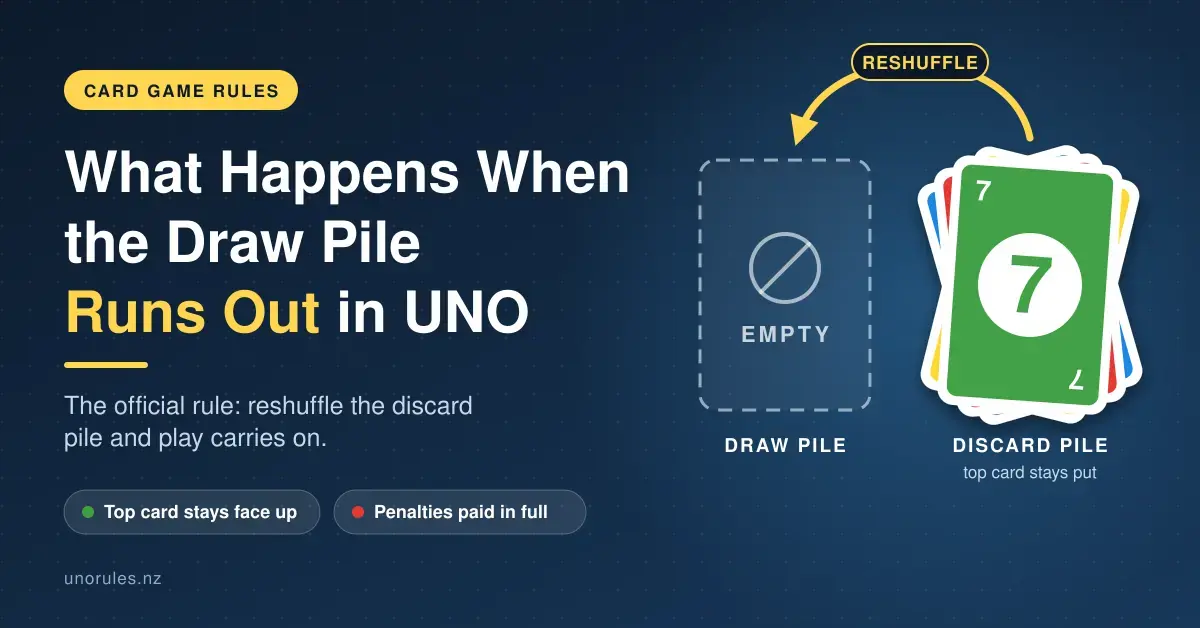
If the draw pile is used up before anyone wins, take the discard pile, leave its top card in place, shuffle the rest, and turn it face down to form a fresh stock. Play then continues as normal.
Scoring and winning
Many casual games end after a single hand, with everyone cheering the first player to empty their hand. For longer sessions, add scoring. When a hand ends, the winner scores nothing, and every other player counts the cards still in their hand against themselves:
- Each eight is worth 50 points.
- Each face card (king, queen or jack) is worth 10 points.
- Each ace is worth 1 point.
- All other cards score their face value (a seven is worth 7, and so on).
Keep a running tally across hands. A common format plays to a target such as 100 points: once a player reaches it, the game ends, and the person with the lowest total wins the session. Scoring this way rewards steady, careful play over lucky bursts. If you enjoy the maths, our guide to how scoring works in UNO shows how the same idea powers its close cousin.
Strategy tips for winning
Crazy Eights rewards a little planning. These habits will win you more hands without slowing the game down.
Save your eights
An eight is your most flexible card, so playing one early usually wastes it. Hold at least one back to break out of a suit you cannot match, or to switch to a suit your rivals are unlikely to hold.
Track the suits in play
Watch the discard pile. If hearts keep appearing, other players may be short on a different suit — steer the game toward the suit they lack to force them to draw.
Shed high cards early
Face cards cost 10 points each if you are caught holding them, so play kings, queens and jacks while you still have easy chances. The same goes for any leftover eight, which stings for a full 50 points.
Keep an escape route
A hand loaded with a single suit looks strong until someone switches suits on you. Try to keep at least one off-suit card in reserve so you are never forced to draw at the wrong moment.
Common mistakes to avoid
- Dumping all your eights at once. Once your wild cards are gone, you have nothing left to escape an awkward suit.
- Sitting on face cards. Kings, queens and jacks each cost 10 points if the hand ends while they are in your hand.
- Drawing when you could play. Extra cards mean more potential points against you, so play a legal card rather than fishing for a “better” one.
- Ignoring the next player. If the player after you is close to winning, switch to a suit they are unlikely to hold instead of one that helps them.
Popular variations
Crazy Eights has spawned dozens of house rules, and many families mix their own. A few of the best-known:
- Crazy Eights Countdown. A scoring version where each player starts at a score of 8 and subtracts 1 for every round won; the first to reach zero wins. As the count drops, the designated wild card changes from the eight down through the ranks toward the ace.
- Switch and Mau-Mau. Close relatives played in Britain (Switch) and Germany and central Europe (Mau-Mau). They keep the match-or-draw core but add extra card powers on top.
- Optional card powers. Many tables give certain ranks special effects, much as UNO does — for instance a two that forces the next player to draw two, or a queen that skips a turn. These are house rules rather than the standard game, so agree on them before you deal.
For more ways to remix a familiar deck, browse our roundups of easy card games and fun card games.
Comparison
| Game | Deck used | Players | Wild / special mechanic | Goal |
|---|---|---|---|---|
| Crazy Eights | Standard 52-card | 2–8 | Eights are wild; name any suit | Shed all cards first |
| UNO | Dedicated 108-card deck | 2–10 | Wild and Wild Draw Four cards; effects printed on cards | Shed all cards first |
| Switch | Standard 52-card | 2–8 | Extra powers on several ranks (draw, skip, reverse) | Shed all cards first |
| Mau-Mau | Standard 32- or 52-card | 2–6 | Special ranks act as draw, skip and suit-changers | Shed all cards first |
| Skip-Bo | Dedicated 162-card deck | 2–6 | Sequencing from a personal stockpile | Empty your stockpile first |
Who Crazy Eights is for
Crazy Eights is a great pick when you want a game that everyone can learn in one round: young children, casual players and mixed-age groups all get on with it. It travels well, needs nothing more than a single deck, and stretches from a quick two-player warm-up to a lively party of eight. If you already love UNO and its many spin-offs, playing the game that inspired it is well worth a hand or two.
Sources
Vanliga frågor (FAQ)
What are the basic Crazy Eights rules for beginners?
Deal seven cards to each of two players, or five cards each with three or more players. On your turn, play one card that matches the top of the discard pile by suit or rank. If you cannot match, draw from the stock until you can. Eights are wild and let you name a new suit. The first player to shed every card wins the hand.
How do special cards work in Crazy Eights?
In the standard game the eight is the only special card. When you play an eight you choose any suit, and the next player must follow that suit or play another eight. Some variants add powers to other ranks — such as a two that forces a draw or a queen that skips a turn — but those are optional house rules you should agree on before you start.
How many players can play Crazy Eights?
Two to eight people can play. Up to about five players share one 52-card deck comfortably; for six to eight players, shuffle two decks together so the draw pile stays healthy and hands do not stall.
How do you score Crazy Eights?
The winner of a hand scores nothing. Every other player counts their leftover cards against themselves: 50 points for each eight, 10 for each king, queen or jack, 1 for each ace, and face value for the rest. Play to a target like 100 points, and the lowest total wins the session.
How is Crazy Eights related to UNO?
UNO was created in 1971 by Merle Robbins to settle a family dispute over Crazy Eights rules. He printed each card’s effect on the card itself so the rules could not be argued. The wild-card idea — changing the colour or suit in play — comes directly from the crazy eight.