UNO is one of the most-played card games in New Zealand homes, yet it is also one of the most heavily improvised. Most people learn it by watching family and friends rather than by reading the leaflet in the box, so small mistakes get passed on until they feel like gospel. Many of the rules everyone is sure about are actually house rules, while several genuine rules are quietly forgotten. This guide walks through the mix-ups that come up most often and sets each one against the official Mattel ruleset, with plain explanations of every term. It pairs well with our look at the difference between the official UNO rules versus house rules.
Key Points
- Stacking Draw Two or Wild Draw Four cards is a house rule, not an official one.
- If you cannot play, you draw one card only — never until you find a match.
- A Wild Draw Four is only legal with no matching colour in hand, and it can be challenged.
- UNO is officially a race to 500 points, not just to an empty hand.
- Reverse acts as a Skip in two-player games, and the 7-0 hand swap is a house rule.
Why house rules take over
Because UNO spreads by word of mouth, tables tend to drift from the printed rules over time. A neighbour’s version becomes the family version, and after a few years nobody can remember which parts came from the box. Most of these changes are harmless fun, but they can lengthen rounds, punish players unfairly or hide the point-scoring side of the game entirely. Knowing the official baseline simply lets a table decide, on purpose, which extras it wants to keep.
Quick Facts
| Game | UNO |
|---|---|
| Publisher | Mattel |
| First released | 1971, designed by Merle Robbins |
| Deck size | 108 cards |
| Players | 2–10 |
| Game won at | 500 points |
Stacking Draw Two and Wild Draw Four
The most common misconception is “stacking” — the idea that if someone plays a Draw Two on you, you can play your own Draw Two to pass a growing penalty down the table. Mattel has confirmed this is not an official rule. When a Draw Two is played, the next player draws two cards and forfeits their turn; they may not answer with another action card. The same applies to the Wild Draw Four. You can read a fuller breakdown of whether stacking is allowed in official UNO.
| Situation | Common house rule | Official Mattel rule |
|---|---|---|
| Draw Two played on you | Answer with a Draw Two to pass it on | Draw 2 and lose your turn; no card may be played |
| Wild Draw Four played on you | Add another to raise the total | Draw 4 and lose your turn; no card may be played |
The “draw until you can play” myth
Many players believe that if you cannot make a legal move you must keep drawing until you turn up a playable card. This can leave someone holding 20 or 30 cards and grinds the game to a halt. The official rule is far gentler: you draw exactly one card. If that card can be played, you may play it straight away; if it cannot, you keep it and your turn ends. There is no requirement to keep drawing.
The Wild Draw Four is a restricted card
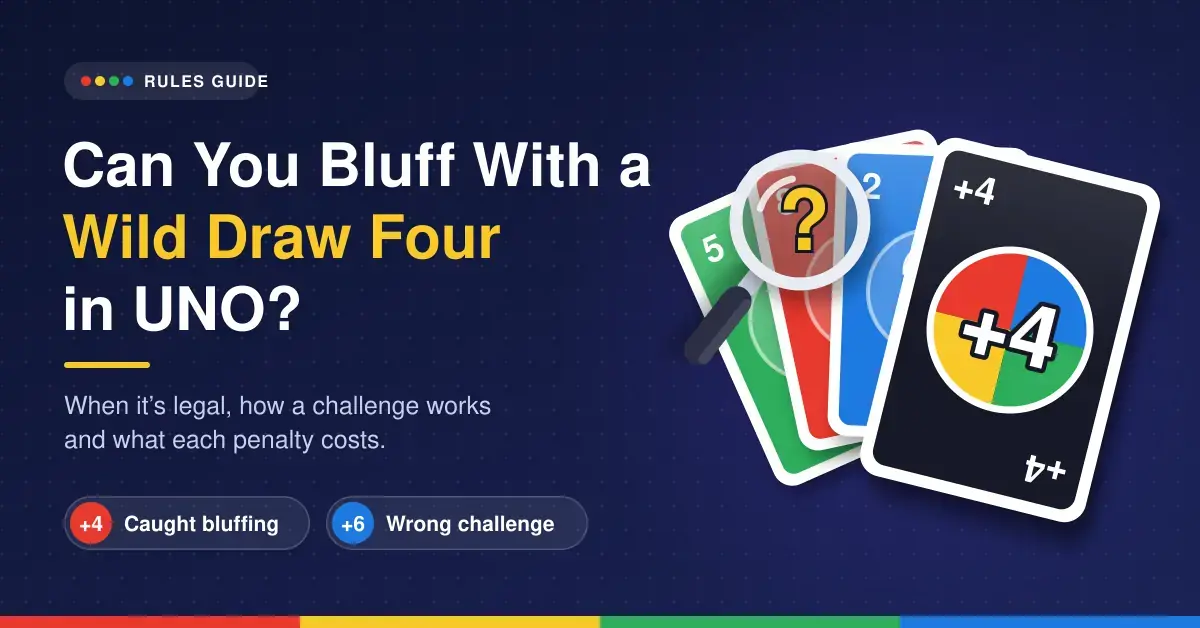
The Wild Draw Four lets you change the colour and force the next player to draw four cards, but it comes with a condition people routinely ignore: you may only play it when you have no card matching the current colour on the discard pile. (You can still hold cards of other colours, numbers or a plain Wild.) If an opponent thinks you broke that rule, they can challenge you. If you were bluffing, you draw the four cards yourself; if the challenge is wrong, the challenger draws six instead. Our guide to the Wild Draw Four rules covers the bluffing side in more depth.
| Challenge result | Player who used the card | Challenger |
|---|---|---|
| Guilty — held a matching colour | Draws 4 cards | Draws nothing |
| Innocent — no matching colour | Draws nothing | Draws 6 cards |
Saying “UNO”: the timing and the penalty
Everyone knows you call “UNO” when you are down to one card, but the timing of the penalty is widely misapplied. You are not automatically punished the instant the card lands. You can only be penalised if an opponent catches you before the next player takes their turn — that is, before the next person draws or plays a card. If you are caught in that window, you draw two cards; if nobody notices in time, you are safe. For more on the edge cases, see what happens if you forget to say UNO.
Skip and Reverse in two-player games
In a game with three or more players, a Reverse card changes the direction of play. In a two-player game there is no direction to change, so people often treat it as a dead card. In fact, with two players a Reverse works exactly like a Skip: your opponent misses their turn and you immediately go again. The same is true of a Draw Two, which makes your opponent draw and then hands the turn straight back to you. This lets a player chain several cards in a row, so it is worth remembering. The UNO Reverse card page has more on its uses.
| Card | Three or more players | Two players |
|---|---|---|
| Skip | Next player misses a turn | Opponent misses a turn; you go again |
| Reverse | Direction of play changes | Opponent misses a turn; you go again |
| Draw Two | Next player draws 2 and is skipped | Opponent draws 2; you go again |
Scoring: the half of UNO most players skip
Perhaps the biggest rule people get wrong is how the game is actually won. Most casual tables treat an empty hand as the end of the game, but officially that is only the end of a round. The round winner scores points based on the cards still held by everyone else, and the first player to reach 500 points wins the whole game. That changes strategy: being caught holding Wilds when someone goes out is expensive. Our guide to how scoring works in UNO shows a full worked example.
- Number cards (0–9): worth their face value.
- Skip, Reverse and Draw Two: 20 points each.
- Wild and Wild Draw Four: 50 points each.
- Target to win the game: 500 points.
Starting the game on an action card
When the first card is flipped from the draw pile to begin the discard pile, that card’s effect applies right away — many groups mistakenly ignore it or flip again. A starting Draw Two makes the first player draw two and skip; a Skip skips the first player; a Reverse makes the dealer play first and reverses the direction; a Wild lets the first player choose the colour. The only exception is a Wild Draw Four, which is returned to the deck so a new starting card can be flipped.
| First card flipped | What happens |
|---|---|
| Draw Two | First player draws 2 cards and misses their turn |
| Skip | First player misses their turn |
| Reverse | Dealer plays first; direction reverses |
| Wild | First player chooses the starting colour |
| Wild Draw Four | Returned to the deck; a new card is flipped |
Drawing when you already have a playable card
Some tables insist you must play a card whenever you can. The official rules let you choose to draw a single card from the pile even when you hold a legal move — a handy way to disguise which colours you are holding. The catch is that after drawing you may only play that newly drawn card; you cannot then switch to a card that was already in your hand until your next turn.
The 7-0 hand-swap rule is not official
A popular variation known as “Seven-Zero” lets a player who plays a 7 swap hands with someone, while a 0 makes everyone pass their hand around the table. It is great fun, but it is a house rule and appears nowhere in the official rulebook — in a standard game, 7 and 0 are ordinary number cards worth their face value. Because it is not universal, it is worth agreeing on before the first card is dealt so nobody is caught out mid-game.
Playing an action card as your final card
You are allowed to win the round on any card, including a Skip, Reverse, Draw Two or Wild. If your last card is a Draw Two or Wild Draw Four, the next player still has to draw those cards, and officially they count toward the round winner’s score. Ending the round the instant the winner’s hand is empty, without drawing those penalty cards, shortchanges the winner’s points.
Correcting these mix-ups turns UNO from an unpredictable free-for-all into a balanced game of tactics, where deciding when to dump high-value cards actually matters. UNO has changed a good deal since its 1971 debut, and general background on the game is widely available online, including on Wikipedia. Whatever version your table prefers, the key is agreeing on the rules before the first card is dealt.
Sources
Frequently Asked Questions (FAQ)
Can you stack Draw Two cards in UNO?
No. Under the official rules you cannot answer a Draw Two with another Draw Two. The next player draws the two cards and loses their turn. Stacking is a house rule.
How many cards do you draw when you cannot play?
Exactly one. If that drawn card is playable you may play it immediately; if not, you keep it and your turn ends. You never have to keep drawing until you find a match.
What is the penalty for forgetting to say UNO?
If an opponent catches you before the next player draws or plays a card, you draw two cards. If nobody catches you in that window, there is no penalty.
How do you win a game of UNO?
Emptying your hand only wins the round. The round winner scores the points left in everyone else’s hands, and the first player to reach 500 points wins the game.
Are the 7 and 0 hand-swap rules official?
No. Swapping hands with a 7 or rotating hands with a 0 is a popular house rule. In the official game, 7 and 0 are ordinary number cards with no special effect.