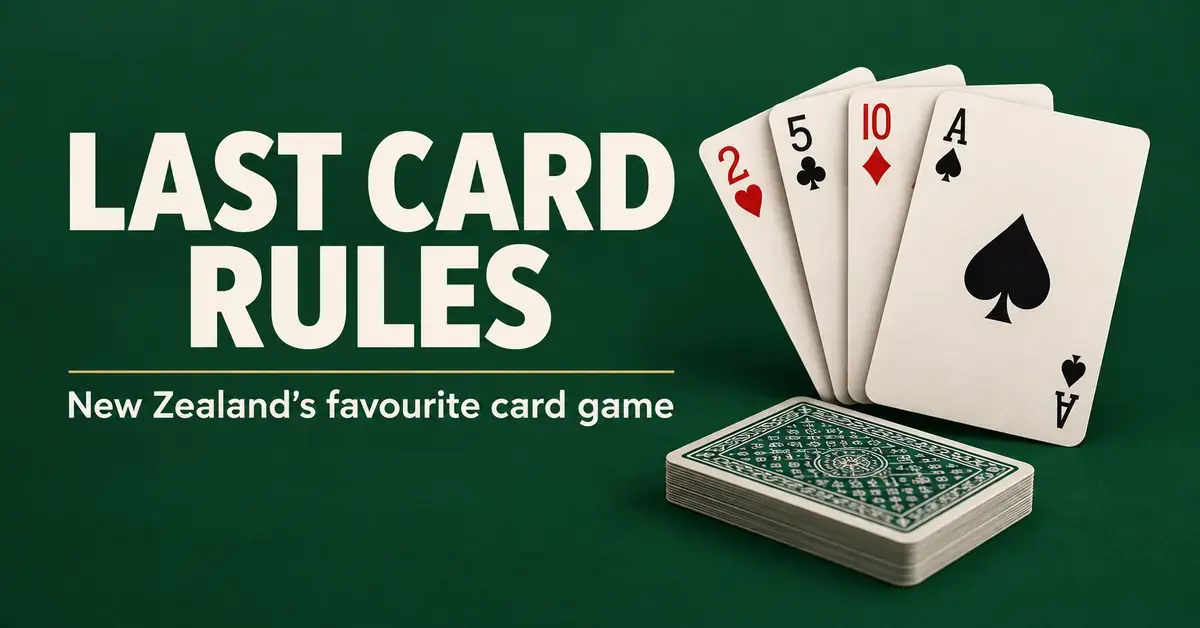
Last Card is one of the most-played card games in New Zealand kitchens, campgrounds and classrooms. It belongs to the same “shedding” family as UNO, Crazy Eights and Mau-Mau, which means the goal is simply to get rid of every card in your hand before anyone else does. All you need is an ordinary 52-card deck, two or more players and a couple of minutes to learn the rules. This guide walks through the setup, the power cards that give Last Card its bite, the famous “Last Card” call and the house rules that change from one whanau to the next.
Key Points
- Goal: be the first player to get rid of every card in your hand.
- Kit: a standard 52-card deck; two or more players.
- Deal: usually seven cards each (some groups deal five).
- Play: match the top card by suit or rank, or draw one card.
- Power cards: 2 = draw two, 5 = draw five, 10 = miss a turn, Ace = wild/choose the suit.
- The call: say “Last Card” when you are down to one card or draw a two-card penalty.
- Rules vary by household — agree on the variations before dealing.
What is Last Card?
Last Card is a shedding-type card game, which simply means a game where you win by emptying your hand of cards. It is played across New Zealand and Australia and is closely related to Crazy Eights and the branded card game UNO. The big difference is that Last Card uses a normal deck of playing cards rather than a special one, and it gives certain ranks “power” effects — forcing opponents to draw cards, miss turns or change the active suit.
Because it is a folk game passed down by word of mouth rather than printed on a rulebook, published versions disagree on some details. The rules below describe the most widely played New Zealand version. Whichever set you use, the golden rule is to agree on the variations before the first card is dealt.
Quick Facts
| Players | 2 or more (best with 3–6) |
|---|---|
| Deck | Standard 52 cards (jokers optional) |
| Cards dealt | 7 each (5 in some versions) |
| Game type | Shedding / matching card game |
| Objective | Be first to play all your cards |
| Typical round | About 10–20 minutes |
| Similar games | UNO, Crazy Eights, Mau-Mau, Switch |
How to play Last Card
Dealing and starting the game
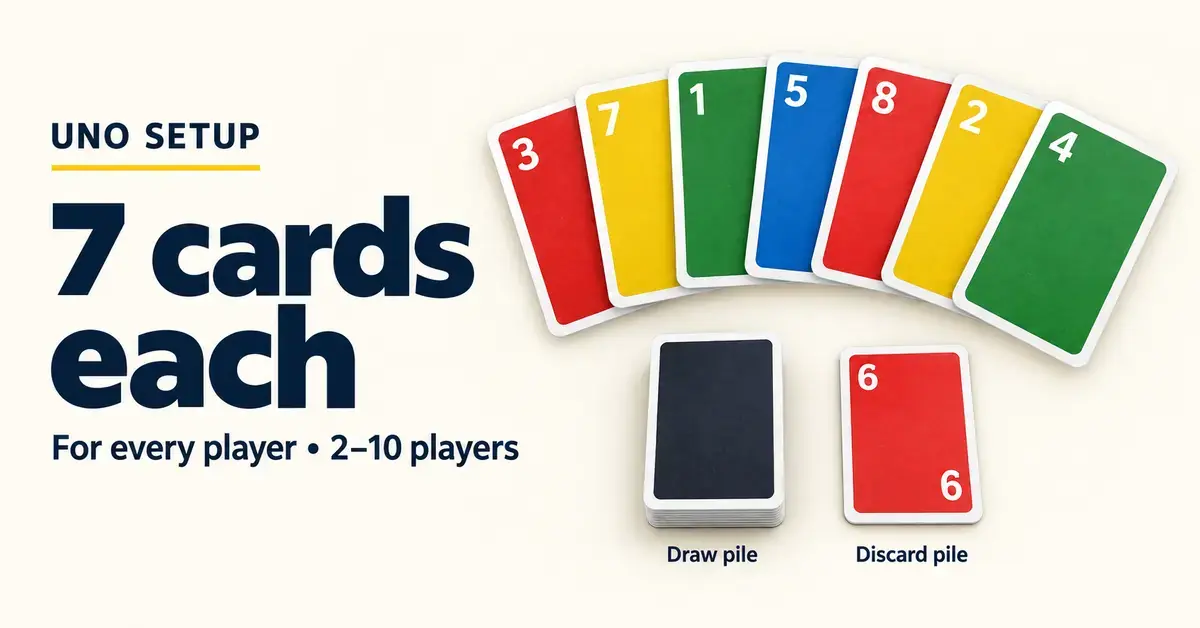
Shuffle a standard 52-card deck. Deal seven cards to each player (some groups deal five — agree beforehand). Place the rest face-down as the draw pile, then turn the top card face-up beside it to start the discard pile. That first face-up card sets the suit and rank that play must follow.
Play usually moves to the left (clockwise). The player to the dealer’s left goes first.
Taking your turn
On your turn you must play one card that matches the top card of the discard pile by either suit or rank. For example, on a red 7 you could play any other 7, or any other heart or diamond of the same colour suit — that is, any heart if the 7 is a heart, or any diamond if it is a diamond.
- If you can play a card, place it face-up on the discard pile.
- If you cannot (or choose not to) play, draw one card from the pile. In most NZ versions you may play that card straight away if it is legal; otherwise your turn ends.
- Power cards (below) override the normal matching rule and force the next player to react.
The first player to legally play their very last card wins the round.
Last Card power cards
The action cards are what set Last Card apart from a plain matching game. The table shows the effects used in most New Zealand households. Card counts and a few effects vary by house rule, so treat this as the common baseline rather than an official standard.
| Card | Common effect in New Zealand |
|---|---|
| 2 | The next player must draw two cards — unless they play another 2, which “stacks” the penalty onto the following player. |
| 5 | The next player must draw five cards, or play another 5 to pass the growing pick-up along. The 5 is the signature Last Card power card. |
| 10 | The next player misses their turn (a skip). |
| Ace | A wild card: it can be played on any card, and the person who plays it names the suit that must be followed next. |
| Jack | Reverses the direction of play in many households; some groups instead treat it as a skip. Agree in advance. |
| Joker (optional) | If jokers are included, they act as a wild card and usually force the next player to draw five. |
When a pick-up card (a 2 or a 5) is played, the next player either adds the same rank to keep the chain going or draws the full running total. Once someone draws, the chain resets. Only cards of the same rank can be stacked in the standard game — you cannot answer a 2 with a 5 unless a house rule allows it.
The “Last Card” call
The rule the game is named after: when you are about to play your second-to-last card — leaving just one card in your hand — you must clearly say “Last Card” before the next player takes their turn. It is the same idea as calling “UNO” when you are down to one card.
If you forget and another player catches you before the next turn is taken, the penalty is to draw two cards. That instantly puts you back to two or more cards, so the call matters. If a pick-up card is played on you while you are on your last card, you still have to draw the penalty and keep playing.
Common house rules and variations
Last Card is famous for its regional and family variations. These are the most common ones you will run into around New Zealand:
- Blocking cards: some groups let a 3 or a 7 of the current suit cancel an incoming 2 or 5 pick-up instead of drawing.
- 8 as the skip: a few households use the 8 rather than the 10 to make the next player miss a turn.
- King reverses: some tables use the King (not the Jack) to change direction of play.
- Nominating the target: a variation where the player of a 2, 5 or skip chooses who it hits rather than it always going to the next player.
- No finishing on a power card: many groups forbid winning on a 2, 5, 10 or Ace, so your final card must be a plain number card.
- Playing after drawing: whether you may play a card you have just drawn is a common point to settle up front.
Because the effects shift so much, Last Card sits in the same “agree the rules first” tradition as UNO house rules. Deciding the pick-up counts, blocking cards and finishing restrictions before you deal prevents most mid-game arguments.
Last Card compared with UNO and Crazy Eights
If you already know UNO, Last Card will feel familiar. The main practical differences are that Last Card uses a standard deck (no need to buy anything), the 5 is a powerful draw-five card, and the Ace does the job UNO’s Wild card does. Crazy Eights is the closest classic relative — the same match-by-suit-or-rank engine — but its trademark twist is that any 8 is wild, whereas in Last Card the Ace is the wild and the 8 usually has no special role.
Because it needs only a normal deck, Last Card travels well and works from two players up to a big group, which is why it turns up alongside other titles in round-ups of the best card games in New Zealand. It also scales down neatly for two-player card games when a full table is not available.
Tips and common mistakes for new players
- Do not forget the call. The most common way to lose ground is failing to say “Last Card” and drawing the two-card penalty.
- Hold your power cards. Keeping a 2, 5 or Ace back gives you an escape when an opponent tries to load you with pick-ups.
- Watch the suit, not just the rank. Beginners often miss that they can switch suits with any matching rank, which opens up more plays.
- Count the chain. When 2s or 5s are stacking, keep track of the running total before you decide to draw or add to it.
Last Card is easy enough for children yet quick enough to keep adults interested, which puts it firmly among the easy card games worth teaching at any gathering.
Who Last Card suits
Last Card is a great fit for families, camping trips, flat nights and classrooms — anywhere you have a deck of cards and a few minutes. It suits mixed ages because the core rules are simple, while the stacking and house-rule options give experienced players room to be tactical. If you enjoy UNO or Crazy Eights and want a version that works with the cards already in your drawer, Last Card is the natural next game to learn.
Sources
Frequently asked questions (FAQ)
How many cards do you deal in Last Card?
The most common New Zealand version deals seven cards to each player, though some groups deal five. Whichever you choose, deal the same number to everyone and agree on it before the first card is turned over.
What does a 5 do in Last Card?
Playing a 5 forces the next player to draw five cards unless they can play another 5. If they do, the pick-up stacks and passes to the following player, who must either add another 5 or draw the full running total.
What happens if you forget to say “Last Card”?
If you play your second-to-last card without calling “Last Card” and another player notices before the next turn is taken, you draw two penalty cards. That returns you to at least two cards in hand.
Is Last Card the same as UNO?
No, but they are close relatives. Both are shedding games where you empty your hand and call out on your last card. Last Card uses a standard 52-card deck and gives ranks such as 2, 5 and Ace their powers, while UNO uses its own custom cards.
Can you win by playing a power card?
It depends on the house rules. Many groups do not allow you to finish on a 2, 5, 10, Ace or Joker, meaning your final card must be an ordinary number card. Decide this before you start playing.