The 7-0 rule is one of the most talked-about optional twists you can add to a game of UNO. It turns two ordinary number cards into hand-changing bombs: a 7 lets you trade your whole hand with another player, and a 0 sends every hand sliding around the table. Because it can wipe out a near-win in a single card, the rule creates big swings, plenty of laughter and a fair amount of table drama. This guide explains exactly how hand-swapping and passing work, how to set the rule up, and how it changes the way you play.
Quick Facts
| Rule type | Optional variation (house rule, officially supported) |
|---|---|
| Cards affected | Number 7 and number 0 |
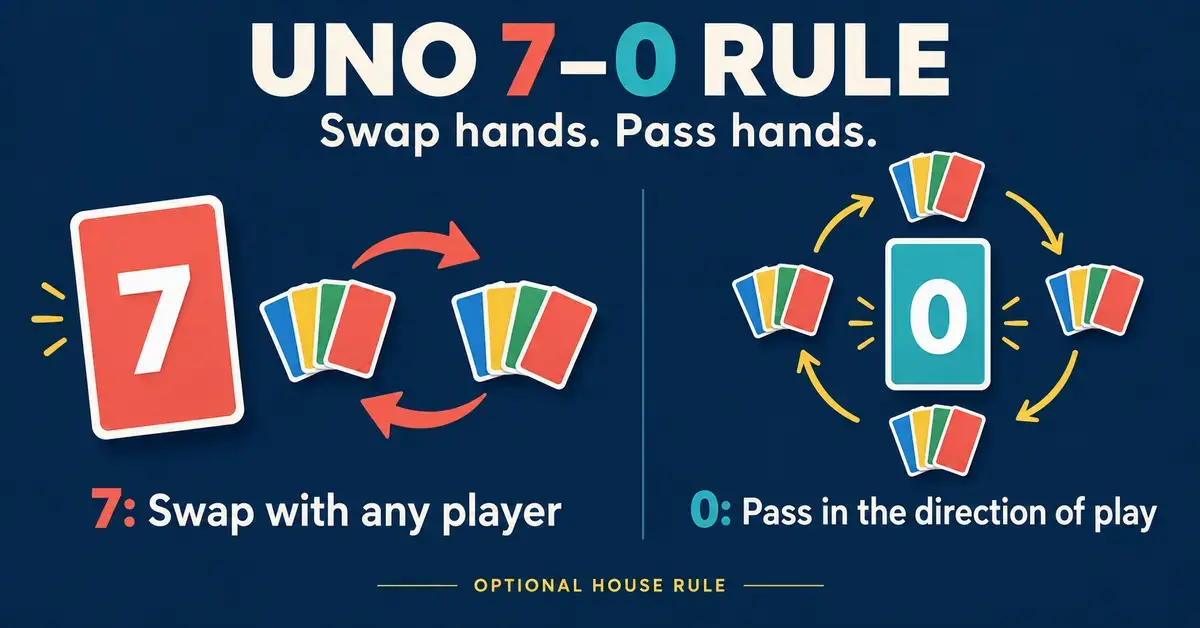
| Playing a 7 | Swap your whole hand with one player of your choice |
| Playing a 0 | All players pass their hands to the next player in the direction of play |
| Two-player games | Both cards simply swap the two hands |
| Where it is available | Official UNO app (toggle) and UNO Show ‘Em No Mercy (built in) |
What Is the UNO 7-0 Rule?
The 7-0 rule (also written “Seven-Zero” or “7 0”) is an optional variation that gives the number 7 and number 0 cards special powers on top of their normal matching function. In standard UNO these are ordinary number cards that you play by matching the colour or number on the discard pile. Under the 7-0 rule they keep that matching behaviour but also trigger an extra action the moment they are played.
It is not part of the basic printed rulebook. Instead it belongs to the family of optional twists that players switch on to keep games fresh, similar to other UNO house rules. That said, it is now widely recognised by the game’s publisher, Mattel: it can be toggled on in the official UNO mobile app and it is baked in as a core mechanic of UNO Show ‘Em No Mercy.
Because a full 108-card deck contains four 0 cards (one per colour) and eight 7 cards (two per colour), these actions come up often — expect several swaps and passes in a typical game.
How the 7 Card Works (Hand-Swapping)
When you play a 7, you immediately swap your entire hand with one other player of your choice. You do not shuffle the cards or pick and choose — the two hands change owners completely.
- You choose the target. The person who plays the 7 decides who to trade with, so the power is entirely in their hands.
- The whole hand moves. If you are holding two cards and your opponent is holding nine, you give away your two and receive their nine (or the other way around, depending on who you target).
- Play then continues normally. After the swap, the turn passes to the next player in the current direction of play, just as it would after any other card.
Strategically, a 7 is usually aimed at whoever is closest to winning. If a rival is down to one or two cards, playing a 7 to grab their tiny hand can flip the game in an instant. It can equally be used to dump a bloated hand onto a leader who is about to call “UNO”.
How the 0 Card Works (Passing Hands)
The 0 card is the table-wide version of the same idea. When any player plays a 0, every player passes their whole hand to the next player in the current direction of play. Everyone hands their cards on at the same time, so all hands shift one seat around the table.
Which Way Do the Hands Go?
The passing direction follows the current flow of the game:
- Clockwise play: each player passes their hand to the player on their left.
- Counter-clockwise play: if a Reverse card has flipped the direction, each player passes their hand to the player on their right instead.
Unlike the 7, the 0 gives no choice about who receives your cards — the direction of play decides for you. This makes the 0 less targeted but often more chaotic, because a single card reshuffles the standings of everyone at the table at once. To understand how the underlying cards behave before the rule is applied, it helps to review how ordinary number cards function in standard play.
The 7-0 Rule in a Two-Player Game
With only two players at the table, the 7 and the 0 do exactly the same thing: the two hands swap. There is only one other person to trade with when you play a 7, and passing “to the next player” in a two-person game simply means handing your cards to your single opponent. So in head-to-head UNO, both cards act as a straight hand exchange between you and your rival.
7 vs 0 Comparison
| Feature | 7 Card (Swap) | 0 Card (Pass) |
|---|---|---|
| Who is affected | The player who plays it and one chosen player | Every player at the table |
| Choice of target | Yes — you pick who to trade with | No — direction of play decides |
| How hands move | Two hands swap directly | All hands shift one seat around the table |
| Direction | Not applicable | Follows current play (left if clockwise, right if reversed) |
| Two-player effect | Swaps the two hands | Swaps the two hands |
How to Turn On the 7-0 Rule
Because it is optional, the 7-0 rule only applies if everyone agrees to it before the game starts. There are a few common ways to enable it:
- At the table: agree with the group that 7s swap hands and 0s pass hands, and confirm the passing direction, before dealing the first hand.
- In the official UNO app: the digital game includes a Seven-Zero toggle in its room or rule settings, so you can switch it on for online matches.
- In UNO Show ‘Em No Mercy: this faster, higher-stakes edition builds the 7-0 mechanic in as a standard part of play, alongside its other aggressive rules.
It is worth deciding a few edge cases in advance — for example, whether a 7 or 0 can be played on your very last card, and whether the swap or pass counts before or after you announce “UNO”. Settling these up front avoids arguments mid-game. If you are unsure where an optional rule ends and the rulebook begins, our guide to official rules versus house rules lays out the boundaries clearly.
Strategy: Playing With and Against the 7-0 Rule
The rule rewards timing and observation. A few principles help you use it well:
- Hold your 7 until it hurts. A 7 is most powerful when an opponent is nearly out of cards. Playing it early, when everyone holds a similar number, wastes its swing potential.
- Watch the direction before a 0. A 0 might hand your good position to the player you least want to help. Check who sits “downstream” of you before you commit.
- Don’t over-trim your hand. Racing down to one card is risky when any opponent could swap a fat hand onto you. Sometimes keeping a slightly larger, flexible hand is safer.
- Bluff pressure. Simply holding a visible willingness to play a 7 can make opponents reluctant to run their hands down, changing how the whole table plays.
The 7-0 rule pairs naturally with other twists, and many groups run it alongside broader UNO gameplay variations for an even more unpredictable game.
Common Mistakes and Clarifications
- It is not a default rule. The standard rulebook does not include hand-swapping. If nobody agreed to the 7-0 rule beforehand, 7s and 0s are just ordinary number cards.
- The 7 targets one player, the 0 moves everyone. A common mix-up is thinking a 7 also rotates all hands. It does not — only the player who played it swaps, and only with the person they choose.
- Passing is not optional. When a 0 is played, every player must pass; you cannot keep your hand because you like it.
- Colour still matters. A 7 or 0 must still legally match the colour or number of the top discard to be played in the first place. The special action only triggers on a legal play.
Where the 7-0 Rule Comes From
The Seven-Zero rule began life as a grassroots house rule and became especially popular in parts of Europe and North Africa before spreading worldwide. Its staying power comes from how dramatically it changes the endgame: no lead is ever truly safe. Mattel eventually embraced it, offering it as a selectable option in the official app and folding it into UNO Show ‘Em No Mercy, which cemented it as one of the best-known optional rules in the game.
Sources
Frequently Asked Questions (FAQ)
Is the 7-0 rule an official UNO rule?
It is an optional rule rather than part of the basic rulebook, but Mattel officially recognises it. You can switch it on in the official UNO mobile app, and it is built into UNO Show ‘Em No Mercy as a standard mechanic.
What happens when you play a 7 under the 7-0 rule?
The player who plays the 7 swaps their entire hand with one other player of their choice. The two hands change owners completely, and then play continues to the next player as normal.
What happens when you play a 0 under the 7-0 rule?
Every player passes their whole hand to the next player in the current direction of play. If play is clockwise, hands move to the left; if a Reverse has been played, hands move to the right.
How does the 7-0 rule work with only two players?
With two players, both the 7 and the 0 simply swap the two hands, because there is only one other player to trade with or pass to. In practice the two cards do the same thing in a head-to-head game.
Do you have to use the 7-0 rule?
No. It only applies if all players agree to it before the game begins. Without that agreement, 7s and 0s are ordinary number cards with no special hand-swapping or passing effect.