The Five Crowns card game is a brilliant, fast-paced rummy-style card game that has become an absolute staple for family games nights, rainy afternoons in visual holiday hotspots like Queenstown, and casual gatherings right across Aotearoa. Unlike traditional card games that rely on the classic four suits, this game introduces a unique fifth suit—stars—which completely changes the dynamic of building sets and runs.
Whether you are a seasoned card shark who grew up playing traditional rummy or a casual player looking for a fresh challenge to enjoy with friends over a few cold drinks, learning the five crowns card game rules is straightforward, yet the game offers immense tactical depth. The beauty of this game lies in its rotating wild cards and its unique structure of nine distinct rounds, meaning that no two games ever play out the same way. In this comprehensive guide, we will break down the essential five crowns rules, unpack the scoring system, explore the unique role of the extra suit, and provide practical strategies tailored for New Zealand players looking to dominate the table.
- Game Type: Rummy-style card game featuring a unique five-suit deck and rotating wild cards.
- Player Count: Accommodates 1 to 7 players seamlessly, making it highly versatile for small or larger groups.
- Target Audience: Perfect for families, flatmates, and casual gaming groups aged 8 and older.
- Average Duration: A full nine-round game typically spans between 45 to 60 minutes.
- Main Objective: Achieve the lowest cumulative score by organizing your hand into valid sets and runs across nine rounds.
What Makes the Five Crowns Card Game Unique?
At first glance, anyone familiar with traditional card games will recognize the basic structure of building melds, which are combinations of cards. However, the five crowns card game fundamentally alters these expectations by adding a fifth suit to the mix: stars. This means the double deck contains beautiful, distinct suits consisting of Spades (green), Clubs (blue), Diamonds (red), Hearts (red), and Stars (yellow). The inclusion of this fifth suit dramatically increases the mathematical possibilities for creating hands, while simultaneously making it slightly more challenging to track which cards have already been discarded by your opponents around the table.
Another defining characteristic that keeps players constantly on their toes is the rotating wild card system. In a standard rummy game, Jokers are typically the only wild cards available. In this game, while Jokers remain permanently wild, an additional card value becomes wild in every single round, directly matching the number of cards dealt in that specific hand. This means a card that was completely useless to you in round two could easily become the most valuable card at the table by round five, forcing you to constantly re-evaluate your hand management and long-term strategy.
Complete Deck Breakdown and Card Values
To fully grasp the five crowns card game rules, you first need to understand the composition of the specialised deck. The game utilizes two custom decks shuffled together, totaling 116 cards in absolute. This massive pile includes two of every standard card from the number 3 up to the King across all five distinct suits, alongside a dedicated pool of permanent Jokers. It is important to note that Aces and Twos are completely absent from this game, meaning the lowest face value card you can hold or use to start a run is a 3.
Understanding the specific point values of each card is critical because any cards left trapped in your hand when a round ends will count against your cumulative score as penalty points. Because the ultimate goal is to have the absolute lowest score at the completion of the ninth round, knowing which high-value cards to discard early can save you from a massive deficit on the scoreboard.
| Card Types and Values | Numeric Values / Point Cost | Operational Status in the Deck |
|---|---|---|
| Number Cards (3 through 10) | Face value (3 to 10 points) | Standard building blocks for sets and runs |
| Jack | 11 Points | High-value face card; dangerous to hold late |
| Queen | 12 Points | High-value face card; dangerous to hold late |
| King | 13 Points | Highest standard face card in the deck |
| Current Round Wild Card | 20 Points | Changes every round; high penalty if trapped |
| Permanent Joker | 50 Points | Always wild; massive penalty if caught in hand |
Step-by-Step Game Setup for New Zealand Homes
Setting up a round is an easy process that takes less than two minutes, whether you are gathered around a solid wooden dining table in Christchurch or relaxing on a rug in an Auckland flat. To begin, nominate a dealer for the first round. The dealer must thoroughly mix the massive 116-card deck. Because the deck is so thick, splitting it into two smaller piles for a standard riffle shuffle before combining them is highly recommended to ensure the cards are distributed evenly.
The game consists of exactly nine rounds, and the number of cards dealt to each player increases systematically with each progression. In the very first round, the dealer distributes exactly three cards face-down to every participant. In the second round, everyone receives four cards, and this pattern continues sequentially until the ninth and final round, where each player is dealt a substantial hand of eleven cards.
Initializing the Draw and Discard Piles
Once the appropriate number of cards has been dealt face-down to everyone at the table, the dealer places the remaining stack of un-dealt cards squarely in the middle of the table to serve as the face-down draw pile. The top card of this draw pile is then flipped face-up and set directly adjacent to it, forming the foundation of the face-up discard pile. Players are strictly forbidden from looking at or organising their cards until the dealer has completed this entire sequence.
The Core Gameplay Loop: How a Turn Proceeds
The gameplay flows in a clockwise direction, traditionally starting with the player seated to the immediate left of the dealer. Every single turn follows an unyielding, two-step structure that cannot be altered: you must draw exactly one card to start your turn, and you must discard exactly one card to officially conclude your turn. This clean mechanic keeps the game moving at a rapid pace, preventing long delays and keeping everyone actively engaged. Wikipedia
When starting your turn, you have a critical tactical choice to make. You can either draw the top face-down card from the main deck, keeping its identity a complete secret from your opponents, or you can opt to pick up the top face-up card from the discard pile if it perfectly matches a set or run you are currently trying to build. Once you have integrated this new card into your hand and reassessed your options, you must select one card from your hand and place it face-up on top of the discard pile.
Valid Combinations: Understanding Sets and Runs
The absolute core of the five crowns card game rules revolves around organizing your hand into valid groups, known as melds. To successfully “go out” and end a round, every single card in your hand must be part of a valid combination, leaving you with no unmatched cards (often referred to as “deadwood”). There are only two distinct types of valid combinations permitted in this game: sets and runs.
A valid set consists of three or more cards sharing the exact same numeric or face value, regardless of their suits. For example, holding the 5 of Spades, the 5 of Diamonds, and the 5 of Stars constitutes a perfectly legal set of 5s. You can even include duplicate cards of the exact same suit within a set because the deck contains two identical copies of every card.
A valid run, on the other hand, is a sequence of three or more consecutive cards belonging to the exact same suit. For example, the 7, 8, and 9 of Hearts forms a legal run. Remember, because Aces are not included in the deck, you cannot form a sequence like King-Ace-3; all runs must flow numerically through the standard number cards up to the face cards.
- Valid Set Example: Three or four Kings of any suit combination (e.g., Spade, Heart, Club, Star).
- Valid Run Example: The 4, 5, 6, and 7 of the Club suit flowing in perfect numerical order.
- Minimum Combination Size: Every individual set or run must contain a minimum of three cards to be legal.
- Mixing Suits in Runs: Absolutely forbidden; a single incorrect suit breaks the continuity of a run.
Master the Rotating Wild Cards
The feature that gives the game its incredible replayability is the rotating wild card mechanic. While the dedicated Jokers are permanently wild throughout the entire duration of the game, each individual round introduces a brand-new wild card value that directly matches the number of cards currently dealt in that round. This means the wild cards adapt dynamically as the game progresses.
Because wild cards can substitute for any suit or numerical value required to complete a set or run, tracking which cards are wild during the current round is paramount to victory. For instance, during the third round of the game, everyone holds seven cards in their hand, which automatically makes all 7s across all five suits completely wild for that specific duration.
Round-by-Round Wild Card Breakdown
To prevent confusion during intensive play, it is incredibly helpful to have a clear reference for which card is wild during each phase of the game. The wild card always aligns perfectly with the hand size, creating a natural mental association that players can easily track.
| Round Number | Hand Size Dealt | Permanently Wild Cards | Variable Round Wild Card Value |
|---|---|---|---|
| Round 1 | 3 Cards | All Jokers | All 3s are completely wild |
| Round 2 | 4 Cards | All Jokers | All 4s are completely wild |
| Round 3 | 5 Cards | All Jokers | All 5s are completely wild |
| Round 4 | 6 Cards | All Jokers | All 6s are completely wild |
| Round 5 | 7 Cards | All Jokers | All 7s are completely wild |
| Round 6 | 8 Cards | All Jokers | All 8s are completely wild |
| Round 7 | 9 Cards | All Jokers | All 9s are completely wild |
| Round 8 | 10 Cards | All Jokers | All 10s are completely wild |
| Round 9 | 11 Cards | All Jokers | All Jacks are completely wild |
Going Out and Ending a Round
The climax of any round occurs when a player manages to successfully organize every single card in their hand into valid sets or runs, finishes their turn by placing a final card onto the discard pile, and confidently announces to the table that they are “going out”. When you lay down your hand, you must show that all your cards fit perfectly into legal combinations, leaving absolutely zero unmatched cards behind.
The moment a player goes out, the round is not instantly over for everyone else. Instead, it triggers a final, high-tension lightning round. Every remaining player around the table is granted exactly one final turn to draw a card from either pile, attempt to optimize their hand layout to form as many valid sets or runs as possible, and discard one final card. Once this final circuit is complete, everyone must lay their cards flat on the table for final point calculations.
The Power of Laying Down Partial Combinations
During this final turn, the remaining players are allowed to lay down any completed sets or runs they managed to assemble, even if they cannot clear their entire hand. Any card that is successfully integrated into a valid three-card or four-card combination is completely safe and scores zero penalty points. You only calculate scores based on the unmatched cards left dangling outside of your valid combinations.
Scoring Mechanics and Avoiding Deficit
Once the final turns have concluded, the process of calculating scores begins. This is where a pen and a piece of paper are essential for keeping track of the running totals across all nine rounds. If you managed to clear your entire hand or successfully lay down all your cards into combinations during the final turn, you score an ideal 0 for that round.
For everyone else, you must tally up the specific point values of all the unmatched cards remaining in your hand. This is where the game can become incredibly penalising. If you are caught holding onto permanent Jokers or the current round’s wild cards without a valid home, your score will skyrocket massively, putting you at a severe disadvantage heading into the next round.
| Scoring Scenario | Calculation Method | Ideal Strategy |
|---|---|---|
| Completely Cleared Hand | Scores exactly 0 points | Aim to trigger this as fast as possible |
| Standard Number Cards | Face value of the card (3 to 10 points) | Keep lower numbers if forced to hold deadwood |
| High Face Cards (J, Q, K) | 11, 12, or 13 points respectively | Discard early if they do not fit an immediate run |
| Current Round Wild Cards | 20 points per card | Never hold onto these loosely late in a round |
| Permanent Jokers | 50 points per card | High risk; discard if a round is clearly ending |
Tactical Tips for New Zealand Players
To consistently win at the five crowns card game, you must look past simple pattern matching and adopt a flexible, highly observant mindset. One of the most common mistakes amateur players make is holding onto high-value face cards like Kings or Queens in the vague hope of building a massive run. If the round is progressing quickly and opponents are rapidly exchanging cards, it is almost always safer to dump these high-scoring cards in favour of lower numbers like 4s or 5s to minimize your financial point exposure if someone suddenly goes out.
Another brilliant tactic involves closely monitoring the discard pile and the drawing habits of the players sitting to your immediate right and left. If you notice a flatmate or family member consistently picking up Star-suited cards from the discard pile, you should go out of your way to avoid discarding any Stars from your own hand, effectively starving them of the crucial pieces they need to finish their run. Furthermore, always prioritize flexibility; building a set of identical numbers is mathematically easier than completing a single-suit run, especially with five suits in active play.
Summary
Mastering the five crowns card game rules opens up a world of fantastic, unpredictable party entertainment that appeals equally to competitive strategists and casual gamers alike. By understanding the unique role of the fifth suit, capitalizing on the rotating wild card schedule from round to round, and managing your hand to avoid catastrophic point penalties, you will easily elevate your gameplay. It is an incredibly accessible, portable, and endlessly replayable game that makes a phenomenal addition to any Kiwi household’s entertainment collection.
FAQ
Can a single card be used as part of two different combinations at the same time?
No, individual cards cannot double-dip across multiple melds. A specific card can only belong to one single set or one single run at any given moment. For instance, if you use a 7 of Hearts to complete a run of 5-6-7 of Hearts, you cannot simultaneously use that exact same card to anchor a set of 7s in your hand.
What happens if the face-down draw pile completely runs out of cards?
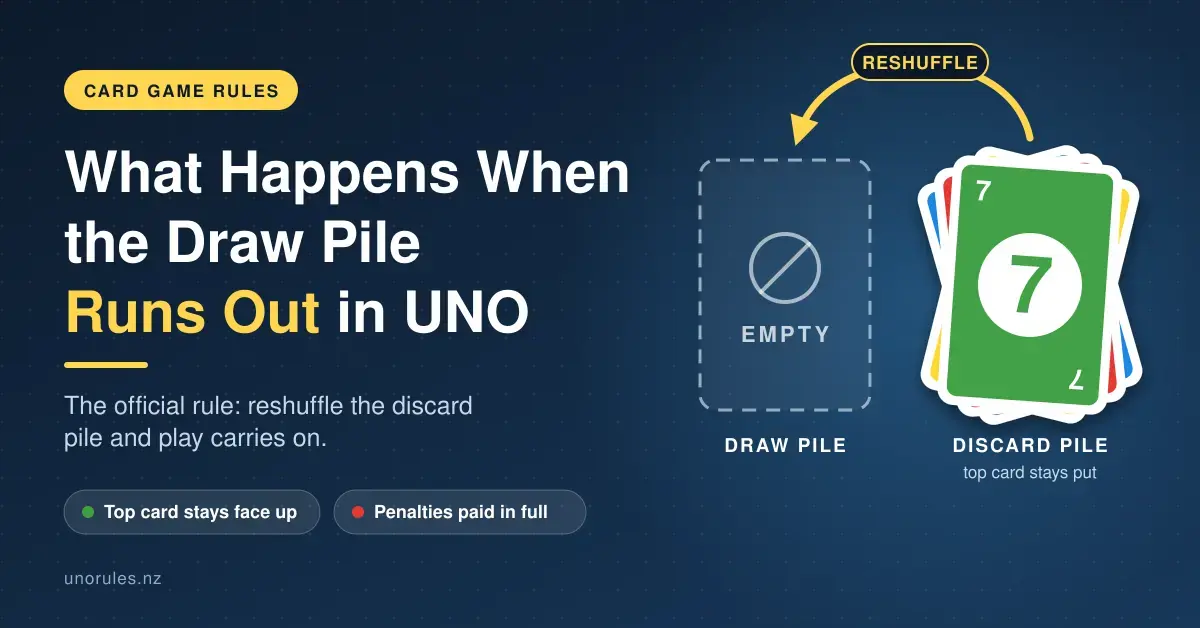
In the rare event that players are taking a long time to build their hands and the face-down draw pile is entirely depleted, you simply take the current face-up discard pile, leave the very top card in place to maintain the discard arena, thoroughly shuffle the remaining cards, and place them face-down to create a fresh draw pile.
Are you allowed to look through the discard pile to see what has been played?
No, players are strictly forbidden from rifling through the history of the discard pile. Only the very top card that was most recently discarded is visible and accessible for active gameplay. Keeping mental track of what cards have already been thrown away throughout a round is a vital skill that separates advanced players from beginners.
Can you use multiple wild cards within a single set or run?
Yes, the five crowns rules state that you are completely free to use as many wild cards (both permanent Jokers and current round wild cards) as you want to complete a single combination. You could theoretically build a valid run consisting of a 4 of Clubs, a Joker, and a round-specific wild card, provided the sequence remains logically intact.
Does the person who goes out first always win the round?
Yes, the individual who triggers the end of the round by successfully clearing their entire hand always scores an absolute 0, meaning they win that specific round. However, because the final winner of the entire game is determined by the lowest cumulative score across all nine rounds, winning a single round does not guarantee ultimate victory.
Is it possible for a player to finish the game with a negative score?
No, it is mathematically impossible to achieve a negative score. The absolute best score a player can achieve in any individual round is a 0, which occurs when they have no unmatched cards left in their hand. The ultimate goal across the full nine rounds of play is to keep your final cumulative tally as close to 0 as possible.
What is the minimum number of players required to play Five Crowns?
While the game shines brightest as a social experience with 3 to 5 players gathered around the table, it actually features a dedicated official solitaire variation, meaning it can be played completely solo. It can also comfortably scale all the way up to 7 players using the standard double deck included in the box.
Can a run wrap around from King back to the number three card?
No, runs must follow a strict linear numerical sequence from the lowest card (3) up to the highest face card (King). You cannot create a “looping” or wrapping run that connects a King back down to a 3 or 4; once a sequence hits the King of a specific suit, that specific run cannot progress any further.
What happens if I accidentally draw a card out of turn?
If a player mistakenly draws a card when it is not their designated turn, it is considered a procedural error. The card must be immediately returned to its original pile. If it was drawn from the face-down deck and its identity was compromised, the deck should be briefly reshuffled by the dealer to ensure absolute fairness.
Are the background illustrations or card frames significant to the rules?
No, the visual design, colours, and frames of the cards are purely cosmetic and intended to help players clearly distinguish between the five different suits at a glance. When evaluating your hand for valid sets and runs, you should focus exclusively on the suit icons (Spades, Clubs, Diamonds, Hearts, Stars) and the face numbers.