Single player card games give you a self-contained way to pass the time with nothing more than a standard deck and a flat surface. Known collectively as Solitaire (or Patience in British and New Zealand usage), these games range from gentle luck-based puzzles to near-pure tests of planning. They need no opponents, no app and no special equipment, which makes a deck of playing cards a practical companion for a quiet evening at home, a long flight, or a rainy afternoon at the bach. This guide explains what a standard deck contains and then walks through the setup, rules and typical strategy of five of the most widely played solo games: Klondike, Spider, Pyramid, FreeCell and Golf.
Key points
- What you need: one standard 52-card deck (Spider uses two) and a flat surface — no opponents or app required.
- Other names: solo card games are known collectively as Solitaire, or Patience in New Zealand and British usage.
- Luck vs skill: Klondike and Pyramid lean on the shuffle, while FreeCell is almost entirely about planning.
- Round length: Pyramid and Golf take a few minutes; Klondike and FreeCell longer; Spider is the biggest time commitment.
- The Ace is low: in most of these games the Ace starts the foundations, rather than being the high card.
Why solo card games still have a place
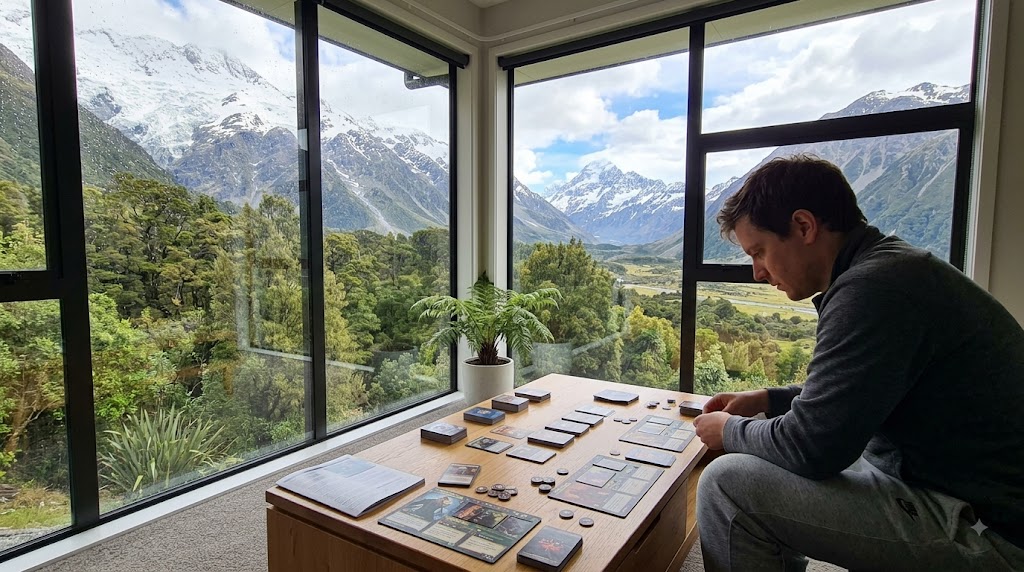
Before smartphones and streaming filled every spare moment, laying out rows of cards was a common way to unwind. Games of Patience were often learned by watching a parent or grandparent shift piles across a kitchen table, and they survived precisely because the barrier to entry is so low: a deck costs little, fits in a pocket and never needs charging.
That simplicity explains why solo card play has held on through the recent revival of interest in tabletop and board games. A deck of cards suits almost anyone and any setting — a student taking a break from study, a traveller filling time in a departure lounge, or someone who simply wants a screen-free mental exercise. If you enjoy games you can play without a group, it also pairs well with the growing range of card games for two players for the times a friend does join in.
The standard 52-card deck explained
Every game below (except Spider, which uses two decks) is played with one standard 52-card French-suited deck. Knowing how that deck is built makes the rules much easier to follow.
The 52 cards are split evenly into four suits: Spades, Clubs, Diamonds and Hearts. Spades and Clubs are printed in black; Diamonds and Hearts in red. Each suit holds 13 cards running from Ace up to King. In most solo games the Ace is the low card — it sits below the 2 and starts the foundation piles — rather than the high card it is in many trick-taking games. The three court cards (Jack, Queen and King) usually count as 11, 12 and 13 when a game needs numeric values. The two Jokers are normally set aside.
| Suit | Ink colour | Cards per suit | Typical solo ranking |
|---|---|---|---|
| Spades (♠) | Black | 13 | Ace (low) up to King |
| Clubs (♣) | Black | 13 | Ace (low) up to King |
| Diamonds (♦) | Red | 13 | Ace (low) up to King |
| Hearts (♥) | Red | 13 | Ace (low) up to King |
| Jokers | Varies | 2 extra | Usually removed for solo play |
Klondike: the classic Solitaire

When people picture “Solitaire,” they are almost always picturing Klondike. It is the version bundled with early desktop computers and the one most newcomers learn first. The goal is to move all 52 cards into four foundation piles, one per suit, each built upward from Ace to King.
To set up, shuffle the deck and deal seven tableau columns from left to right. The first column gets one card, the second two, and so on up to seven, so the columns increase in size across the table. Only the top card of each column is dealt face-up; the cards beneath it stay face-down. The 24 remaining cards form the face-down stock pile.
Moving cards in Klondike

Within the tableau, cards are built downward in alternating colours. A red 7 (Hearts or Diamonds) can only take a black 6 (Spades or Clubs) on top of it, and so on. Whenever you move a face-up card off a column and expose a face-down card, you turn that hidden card face-up, which may open new moves.
An Ace is moved to the foundations as soon as it becomes available, and from there each foundation is built up in suit order (Ace, 2, 3 … King). If a column is emptied completely, only a King — or a valid sequence headed by a King — may be placed into the empty space. You cannot fill an empty column with a lower card, which is one of the main things that makes Klondike challenging.
The stock and waste piles
When you run out of moves in the tableau, you draw from the stock. In the common draw-three version you turn over three cards at a time into a face-up waste pile and may play only the top one; playing it exposes the card beneath. In the easier draw-one version you turn over a single card at a time. When the stock is exhausted you turn the waste pile face-down (without shuffling) to make a fresh stock and go again. Note that not every Klondike deal is winnable — some leave essential cards permanently buried.
Spider Solitaire: a two-deck challenge
Spider steps up the complexity by using two full decks shuffled together — 104 cards in total. The aim is to build eight complete runs of a single suit, each from King down to Ace; completed runs are removed from the table, and clearing all eight wins the game.
Deal ten tableau columns. The first four columns receive six cards each (five face-down plus one face-up), and the remaining six columns receive five cards each (four face-down plus one face-up). That is 54 cards on the table. The other 50 cards form the stock, dealt in later rounds of ten.
Stacking versus moving in Spider
The defining rule of Spider is the gap between how you can stack cards and how you can move them. You may place any card onto one that is exactly one rank higher, regardless of suit — a red 4 can sit on a black 5. That flexibility helps uncover face-down cards. However, you can only pick up and move a group of cards together if they are all the same suit and in unbroken descending order. If you have put a Diamond 4 on a Spade 5, that pair cannot travel as a unit, so you have to plan around the mismatch.
Dealing from the stock
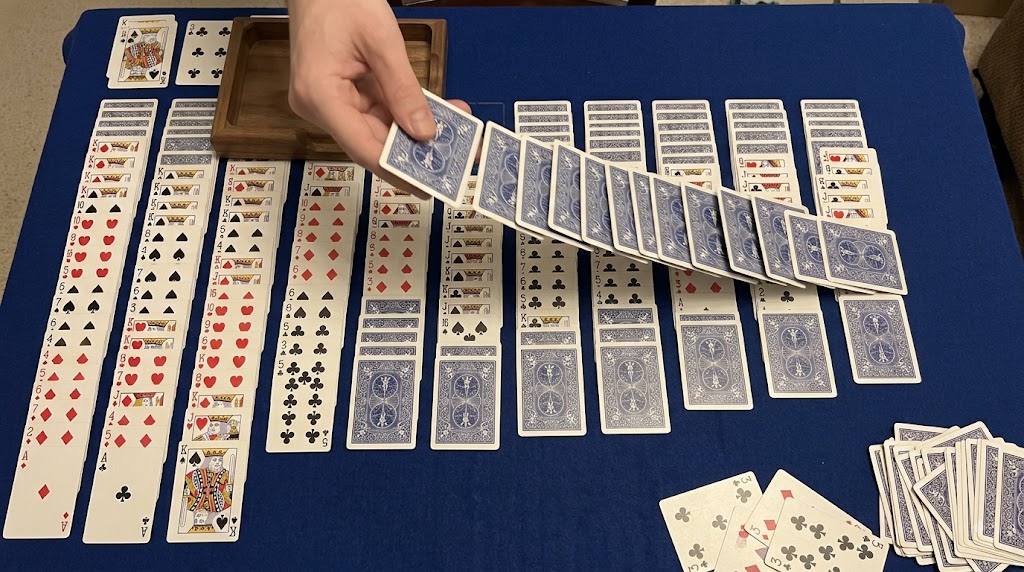
When you are stuck, you deal a round from the stock, which places one face-up card onto the bottom of every column at once — burying your careful sequences under a fresh layer. The game also enforces a strict condition: you may only deal from the stock when there are no completely empty columns on the board. This stops players from hoarding open spaces and keeps the pressure on. Beginners often start with the one-suit version (treating every card as the same suit) before moving up to two- or four-suit Spider. New Zealand players comparing it with other sequencing games sometimes look at Skip-Bo, which uses a similar build-up idea in a multiplayer format.
Pyramid Solitaire: a quick arithmetic game
Pyramid trades long column management for fast mental arithmetic, and a round often takes just a few minutes. The aim is to clear a pyramid of cards by removing pairs that add up to exactly 13.
Deal one card face-up at the top, two overlapping cards below it, then three, and so on down to a seventh row — 28 cards in all, arranged so each card is partly covered by the two beneath it. The remaining 24 cards form the stock.
Only fully uncovered cards can be removed, so at the start just the seven cards along the bottom row are available. As you clear pairs, the cards above become playable. Card values are fixed as follows:
- Number cards keep their face value (a 9 pairs with a 4; a 7 with a 6).
- Aces count as 1, so they pair with a Queen (12).
- Jacks count as 11, pairing with a 2.
- Queens count as 12, pairing with an Ace.
- Kings count as 13 and are removed on their own, with no partner needed.
You draw from the stock to find the matches you need, and depending on the version you may be limited in how many times you can recycle it.
FreeCell: the solo game of skill
FreeCell is the game to try if you dislike relying on luck. The entire 52-card deck is dealt face-up from the very start, so there is no hidden information — every card is visible from move one, turning each deal into a logic puzzle. The accepted estimate is that about 99.999% of randomly shuffled FreeCell deals are solvable, meaning only roughly one deal in tens of thousands cannot be won with perfect play. In practice, though, people win far less often than that, because finding the right sequence of moves is genuinely hard.
Deal the deck face-up into eight columns: the first four columns hold seven cards each and the last four hold six. Above the columns sit two zones of four slots. On one side are the four foundations, built up by suit from Ace to King exactly as in Klondike. On the other side are the four “free cells” that give the game its name.
Using the free cells
Each free cell can hold exactly one card at any time, acting as temporary parking for a card you need to move out of the way. Within the tableau, cards build downward in alternating colours, as in Klondike. The catch is that the more cards you tie up in the free cells (and the fewer empty columns you have), the fewer cards you can shift as a block — the maximum size of a move is set by how many cells and empty columns are free. Disciplined use of those four cells is the heart of good FreeCell play.
Golf Solitaire: fast and sequence-based
Golf is a brisk game built around continuous sequencing rather than suit matching. The aim is to clear the tableau onto a single pile, and across several rounds you try to finish with the lowest “score” — the fewer cards you leave behind, the better, just like in the sport.
Deal seven columns of five overlapping cards, all face-up — 35 cards in total — and the remaining 17 cards become the face-down stock. Turn the top stock card face-up to start the waste (or “table”) pile.
You may move any exposed card from the bottom of a column onto the waste pile if it is exactly one rank higher or one rank lower than the current top card, ignoring suit. On a 7, for example, you can play any 6 or any 8. Chaining these moves can clear whole columns quickly, but the standard rules add two important limits:
- Kings are a dead stop. In the traditional version nothing can be played on top of a King, so the chain ends and you must draw a new stock card.
- No wrapping around. You cannot play an Ace on a King or a King on an Ace; the sequence does not loop from one end of the deck to the other.
When the stock runs out and no legal moves remain, the round ends and you count the cards left in the tableau as your score — an empty board is the equivalent of a hole in one. Many digital versions optionally allow wrap-around play, so it is worth checking the rules of whichever app you use.
Comparison
| Game | Decks used | Objective | Luck vs skill | Typical round |
|---|---|---|---|---|
| Klondike | One (52) | Build four suit foundations Ace to King | Mix of luck and skill | 10–20 minutes |
| Spider | Two (104) | Build eight King-to-Ace suit runs | Skill-heavy, some luck | 20–40 minutes |
| Pyramid | One (52) | Remove pairs that total 13 | Luck-heavy, quick thinking | 3–7 minutes |
| FreeCell | One (52) | Build four suit foundations Ace to King | Almost pure skill (~99.999% solvable) | 10–20 minutes |
| Golf | One (52) | Clear the tableau to the lowest score | Mix of luck and skill | 3–5 minutes |
Looking after your cards
New Zealand’s humidity, coastal air and the habit of taking games outdoors can be hard on paper cards. Moisture, hand oils and repeated shuffling cause edges to fray and surfaces to stick, so a little care goes a long way. Clear plastic card sleeves protect each card from spills and friction without hiding the faces, while fully plastic (waterproof) decks can be wiped clean and shrug off a damp picnic table. Keeping cards in their box and out of direct sun also helps them deal and shuffle smoothly for years.
Where to buy cards in New Zealand
Standard decks are easy to find. General retailers such as The Warehouse, Kmart and Whitcoulls stock budget playing cards in their toy and stationery aisles, and online retailer Mighty Ape carries a wide range for delivery nationwide. For premium or plastic-coated decks and accessories, specialist stores like Card Merchant (Auckland stores plus online) and Cerberus Games in Wellington are good options. If you are building a wider games collection, our guide to board games in New Zealand covers where to buy and what to look for.
Choosing the right game for you
There is no single “best” solo card game — the right choice depends on what you want from a session. For a familiar, moderate challenge with some luck, start with Klondike. For a longer, more demanding puzzle, try Spider. For quick rounds, Pyramid and Golf finish in minutes. And if you want a game decided almost entirely by skill, FreeCell is hard to beat. Once you have the hang of these, there is a whole world of other easy-to-learn options such as Crazy Eights for when you have company.
Reference sources
Frequently Asked Questions (FAQ)
Can every game of Klondike Solitaire be won?
No. Because many cards start face-down in the tableau and stock, a significant share of Klondike deals are impossible to complete no matter how well you play. It is common to reach a dead end where the cards you need are trapped under cards you cannot move, at which point you simply restart with a new shuffle.
What is the difference between draw-one and draw-three Klondike?
In draw-one, you turn over a single stock card at a time, so every reserve card is easy to reach and the game is more forgiving. In draw-three, you turn over three cards at once and can play only the top one, which means you have to work the tableau to unlock the two cards buried beneath it. Draw-three is noticeably harder.
Is FreeCell really a game of pure skill?
Almost. The entire deck is dealt face-up, so there is no hidden information or luck of the draw — every obstacle is visible from the start. About 99.999% of deals can be solved with perfect play, so the outcome rests on your decisions rather than chance, though winning consistently still takes practice.
Can I play Spider Solitaire with only one suit to make it easier?
Yes. In one-suit Spider you treat all 104 cards as though they share a suit, which lets you move any descending run as a single unit. It is a popular way to learn the column-management skills before moving up to the two-suit and four-suit versions, which are much more demanding.
In Golf Solitaire, can you play an Ace on a King?
Not under the traditional rules. Golf does not “wrap around,” so an Ace cannot go on a King and a King cannot go on an Ace. A King also stops the chain entirely, forcing you to draw a fresh card from the stock. Some online versions let you enable wrap-around play, but it is not part of the standard game.