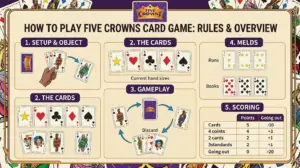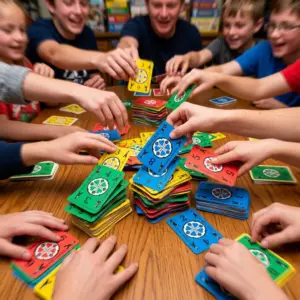
UNO Flip is played exactly like standard UNO, with one difference: every card is printed on both sides. You start on the friendly Light Side, and the moment somebody plays a Flip card, the whole game turns over to a much harsher Dark Side.
This guide follows Mattel’s official instruction sheet for UNO Flip. It covers the deck, setup, every action card, scoring, and the rules people most often get wrong.
The game is made for 2 to 10 players and is rated for ages 7 and up. It was released by Mattel in 2018.
What makes UNO Flip different
In classic UNO, you only ever look at one face of a card. The back is just a printed pattern.
In UNO Flip, both faces matter. One side of each card is the Light Side, marked by a white border. The other side is the Dark Side, marked by a black border.
Play always begins on the Light Side. When a Flip card is played, the draw pile, the discard pile and every player’s hand all turn over at once. From that moment everyone plays off the Dark Side until someone plays another Flip card and sends it back.
The Dark Side is not a different game. It is the same game with meaner penalties.
What is in the box
An UNO Flip deck contains 112 cards. This is the number that confuses most new players, because rulebooks list the Light Side and the Dark Side separately.
Those two lists describe the same 112 pieces of card. They are not added together. If you count 224, you have counted every card twice.
One more thing that surprises people coming from standard UNO: there are no zero cards. Each colour runs from 1 to 9, with two of each number, which is why each colour totals 18 cards.
What is in an UNO Flip deck
One deck holds 112 physical cards. Every card has a Light Side and a Dark Side printed on it, so the two lists below describe the same 112 cards — not 224.
| Card | How many | Colours |
|---|---|---|
| Number cards 1–9 | 72 (18 per colour) | Blue, green, red, yellow |
| Draw One | 8 | 2 of each colour |
| Reverse | 8 | 2 of each colour |
| Skip | 8 | 2 of each colour |
| Flip | 8 | 2 of each colour |
| Wild | 4 | No colour |
| Wild Draw Two | 4 | No colour |
| Total | 112 | — |
| Card | How many | Colours |
|---|---|---|
| Number cards 1–9 | 72 (18 per colour) | Pink, teal, orange, purple |
| Draw Five | 8 | 2 of each colour |
| Reverse | 8 | 2 of each colour |
| Skip Everyone | 8 | 2 of each colour |
| Flip | 8 | 2 of each colour |
| Wild | 4 | No colour |
| Wild Draw Colour | 4 | No colour |
| Total | 112 | — |
How to read this: there are no zero cards in UNO Flip. Each colour runs 1 to 9, with two copies of every number, which is why each colour totals 18 cards.
The Light Side uses blue, green, red and yellow. The Dark Side uses pink, teal, orange and purple. A card that is blue on one face will be one of the four dark colours on the other.
How to set up UNO Flip
Because the deck is double-sided, setup takes slightly more care than normal UNO.
- Sort the deck so every card faces the same way — all Light Sides pointing one direction, all Dark Sides the other. Mixed orientation ruins the game.
- Each player draws a card and reveals the Light Side. Highest number deals. Any card showing a symbol instead of a number counts as zero for this purpose.
- The dealer shuffles and gives everyone 7 cards. Hold them with the Light Side facing you, so opponents only see your Dark Side.
- Place the rest of the deck with the Light Side facing down. This is the draw pile — the stack you take cards from when you cannot play. The Dark Side will be facing up.
- Turn the top card of the draw pile over to start the discard pile — the stack you play onto. The Light Side is now facing up.
If that first card is an action card, apply its normal effect. The one exception is Wild Draw Two, which goes back into the deck so a different card can be turned up instead.
How a turn works
Play starts with the person to the dealer’s left.
On your turn, play one card from your hand that matches the top of the discard pile by colour, number, or symbol. A symbol means an action card, so a Skip can go on any other Skip regardless of colour.
If the top card is a blue 7, you can play any blue card or any 7. You could also play a Wild.
If you have nothing that matches, take one card from the draw pile. If that card is playable you may put it down straight away. If not, your turn ends.
You are also allowed to skip playing a card you could play. In that case you must draw one card, and only that drawn card may be played afterwards.
One habit to build early: when you pick up cards, add them to your hand facing the same way as everything else you are holding.
Light Side action cards
Draw One — the next player takes one card and loses their turn. Playable only on a matching colour or another Draw One.
Reverse — the direction of play flips. If it is the first card turned up, the dealer plays first and play moves to the right. The Reverse card behaves identically on both sides of the deck.
Skip — the next player loses their turn. If it starts the discard pile, the player to the dealer’s left is skipped.
Wild — you choose the colour that play continues in, including the colour already in play. You may play a Wild even when you have a perfectly good matching card.
Wild Draw Two — you choose the colour and the next player draws two cards and loses their turn. You may only play it when you hold no card matching the current colour. Holding a matching number or action card in another colour is fine.
Flip — switches the game to the Dark Side.
Dark Side action cards
Draw Five — the next player takes five cards and loses their turn.
Reverse — same as the Light Side.
Skip Everyone — every other player loses their turn, so play comes straight back to you and you play again.
Wild — same as the Light Side.
Wild Draw Colour — you name a colour, and the next player keeps drawing until they find one. There is no cap. They could draw two cards or twelve. Like Wild Draw Two, you may only play it when you hold no card matching the current colour.
Flip — switches the game back to the Light Side.
Light Side vs Dark Side action cards
Each row is the same slot in the deck, printed differently on each side. The Dark Side version is always the harsher one.
| Light Side card | Dark Side card | What changes |
|---|---|---|
| Draw One Next player draws 1 and loses their turn |
Draw Five Next player draws 5 and loses their turn |
Penalty jumps from 1 card to 5 |
| Skip Next player loses their turn |
Skip Everyone All players lose their turn |
You get to play again immediately |
| Wild Draw Two Choose the colour; next player draws 2 |
Wild Draw Colour Next player draws until they find your chosen colour |
Penalty becomes open-ended |
| Reverse | Reverse | Nothing — identical on both sides |
| Wild | Wild | Nothing — identical on both sides |
| Flip | Flip | Switches play to the other side, either direction |
Note: Draw One, Draw Five, Skip, Skip Everyone, Reverse and Flip can only be played on a matching colour, or on another card of the same type.
How the Flip card works
Play a Flip card and everything turns over, in this order: the discard pile first, then the draw pile, then every hand at the table.
The card you just played ends up at the bottom of the flipped discard pile. Whatever was underneath it is now showing, and that is the card the next player must match.
The new side stays in play until another Flip card appears. A Flip card can only be played on a matching colour or on another Flip card.
Challenging a Wild Draw Two or Wild Draw Colour
This is the rule most home games never use, and it is fully official.
If you think someone played a Wild Draw Two illegally — meaning they did have a matching colour in hand — you can challenge them. They must show you their cards.
If they were cheating, they take the two cards instead of you. If they were playing legally, you take the two cards plus two more, for four in total.
The same structure applies to Wild Draw Colour on the Dark Side. Get it wrong there and you draw until you find the chosen colour, plus two extra cards on top.
Saying “UNO” and ending the round
When you play your second-to-last card, call out “UNO”. If somebody catches you before the next player has started their turn, you draw two cards as a penalty. The rule works the same on both sides of the deck, and it matches what happens when you forget to say UNO in standard play.
The round ends the moment a player has no cards left.
If the final card played is a Draw One, Draw Five, Wild Draw Two or Wild Draw Colour, the next player still takes the penalty — and those cards count towards the score.
If the draw pile empties before anyone goes out, shuffle the discard pile and carry on.
Scoring
The player who goes out collects points for every card the other players are still holding.
UNO Flip scoring values
The player who goes out scores the value of every card still held by the other players. Score the side the round ended on.
| Card | Side | Points |
|---|---|---|
| Number cards 1–9 | Both | Face value |
| Draw One | Light | 10 |
| Draw Five | Dark | 20 |
| Reverse | Both | 20 |
| Skip | Light | 20 |
| Skip Everyone | Dark | 30 |
| Flip | Both | 20 |
| Wild | Both | 40 |
| Wild Draw Two | Light | 50 |
| Wild Draw Colour | Dark | 60 |
How to read this: a card is worth its Light Side value if the round ended on the Light Side, and its Dark Side value if the round ended on the Dark Side. The first player to 500 points wins.
The detail that trips people up: score the side the round ended on. If the last Flip card left the game on the Dark Side, a card in someone’s hand is worth its Dark Side value, even if the round mostly played out in the light.
The first player to reach 500 points wins. If nobody has reached 500, reshuffle and play another round. If you want a fuller picture of how points work across the UNO family, our guide to scoring in UNO covers the standard system.
Mattel also documents an inverted method. Instead of scoring the winner, each player tallies the points left in their own hand each round. Once anybody hits 500, the player with the lowest total wins.
Rules people get wrong
Stacking is not official. You cannot answer a Draw One with another Draw One to pass the penalty along, and you cannot chain Draw Fives. The rulebook has no stacking rule at all. Plenty of households play it anyway, which is fine as long as everyone agrees first — the same situation as stacking in standard UNO.
A Flip card is not a free pass. It still needs a matching colour, or another Flip card, to be played.
Skip Everyone does not end the round. It returns the turn to you, so you play again immediately.
Wild Draw Colour has no upper limit. There is nothing in the rules capping how many cards the next player draws.
If you want to add your own twists on top, it is worth understanding where official rules end and house rules begin.
Playing UNO Flip with two people
Mattel’s UNO Flip sheet lists 2 to 10 players and gives no separate two-player section, so the standard rules apply as written.
Two cards behave distinctively at a two-person table. Reverse effectively works like a Skip, since reversing direction hands the turn back to you. Skip Everyone does the same thing, because your opponent is the only player being skipped.
That is a consequence of the printed rules rather than a special two-player rule, so it is worth confirming with your opponent before the first hand.
Reference sources
- Mattel — UNO FLIP official instruction sheet (GDR44), 2018 — link
- Mattel Consumer Services — instruction sheet library — link
- Mattel Consumer Services — UNO product detail, deck contents (FFK04) — link
- Geeky Hobbies — UNO Flip! card meanings and rules, full deck contents listing — link
- Manuals.plus — UNO FLIP card game rules and instructions (converted Mattel sheet) — link
Frequently asked questions
How many cards are in an UNO Flip deck?
There are 112 cards. Each one is double-sided, with a Light Side and a Dark Side printed on the same piece of card. Rulebooks list the two sides separately, which sometimes leads people to believe there are 224 cards. There are not.
Does UNO Flip have zero cards?
No. Each colour runs from 1 to 9 only, with two copies of every number, giving 18 cards per colour. This is different from standard UNO, which includes a single zero in each colour.
Can you stack Draw One or Draw Five cards?
Not under the official rules. If a Draw card is played on you, you take the penalty and lose your turn. Many households allow stacking as a house rule, so agree on it before you start rather than mid-round.
What happens if you play a Wild Draw Two when you have a matching colour?
The next player can challenge you and make you show your hand. If you did hold a matching colour, you draw the two cards yourself. If your play was legal, the challenger draws two extra cards on top of the original two.
How many cards does Wild Draw Colour make you draw?
As many as it takes. The player who plays it names a colour, and you keep drawing until you turn one up. There is no maximum, so it can be far harsher than any fixed penalty in the game.
Which side do you score on if the game keeps flipping?
Score on whichever side the round finished on. The Light and Dark values differ for several cards, so a hand can be worth noticeably more or less depending on where the final Flip left things.
What score do you need to win UNO Flip?
The first player to reach 500 points wins. Points accumulate across rounds, so a single round rarely decides the game.