What happens when the draw pile runs out in UNO

This comprehensive guide explains the official resolution for when the draw pile is exhausted during a game of UNO, detailing the reshuffling process, strategic implications for New Zealand players, and specific house rule variations. We cover the transition from the discard pile back to a fresh draw stack, how to handle the final card played, and the ripple effects this has on card counting and late-game tactics. Whether you are playing a casual family round in Auckland or a competitive match in Wellington, understanding this mechanic ensures the game remains fluid and fair.

The Official Rule for an Empty Draw Pile

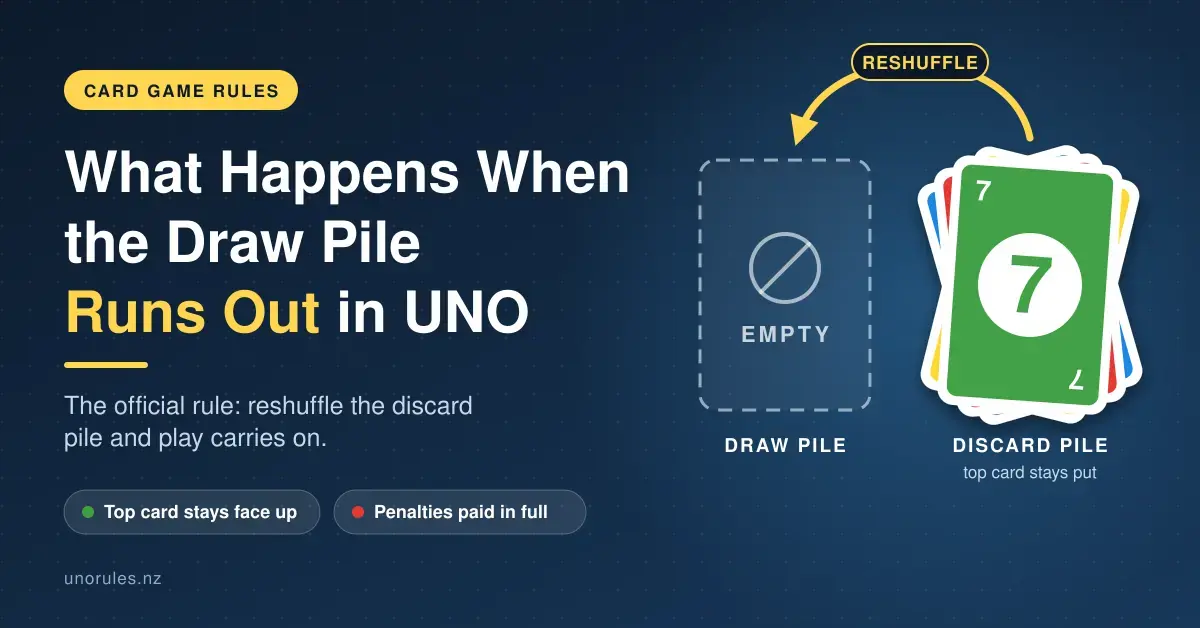
In the fast-paced environment of a standard UNO match, players often burn through the deck faster than expected, especially in games with four or more participants. When the draw pile becomes empty and a player is required to take a card—either by choice or due to an action card like a Draw Two—the game does not stop. Instead, you take the current discard pile (excluding the very top card), shuffle it thoroughly, and place it face down to form a brand-new draw pile. This ensures that the flow of play remains uninterrupted and that the "economy" of cards stays in balance until someone finally shouts "UNO" and plays their last card.

  • Trigger: A player needs to draw a card, but the draw stack is empty.
  • The Anchor: The top card of the discard pile must stay in place to maintain the current color and value in play.
  • The Reset: All cards underneath the top discard are gathered and reshuffled.
  • Deployment: The newly shuffled deck becomes the fresh draw pile.

Trigger: A player needs to draw a card, but the draw stack is empty.

The Anchor: The top card of the discard pile must stay in place to maintain the current color and value in play.

The Reset: All cards underneath the top discard are gathered and reshuffled.

Deployment: The newly shuffled deck becomes the fresh draw pile.

Action PhaseResponsibilityOutcome
IdentificationCurrent player or dealer

Confirms draw pile is at zero

SeparationDealer

Removes the top “active” card from the discard pile

RandomizationDealer

Shuffles the remaining discard pile

ResumptionCurrent player

Draws the required number of cards from the new stack

Confirms draw pile is at zero

Removes the top "active" card from the discard pile

Shuffles the remaining discard pile

Draws the required number of cards from the new stack

Practical Execution of the Reshuffle

When executing the reshuffle, it is vital to ensure that the cards are mixed well. Because the discard pile is often organized in "runs" or clusters of the same color (as players follow suit), a poor shuffle can result in a new draw pile that is highly predictable or frustratingly repetitive. In a New Zealand competitive context, a "bridge" or "riffle" shuffle is usually preferred over a simple "overhand" shuffle to guarantee that the previous game’s sequences are completely broken up, giving everyone a fair shot at a diverse hand.

Maintaining the Active Discard Card

One of the most common mistakes made during the reshuffling process is accidentally including the top card of the discard pile into the new draw deck. This card is the "active" card; it defines what the next player must play against. If you shuffle it back into the deck, you lose the game's continuity. You must keep that single card face-up on the table to serve as the new starting point for the discard pile. Only the cards sitting beneath that top card are eligible to be recycled into the game.

  • Keep the Lead: The top card remains the target for the next move.
  • Clean Slate: The area under the lead card becomes the new foundation for future discards.
  • Transparency: All players should see which card remains so they can plan their next move during the shuffle.

Keep the Lead: The top card remains the target for the next move.

Clean Slate: The area under the lead card becomes the new foundation for future discards.

Transparency: All players should see which card remains so they can plan their next move during the shuffle.

ComponentStatus During ReshufflePurpose
Top Discard CardRemains Face-Up

Sets the current color/number

Lower Discard StackShuffled and Flipped

Becomes the new Draw Pile

Player HandsRemains with Players

No change to current player holdings

Sets the current color/number

Becomes the new Draw Pile

No change to current player holdings

Why the Active Card Stays Put

Imagine a scenario where the top card is a Blue 7. If you shuffle that Blue 7 back into the deck, the player whose turn it is would have nothing to play against. By leaving the Blue 7 on the table, the game state is preserved. This is particularly important if the top card is a "Wild" or "Wild Draw Four," as the color chosen by the previous player must remain the requirement for the next player, even after the deck is reset.

Handling Action Cards During the Reset

A frequent point of confusion arises when the draw pile runs out exactly when a player is forced to "Draw Two" or "Wild Draw Four." If there is only one card left in the draw pile and you are hit with a Draw Two, you take that final card, then immediately perform the reshuffling process described above to obtain the second card. The action does not "fizzle" or cancel out just because the deck is low. The full penalty must always be served, utilizing the newly created draw pile to complete the requirement.

  • Partial Draws: Take what is available first, then shuffle for the remainder.
  • Penalty Continuity: Action cards maintain their full power regardless of deck size.
  • Turn Flow: The player receiving the cards still loses their turn if the card played was a Draw Two or Draw Four.

Partial Draws: Take what is available first, then shuffle for the remainder.

Penalty Continuity: Action cards maintain their full power regardless of deck size.

Turn Flow: The player receiving the cards still loses their turn if the card played was a Draw Two or Draw Four.

Card PlayedDeck StatusResulting Action
Draw Two1 card remaining

Draw 1, reshuffle discard, draw 1 more

Wild Draw Four0 cards remaining

Reshuffle discard, draw 4 cards

Skip0 cards remaining

Next player is skipped; no drawing required unless they choose to

Draw 1, reshuffle discard, draw 1 more

Reshuffle discard, draw 4 cards

Next player is skipped; no drawing required unless they choose to

Example of Action Card Resolution

If Hemi plays a Draw Two on Sarah, but there is only one card in the draw pile, Sarah picks up that one card. The dealer then takes the discard pile (minus Hemi's Draw Two), shuffles it, and Sarah draws her second card from the new pile. Sarah then misses her turn as per the standard rules. This ensures that the tactical advantage of playing an action card is never lost due to the timing of the deck's depletion.

Strategic Implications of a Deck Reset

When the draw pile runs out and is reshuffled, the "memory" of the game is essentially reset. If you have been tracking which cards have been played—for example, noticing that all the "Red" cards seemed to be in the discard pile—you now know that those cards are back in the draw stack. This is a critical moment for strategic players to recalibrate. In the New Zealand finance-minded approach to gaming, we look at this as a "re-balancing of the portfolio." The odds of drawing specific colors or high-value action cards change the moment that discard pile is flipped over.

  • Card Tracking: Note which powerful cards (Wilds, Draw Fours) are returning to the deck.
  • Probability Shift: The likelihood of drawing a specific color resets to a more even distribution.
  • Hand Management: If you know the deck is about to be reshuffled, you might hold onto a Wild card to see what new colors emerge.

Card Tracking: Note which powerful cards (Wilds, Draw Fours) are returning to the deck.

Probability Shift: The likelihood of drawing a specific color resets to a more even distribution.

Hand Management: If you know the deck is about to be reshuffled, you might hold onto a Wild card to see what new colors emerge.

Strategic FactorPre-ReshufflePost-Reshuffle
InformationHigh (many cards are visible/discarded)Low (cards are hidden and randomized)
Risk LevelPredictable (limited pool of cards)Variable (full pool of cards available)
Wild AvailabilityPotentially zero if all are in discard

All discarded Wilds are now draw-able

All discarded Wilds are now draw-able

Mastering the Mid-Game Reset

Advanced players often watch the thickness of the draw pile. If it is getting thin, they may intentionally play certain cards to ensure they end up in the discard pile before the shuffle occurs. This effectively "recycles" their best cards back into the draw pile sooner, increasing the chances they might draw them again later in the game. This level of foresight is what separates casual players from those who consistently win their local UNO nights.

Impact on Scoring and Game Duration

In games where the draw pile runs out frequently, the total duration of the match tends to increase. This is common in "defensive" playstyles where players are forced to draw frequently because they cannot match the discard pile. Since UNO is often played to a point total (like 500 points), a reshuffle means more opportunities for players to accumulate cards in their hands, which ultimately leads to higher scores for the winner of that round. For Kiwi players aiming for a quick game, a reshuffle is a sign that the table is playing very conservatively.

  • Increased Points: More cards in circulation usually mean a higher point total for the round winner.
  • Endurance: Players must maintain focus as the game resets its primary resource.
  • Tempo: The shuffle provides a brief "time-out" that can break an opponent's momentum.

Increased Points: More cards in circulation usually mean a higher point total for the round winner.

Endurance: Players must maintain focus as the game resets its primary resource.

Tempo: The shuffle provides a brief "time-out" that can break an opponent's momentum.

Game MetricEffect of ReshuffleReason
Round LengthIncreases

More cards are available to be drawn and played

Total ScorePotentially Higher

Hands tend to be larger in drawn-out games

ComplexityIncreases

New card sequences emerge from the randomized deck

More cards are available to be drawn and played

Hands tend to be larger in drawn-out games

New card sequences emerge from the randomized deck

Calculating Your Risk

As the draw pile nears its end, the "cost" of drawing a card changes. You are no longer drawing from a known pool of remaining cards, but rather prepping for a total refresh. If you are close to winning, a reshuffle can be dangerous as it might put "Skip" or "Reverse" cards back into your opponents' hands just when you were about to cross the finish line.

House Rules and Local Variations in NZ

While the official Mattel rules dictate a reshuffle, many New Zealand households employ "House Rules" that change what happens when the cards run out. Some families play a "Sudden Death" version where, if the draw pile ends, the player with the fewest cards in their hand is immediately declared the winner. While not official, these variations are part of the local gaming culture and should be agreed upon before the first card is dealt to avoid any backyard barneys.

  • Sudden Death: Game ends when the draw pile is empty; lowest points win.
  • No Reshuffle: Once the pile is gone, you can only play what is in your hand. If you can't play, you pass.
  • The Penalty Draw: Some play that if the deck is empty, the next person to draw must take a "penalty" from the discard pile without a shuffle.

Sudden Death: Game ends when the draw pile is empty; lowest points win.

No Reshuffle: Once the pile is gone, you can only play what is in your hand. If you can't play, you pass.

The Penalty Draw: Some play that if the deck is empty, the next person to draw must take a "penalty" from the discard pile without a shuffle.

Rule TypeMechanismNZ Popularity
Official

Reshuffle discard pile minus top card

Very High (Standard)
Sudden DeathGame ends immediatelyModerate (Short games)
Pass RuleNo draw allowed; skip turn if no matchLow (Can stall game)

Reshuffle discard pile minus top card

Setting Expectations

Always clarify the "Empty Pile" rule before starting. In competitive settings, sticking to the official reshuffle rule is the only way to ensure a balanced game. However, if you're at a BBQ and time is tight, the Sudden Death variant can be a great way to wrap things up before the pavlova is served.

Card Counting and the Draw Pile

While UNO isn't Blackjack, keeping a mental tally of which "0" cards or "Wild Draw Fours" have been played gives you a significant edge. When the draw pile runs out, your mental tally must be reset or adjusted. You now know that every card you saw go into that discard pile is now back in the "unknown" zone of the draw pile. This transition is the perfect time to switch from a defensive strategy to an offensive one, as the distribution of "power cards" has just been randomized again.

  • Wild Awareness: If all four Wild Draw Fours were in the discard, they are now all back in the draw pile.
  • Color Density: If the discard pile was heavily slanted toward Red, the new draw pile will be Red-heavy.
  • Probability: Use the reshuffle to estimate your chances of drawing the specific card you need to win.

Wild Awareness: If all four Wild Draw Fours were in the discard, they are now all back in the draw pile.

Color Density: If the discard pile was heavily slanted toward Red, the new draw pile will be Red-heavy.

Probability: Use the reshuffle to estimate your chances of drawing the specific card you need to win.

Information TypeAccuracy Pre-ShuffleAccuracy Post-Shuffle
Discard History100% (Visible)0% (Randomized)
Deck CompositionHigh (Process of elimination)Low (Total reset)
Opponent NeedsModerateModerate

The "New Deck" Mentality

Treat the reshuffled deck as a completely new game phase. If you were struggling with a hand full of Yellow cards and the deck just reshuffled a pile that was mostly Green and Blue, your chances of "drawing out" of your bad hand have actually improved. Use the reshuffle as a psychological reset to stay in the game.

Troubleshooting Common Reshuffle Issues

Sometimes disputes arise during the reshuffle, particularly regarding who should shuffle and how the cards are handled. To maintain professionalism—especially in NZ club play—the person who played the card that caused the need for a draw should not be the one shuffling. Ideally, the player to the left of the current dealer shuffles the new deck to prevent any accusations of "deck stacking" or "favouritism" toward certain card positions.

  • Dealer Neutrality: The player with the least interest in the current draw should shuffle.
  • Card Integrity: Ensure no cards are stuck together, as UNO cards can get "tacky" with use.
  • Verification: Briefly fan the cards to ensure the "active" discard card wasn't accidentally included.

Dealer Neutrality: The player with the least interest in the current draw should shuffle.

Card Integrity: Ensure no cards are stuck together, as UNO cards can get "tacky" with use.

Verification: Briefly fan the cards to ensure the "active" discard card wasn't accidentally included.

ProblemSolutionPreventive Measure
Missing Active CardStop, find it in the new pile, and restart

Place active card far from discard stack

Biased ShuffleRe-shuffle using a different method

Use a neutral shuffler

Card DamageReplace deck or mark cardRegular deck maintenance

Place active card far from discard stack

Use a neutral shuffler

Keeping the Game Fair

In New Zealand, we value "fair go." If a player is caught trying to peek at the bottom of the discard pile before it’s shuffled, it’s generally considered poor form. Keeping the discard pile squared and tidy throughout the game makes the transition to a new draw pile much smoother and more transparent for everyone involved.

When the Draw Pile Runs Out and No One Can Play

In rare instances, specifically in very small decks or customized games, the draw pile might run out, be reshuffled, and players still find themselves unable to play any cards. This usually happens if the "active" card is a color that no one has, and the new draw pile is also exhausted without anyone finding a match. In this specific "stale-mate" scenario, the round ends immediately. Points are tallied based on the cards remaining in everyone's hands, and the player with the lowest total wins the round.

  • Stalemate Trigger: No cards left in draw pile AND no legal moves possible.
  • Scoring: All players count their hand points.
  • Victory: The lowest point holder receives the total sum of all other players' points.

Stalemate Trigger: No cards left in draw pile AND no legal moves possible.

Scoring: All players count their hand points.

Victory: The lowest point holder receives the total sum of all other players' points.

ScenarioResolution
Playable Card Exists

Game continues until “UNO” is called

No Playable Cards / No Deck

Round ends; point tally occurs

Only Action Cards Left

Action cards are played/drawn until gone

Game continues until "UNO" is called

Round ends; point tally occurs

Action cards are played/drawn until gone

Breaking the Deadlock

To avoid stalemates, ensure you are playing with a full 108-card UNO deck. Using "travel" versions or decks with missing cards significantly increases the likelihood of the draw pile running out prematurely and the game grinding to a halt. A healthy deck is the key to a healthy game.

Final Thoughts on Deck Management

Mastering the mechanics of the draw pile is essential for any serious UNO player. While it seems like a simple administrative task, the reshuffle is a pivotal moment that redistributes resources and resets the tactical landscape. By following the official rules—keeping the active card visible and ensuring a thorough shuffle—you maintain the integrity of the game and keep the competition fierce but fair. Next time the stack runs low, you’ll be ready to manage the transition like a pro, keeping your eyes on the prize and your hands ready for the win.

He Pātai Auau (Frequently Asked Questions)

What do I do if the draw pile is empty?

You must take the current discard pile, leave the top card face up on the table, shuffle the rest of the cards, and place them face down to create a new draw pile.

Does the top card of the discard pile get shuffled?

No, the top card of the discard pile stays on the table to act as the current card that players must match.

Who is responsible for shuffling the new draw pile?

While the rules don't strictly specify, it is common practice for the dealer or a neutral player to shuffle to ensure fairness.

Can I draw the last card of the pile and then play it?

Yes, if you draw the last card and it is playable, you may play it immediately. If not, the deck must be reshuffled before the next person draws.

What happens if I need to draw four cards but only two are left?

You draw the two available cards, then the discard pile is reshuffled, and you draw the remaining two cards from the new stack.

Is there a limit to how many times we can reshuffle the deck?

There is no limit. You continue to reshuffle the discard pile into a new draw pile as many times as necessary until a player wins.

Does the game end if the draw pile runs out twice?

No, the game only ends when a player plays their last card or a stalemate is reached where no one can move.

Can we just stop the game if the deck runs out?

Stopping the game is a common house rule (Sudden Death), but the official rules require a reshuffle to continue play.

Does a Wild card stay on the discard pile during a reshuffle?

Yes, if a Wild card was the last card played, it stays on the table to show the current chosen color for the next player.

What if I don't want to shuffle the discard pile?

To follow the official rules of UNO, you must reshuffle to provide a draw pile for players who cannot make a move.

External Resource

For more information on the history and variations of this game, visit the UNO Wikipedia page.