This comprehensive guide explores the unique mechanics, specialized farm animal pieces, and educational advantages of the Uno Moo rules, providing parents and educators in the New Zealand market with a detailed roadmap for early childhood tabletop gaming. We cover the fundamental objectives of matching colors and animal types, the specific functions of the Farmer Wild figure, and practical advice for transitioning toddlers from simple play to strategic thinking. By understanding the intersection of tactile learning and the classic Uno "match-and-discard" logic, you will learn how to facilitate a fun, developmental environment that builds social skills and pattern recognition. Whether you are setting up a game in a Christchurch preschool or a family living room in Auckland, this guide provides the actionable insights and clear explanations needed to master the rules of this barnyard hit.

Introduction to the Tactile Mechanics of Uno Moo
Uno Moo is a brilliantly simplified version of the world-famous card game, specifically redesigned for the developmental needs of children aged three to six. In the New Zealand context, where early childhood education emphasizes "learning through play," Uno Moo serves as a vital tool for introducing the concepts of turn-taking and rule-following. Instead of a deck of cards, players use chunky, easy-to-grip plastic animal figures—including cows, pigs, sheep, and chickens—and a "barn" that doubles as a carrying case and the game’s discard area. The objective is for players to be the first to get all their animals back into the barn by matching the animal currently standing in the barn door by either its color or its species. This physical interaction with the game pieces makes it an ideal sensory experience for young children whose fine motor skills are still maturing.
The game is designed for two to four players, making it perfect for small playgroups or family bonding. Unlike the standard version, which can feel abstract to a toddler, Uno Moo provides immediate visual and tactile feedback. Every move is a physical act of "returning an animal to the barn," which resonates with a young child's understanding of storytelling and order. The removal of numerical values in favor of animal types reduces the barrier to entry for pre-readers while still reinforcing the core logic that has made the franchise a household name for decades.
- Tactile Play: Chunky plastic figures replace cards for better grip and durability.
- Color Recognition: Brightly colored figures (Red, Blue, Yellow, Green) aid in visual learning.
- Species Identification: Matching by animal type (Cow, Pig, Sheep, Chicken, Skunk).
- Portable Design: The barn unit stores all pieces and acts as the central play hub.
Tactile Play: Chunky plastic figures replace cards for better grip and durability.
Color Recognition: Brightly colored figures (Red, Blue, Yellow, Green) aid in visual learning.
Species Identification: Matching by animal type (Cow, Pig, Sheep, Chicken, Skunk).
Portable Design: The barn unit stores all pieces and acts as the central play hub.
| Component | Quantity | Purpose |
|---|---|---|
| Barn Unit | 1 | Storage and Discard Area |
| Animal Figures | 24 | The “cards” used for matching |
| Farmer Figures | 4 | The Wild pieces |
| Haystacks | 4 | Screen to hide animals from opponents |
Setting Up Your Barnyard Match
Preparation for a round of Uno Moo is exceptionally fast, which is essential when dealing with the shorter attention spans of preschoolers. To begin, all animal and farmer figures are placed inside the barn and mixed thoroughly. Each player then chooses a "haystack" screen to hide their hand from other players. Players draw five figures from the barn at random and place them behind their haystacks. One figure is then drawn from the barn and placed on the "barn door" ledge to serve as the starting animal. If the first animal drawn is a Farmer (Wild), it is returned to the barn and a new piece is selected to ensure a fair starting point for all participants.
In many New Zealand households, the youngest player is traditionally given the first turn, and play proceeds in a clockwise direction. Ensuring each player’s haystack is positioned correctly is vital for maintaining the "secret" element of the game, which adds a layer of excitement as children peek behind their own screens to find a match. This setup phase effectively teaches children about boundaries and the concept of "hidden information" in a low-stakes, fun environment.
- Mix the Figures: Ensure all animals are jumbled inside the barn.
- Draw Five: Each player starts with a small, manageable hand of five pieces.
- The Ledge: The starting piece must be clearly visible on the barn door.
- Haystack Privacy: Teach children to keep their animals "sleeping" behind the screen.
Mix the Figures: Ensure all animals are jumbled inside the barn.
Draw Five: Each player starts with a small, manageable hand of five pieces.
The Ledge: The starting piece must be clearly visible on the barn door.
Haystack Privacy: Teach children to keep their animals "sleeping" behind the screen.
| Setup Step | Action | Detail |
|---|---|---|
| 1. Empty Barn | Open the barn door and mix all figures inside. | Prepares the “deck.” |
| 2. Distribute Screens | Give each player one haystack. | Defines player territory. |
| 3. Draw Hand | Each player takes 5 figures. | Standard starting hand size. |
| 4. Reveal Starter | Place one figure on the door ledge. | Sets the initial color/animal. |
Mastering the Matching Logic for Toddlers
The core of Uno Moo is the matching process. When it is a player’s turn, they look behind their haystack for an animal that matches the one on the barn door. A match can be made by color (e.g., a Blue Cow matches a Blue Pig) or by animal type (e.g., a Red Pig matches a Blue Pig). When a match is found, the player replaces the current animal on the barn door with their own, and the old animal is pushed back into the barn. This physical act of "pushing" the animal into the barn is often a child's favorite part of the game, providing a satisfying conclusion to their turn.
If a player does not have a matching animal or a Farmer, they must draw one figure from the barn. If the new figure matches the one on the barn door, they can play it immediately. If not, they add it to their collection behind their haystack, and the turn passes to the next person. In the New Zealand early childhood curriculum (Te Whāriki), this type of logic-based play is seen as a key step in developing "exploration" and "contribution," as children learn to solve the puzzle of matching while interacting socially with their peers.
- Match by Color: Simplest form of matching for the youngest players.
- Match by Animal: Encourages vocabulary development (Sheep, Cow, etc.).
- Drawing Mechanic: Teaches patience and the concept of "trying again."
- Immediate Play: If a drawn piece matches, the player gets a reward for their luck.
Match by Color: Simplest form of matching for the youngest players.
Match by Animal: Encourages vocabulary development (Sheep, Cow, etc.).
Drawing Mechanic: Teaches patience and the concept of "trying again."
Immediate Play: If a drawn piece matches, the player gets a reward for their luck.
Understanding the Farmer Wild Figures
The Farmer figures in Uno Moo are the equivalent of the Wild cards in the standard version. These pieces are white and depict a friendly farmer. A Farmer can be played on any turn, regardless of what animal or color is currently on the barn door. When a player uses a Farmer, they get to choose what the next color of play will be. This introduces a basic level of strategy, as the child is encouraged to choose a color that they have plenty of in their own hand.
Strategically, the Farmer is a powerful tool for escaping a situation where you have no other matches. However, because there are only four Farmers in the set, they must be used wisely. Parents can use the Farmer's appearance as a teaching moment to ask, "The Farmer is looking for a color—which one should we pick?" This helps the child move beyond rote matching into the realm of decision-making. .Read more in Wikipedia.
| Figure Type | Power | Result |
|---|---|---|
| Animal Piece | Standard Match | Changes color or animal type. |
| Farmer (Wild) | Change Color | Allows player to dictate the next suit. |
| Skunk (Penalty) | Skip/Draw | (In some variants) Forces a skip or draw action. |
The Special Role of the Skunk Piece
In many versions of Uno Moo, the Skunk figure serves as the "Action Card." The Skunk usually acts as a "Skip" or a "Draw Two" equivalent, depending on the specific edition's rules. When a player plays a Skunk, the next player must miss their turn, or in more advanced variants, they might have to draw an extra animal from the barn. The Skunk introduces the concept of "mild competition" to the game, teaching children that sometimes things don't go their way, but the game continues regardless.
Handling the Skunk is a great way to build emotional resilience in young children. It is often helpful for parents to "over-act" the Skunk's arrival with a silly "Phew! Stinky!" reaction to keep the mood light. This ensures that the child sees the Skunk as a fun game mechanic rather than a frustrating setback. By the time a child has mastered the Skunk’s effect, they are usually ready to start thinking about more complex social games.
- Skip Turn: The next player must wait until the following round.
- Draw Penalty: (Variant) Next player draws one or two animals.
- Stinky Fun: Use humor to mitigate the frustration of being skipped.
- Strategic Blocking: Save the Skunk for when an opponent has only one animal left.
Skip Turn: The next player must wait until the following round.
Draw Penalty: (Variant) Next player draws one or two animals.
Stinky Fun: Use humor to mitigate the frustration of being skipped.
Strategic Blocking: Save the Skunk for when an opponent has only one animal left.
The Essential "Uno Moo" Declaration
The most iconic rule of the franchise is preserved here, but with a thematic twist. When a player has only one animal figure left behind their haystack, they must shout "Uno Moo!" This alerts the other players that someone is about to win. If a player fails to shout "Uno Moo" and is caught by another player before the next person begins their turn, they must draw two animals from the barn as a penalty.
This rule is vital for teaching children about awareness and the "endgame" phase of a match. In the excitement of play, toddlers often forget the shout. As a parent or educator, reminding the child gently at first, and then gradually enforcing the draw penalty as they become more experienced, helps them develop focus. The "Uno Moo" shout is a celebratory moment that builds anticipation for the victory and keeps everyone at the table alert.
- Shout Requirement: Must say "Uno Moo" at exactly one animal remaining.
- The Penalty: Drawing two animals if caught by an opponent.
- The Window: Opponents must "catch" the mistake before the next turn starts.
- Reinforcement: Practice the shout together to make it a fun ritual.
Shout Requirement: Must say "Uno Moo" at exactly one animal remaining.
The Penalty: Drawing two animals if caught by an opponent.
The Window: Opponents must "catch" the mistake before the next turn starts.
Reinforcement: Practice the shout together to make it a fun ritual.
| Scenario | Action | Penalty |
|---|---|---|
| 1 Animal Left (Shouted) | Play continues normally. | No penalty. |
| 1 Animal Left (Forgot) | Opponent says “Caught you!” | Draw 2 animals. |
| Last Animal Played | Player wins the round! | No penalty. |
Scoring and Winning the Round
In Uno Moo, the concept of winning is kept very simple. There are no complex point calculations or mathematical tallies like in the adult version. The first player to get all of their animals back into the barn is the winner of that round. This immediate gratification is perfect for preschoolers, as it provides a clear and understandable goal. Once a winner is declared, the animals are all put back into the barn, mixed up, and a new round can begin.
For older children in the 5-6 age range who are beginning to learn basic counting, you can introduce a simple scoring system where the winner gets a "sticker" or a "point" for every animal left behind the other players' haystacks. This can help extend the game session and provide a longer-term goal for the afternoon. However, for most Kiwi families, the "first out wins" rule is the gold standard for a stress-free game night.
- Primary Goal: Empty the haystack of all animal figures.
- Winning Action: Push the final animal into the barn.
- Replayability: Rounds are short, allowing for multiple winners in one hour.
- Simplified Logic: Avoids the "500 points" complexity of standard Uno.
Primary Goal: Empty the haystack of all animal figures.
Winning Action: Push the final animal into the barn.
Replayability: Rounds are short, allowing for multiple winners in one hour.
Simplified Logic: Avoids the "500 points" complexity of standard Uno.
Strategic Tips for Preschoolers
While Uno Moo is largely a game of luck, there are basic strategies that parents can teach their children to help develop their logic skills. One such strategy is "Saving the Farmer." Teach the child that the Farmer is a "helper" that should be used only when they have no other animals to play. This introduces the concept of resource management. Another tip is to look at the animals behind the screen and decide which color they have the most of, then try to change the barn door to that color as soon as possible.
These small tactical decisions help move the child away from passive play into an active, thinking role. In the New Zealand context, where "problem-solving" is a key competency in the primary school curriculum, these early strategic habits provide a solid foundation. Even something as simple as choosing which animal to play when you have two matches is a significant cognitive exercise for a four-year-old.
- Farmer Preservation: Don't use your "helper" too early.
- Majority Rule: Aim to change the color to the one you have the most pieces in.
- Observation: Pay attention to which colors other players are drawing.
- Pattern Prep: Arrange your haystack by color to see matches faster.
Farmer Preservation: Don't use your "helper" too early.
Majority Rule: Aim to change the color to the one you have the most pieces in.
Observation: Pay attention to which colors other players are drawing.
Pattern Prep: Arrange your haystack by color to see matches faster.
| Strategy | Action | Cognitive Benefit |
|---|---|---|
| Hand Organization | Group same-colored animals. | Sorting and categorization. |
| Wild Choice | Call the color you have most of. | Basic probability. |
| Turn Waiting | Wait for your turn quietly. | Social self-regulation. |
Common Mistakes and How to Avoid Them
The most frequent mistake in Uno Moo occurs during the draw phase. Many children (and some adults) assume that if you draw an animal, you must keep it even if it matches the barn door. According to the official Uno Moo rules, if you draw a matching animal, you can play it immediately. Another common error is "barn door confusion," where players try to match the animal that was just pushed into the barn rather than the one currently sitting on the ledge.
To avoid these pitfalls, it is helpful for an adult to act as a "referee" for the first few games. Clearly pointing to the animal on the ledge and saying, "This is the boss animal we have to match!" helps keep the game on track. Additionally, ensuring that the barn door is fully closed after each push prevents animals from falling out and confusing the game state.
- Draw-and-Play: Remind children they can play a lucky draw right away.
- Ledge Focus: Always match the figure on the "balcony" of the barn.
- One Move per Turn: Ensure children don't try to play multiple animals at once.
- Barn Hygiene: Keep the barn area clear of stray pieces.
Draw-and-Play: Remind children they can play a lucky draw right away.
Ledge Focus: Always match the figure on the "balcony" of the barn.
One Move per Turn: Ensure children don't try to play multiple animals at once.
Barn Hygiene: Keep the barn area clear of stray pieces.
Final Thoughts on the Uno Moo Experience
Uno Moo is a masterpiece of simplified game design, perfectly capturing the spirit of the original Uno while tailoring the experience for the smallest hands and newest minds. It successfully bridges the gap between toy play and game play, offering New Zealand families a durable, educational, and genuinely fun way to spend time together. By focusing on color and animal recognition, the game builds foundational skills that children will use throughout their lives, all while they think they are just "helping the sheep go to bed." Mastering the Farmer's wild potential and the excitement of the "Uno Moo" shout ensures that every game night is a success. For any Kiwi parent looking to introduce their child to the world of tabletop gaming, Uno Moo is the perfect first step on that journey.
Quick Reference Summary Table
| Game Aspect | Detail |
|---|---|
| Age Group | 3 to 6 years old. |
| Starting Hand | 5 animal/farmer figures. |
| Match Rule | Match color or animal type on the ledge. |
| Farmer Figure | Acts as a Wild; changes the color. |
| Victory Condition | First to get all 5 animals into the barn. |
FAQ
What is the age range for Uno Moo? Uno Moo is specifically designed for children aged 3 to 6 years.
How many pieces do you start with? Each player starts with five figures (animals or farmers) hidden behind their haystack.
Do you have to say "Uno Moo" when you have one piece left? Yes, it is a core rule. If you forget and are caught, you must draw two animals as a penalty.
What happens if I draw a matching animal from the barn? If the animal you draw matches the color or species on the barn door, you can play it immediately.
Are the pieces safe for toddlers? The figures are chunky and designed for small hands, but as with all toys with small parts, adult supervision is recommended for children under 3.
Can two people play Uno Moo? Yes, the game is designed for 2 to 4 players.
What is the Farmer's role? The Farmer is a Wild piece. It can be played on any turn, and the player chooses the next color.
How long does a typical game last? A round of Uno Moo usually takes about 5 to 10 minutes, making it ideal for young attention spans.
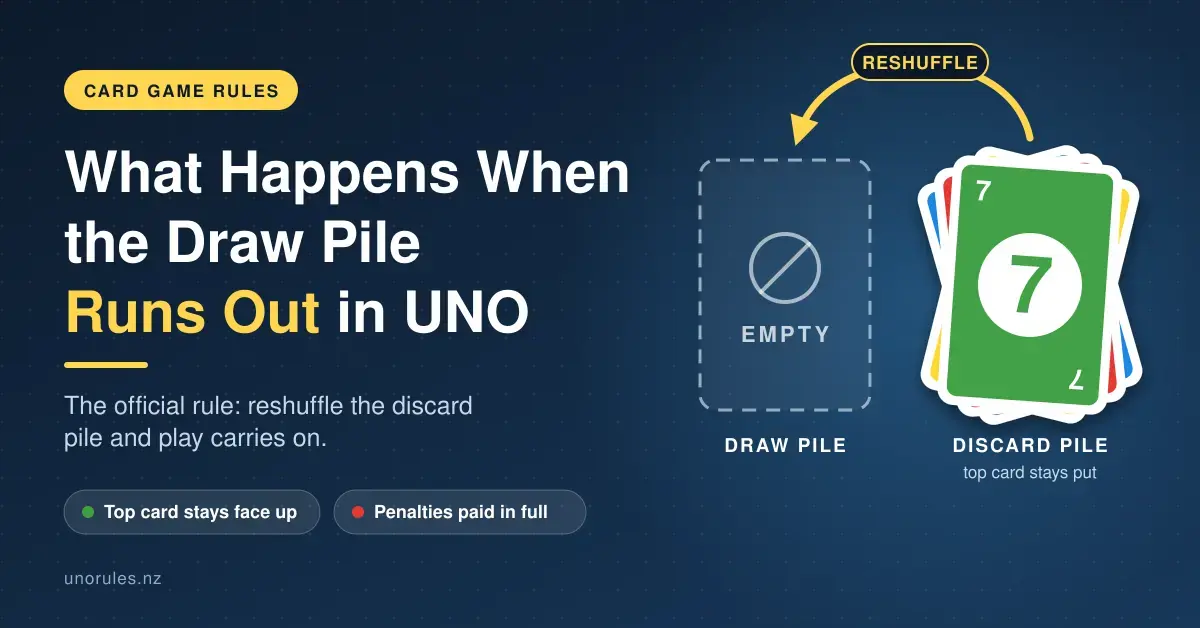
What happens if the barn is empty of draw pieces? Open the barn door, mix up the animals already inside, and continue drawing as needed.
Why is it called Uno Moo? It is a play on the original "Uno" name combined with the thematic sound of a cow ("Moo") to highlight the farm theme.
IMAGE LIST FORMAT: create image for; uno-moo-rules-setup.jpg – “A top-down view of the Uno Moo barn on a play mat with colorful animal figures (Cows, Pigs, Sheep) and haystack screens set up for four players.”
METAS: META TITLE: Uno Moo Rules: The Complete Preschool Game Guide META DESCRIPTION: Learn the official Uno Moo rules for toddlers. Master color and animal matching, the Farmer Wild figure, and the 'Uno Moo' shout with our expert guide.