This comprehensive guide provides an in-depth analysis of the Uno Dice rules, exploring how the traditional card game mechanics transition into a fast-paced tabletop experience using specialized dice and trays. We cover everything from the initial setup and the unique functions of action faces on the dice to advanced strategies for managing your tray and blocking opponents. By examining the nuances of "drawing" dice, the critical importance of the "Uno" shout, and the point-based scoring system popular in the New Zealand gaming circuit, players will gain the tactical knowledge necessary to dominate their next game night. Whether you are a veteran of the classic card game or a newcomer to the dice-based variant, this guide offers actionable insights and clear examples to help you navigate the rolls and secure a victory.

Introduction to the Mechanics of Uno Dice
Uno Dice takes the globally recognized "match by color or number" logic of the original card game and applies it to a tactile, high-energy dice format. Instead of a hand of cards, each player is given a set of dice and a tray to hold them. The game eliminates the need for shuffling and replaces it with the sound of rolling plastic, making it a favorite for outdoor gaming and social clubs in New Zealand. The objective remains the same: be the first player to empty your tray by matching the die on the "active" play area. The transition from cards to dice introduces a physical element where players must physically roll to "draw," adding a layer of suspense that differs significantly from the standard deck.
The game is designed for 2 to 4 players and is highly portable, making it ideal for the Kiwi lifestyle, whether at a beach bach or a rainy day indoors. The deck is replaced by 11 specialized dice, featuring numbers 1 through 6 in four standard colors (Red, Yellow, Blue, and Green), alongside various action symbols. Understanding how these symbols interact is key to mastering the game, as the dice variant moves much faster than the card version, requiring quick reflexes and even quicker decision-making.
- Fast-Paced Gameplay: Rounds typically last 5–10 minutes.
- Tactile Engagement: Players physically roll dice into a central play area.
- Accessible Learning Curve: If you know the card game, you can learn the dice version in seconds.
- New Zealand Popularity: Frequently featured in local "board game cafes" across Auckland and Wellington.
Fast-Paced Gameplay: Rounds typically last 5–10 minutes.
Tactile Engagement: Players physically roll dice into a central play area.
Accessible Learning Curve: If you know the card game, you can learn the dice version in seconds.
New Zealand Popularity: Frequently featured in local "board game cafes" across Auckland and Wellington.
| Feature | Uno Card Game | Uno Dice Game |
|---|---|---|
| Primary Tool | 108 Card Deck | 11 Specialized Dice |
| Player Count | 2 – 10 Players | 2 – 4 Players |
| Setup Time | Medium (Shuffling) | Very Fast (Distribute trays) |
| Portability | High | Extreme (Small pouch) |
Setting Up Your Uno Dice Match
Setting up a match is remarkably straightforward. Each player takes one of the four colored trays and is dealt a set number of dice—usually five dice each for a standard game. One die is chosen at random to be the "starting" die. This die is rolled and placed in the center of the play area (often inside the provided case or a specialized play mat). The remaining dice that are not distributed to players form the "Draw Pile" or "Bank." These are kept in a central location where any player can grab them when required.
In the New Zealand context, where "House Rules" are often part of the charm, some families choose the dealer by having everyone roll one die, with the highest number taking the first turn. However, the official rules state the player to the left of the person who set up the game begins. Players keep their dice in their trays, facing away from other players to keep their "hand" secret. Ensuring the trays are placed on a flat surface is essential, as a stray die roll can easily disrupt the game state.
- Distribute Trays: Each player gets one tray to hold their dice.
- Starting Hand: Deal 5 dice to each participant.
- Center Die: Roll one die to start the "Discard" area.
- Turn Order: Play traditionally proceeds in a clockwise direction.
Distribute Trays: Each player gets one tray to hold their dice.
Starting Hand: Deal 5 dice to each participant.
Center Die: Roll one die to start the "Discard" area.
Turn Order: Play traditionally proceeds in a clockwise direction.
| Setup Step | Action Required | Responsibility |
|---|---|---|
| 1. Choose Banker | Select someone to manage the extra dice. | All Players |
| 2. Distribution | Give 5 dice to each player for their trays. | Banker |
| 3. Initial Roll | Roll 1 die into the center to start. | Starting Player |
| 4. Alignment | Arrange dice in trays so only you see them. | Individual Players |
Mastering the Matching and Rolling Logic
On your turn, you look at the die currently in the center play area. You must play a die from your tray that matches either the color or the number of the center die. For example, if the center die shows a "Blue 4," you can play any Blue die or any color die that shows a "4." To play a die, you simply move it from your tray into the center, replacing the previous die. The die you just played now becomes the new active die that the next player must match.
If you do not have a matching die in your tray, you must "draw" by taking one die from the Bank and rolling it. If the rolled die matches the center die, you may play it immediately. If it does not match, you must add that die to your tray, increasing your count and making it harder to win. This "roll to draw" mechanic is the most significant departure from the card game, as it adds a level of randomness that can either save a player or buries them under a mountain of dice.
- Match by Color: Play a Yellow die on a Yellow die.
- Match by Number: Play a 3 on a 3.
- No Match: Take a die from the Bank, roll it, and keep it if it doesn't match.
- Turn End: Your turn is over after you either play a die or add a rolled die to your tray.
Match by Color: Play a Yellow die on a Yellow die.
Match by Number: Play a 3 on a 3.
No Match: Take a die from the Bank, roll it, and keep it if it doesn't match.
Turn End: Your turn is over after you either play a die or add a rolled die to your tray.
Understanding the Action Symbols on the Dice
The specialized dice in Uno Dice feature unique symbols that mirror the action cards in the original game. These symbols are the primary way players interact with and disrupt their opponents. The "Skip" symbol forces the next player to lose their turn, while the "Reverse" symbol changes the direction of play. Because there are only four players max, a "Reverse" in a two-player game functions effectively as a "Skip," returning the turn immediately to the person who rolled it.
The "Draw Two" symbol is a powerful offensive tool. When you play a die with this symbol, the next player must take two dice from the Bank and add them to their tray without getting a chance to play on that turn. Understanding the distribution of these symbols is vital; they appear on the dice faces alongside numbers, meaning a single die might be your only way to defend yourself against an opponent who is down to their last die. .Read more in Wikipedia.
| Action Symbol | Icon | Result |
|---|---|---|
| Skip | 🚫 | Next player misses their turn. |
| Reverse | ⇄ | Play direction switches. |
| Draw Two | +2 | Next player takes 2 dice and misses turn. |
| Wild | ⦾ | You choose the next color. |
The Strategic Use of Wild Dice
Wild dice are the most versatile assets in your tray. A Wild die can be played on any color or number. When you play a Wild, you must announce the color that the next player must match. In the New Zealand market, players often use the Wild die to switch the game to a color they have a surplus of, ensuring they can go out on their subsequent turns. Some versions of Uno Dice also include a "Wild Draw Four" face, though this is rarer and often substituted by the "Wild" face with an extra draw penalty in modern sets.
Strategically, saving a Wild die for your final move is a common tactic. Since a Wild matches everything, it is a guaranteed way to empty your tray once you are down to one die. However, if an opponent plays a "Draw Two" on you before you can use your Wild, you might find yourself stuck with three or four dice again, losing the advantage. Managing your "Wilds" versus your standard numbered dice is the hallmark of a skilled Uno Dice player.
- Color Control: Use Wilds to force opponents into colors they are lacking.
- Emergency Match: Use a Wild if you have no other legal moves to avoid drawing.
- Declaration: You must clearly state the new color as the die hits the center.
- Risk: Holding onto a Wild too long can lead to a high point penalty if you lose.
Color Control: Use Wilds to force opponents into colors they are lacking.
Emergency Match: Use a Wild if you have no other legal moves to avoid drawing.
Declaration: You must clearly state the new color as the die hits the center.
Risk: Holding onto a Wild too long can lead to a high point penalty if you lose.
The Critical "Uno" Rule for Dice
Just like the card game, you must alert your opponents when you are close to winning. When you have only one die left in your tray, you must shout "Uno!" loudly enough for all players to hear. This must be done the moment your second-to-last die is played into the center. If you fail to say "Uno" and another player catches you before the next person takes their turn, you are penalized and must draw two dice from the Bank and add them to your tray.
In the fast-paced environment of a Kiwi family game night, opponents will be watching your tray like hawks. The "Uno" shout is often the most contested part of the game. If you play your last die and haven't been caught for forgetting the shout, you win the round. However, if your last die is an action die (like a Draw Two), the penalty applies to the next player before the round is officially tallied, which can impact the final score.
| Scenario | Action | Penalty |
|---|---|---|
| 1 Die Left (Shouted) | Play continues. | None. |
| 1 Die Left (Forgot) | Caught by opponent. | Draw 2 Dice. |
| Last Die Played | Round ends. | None (if shouted previously). |
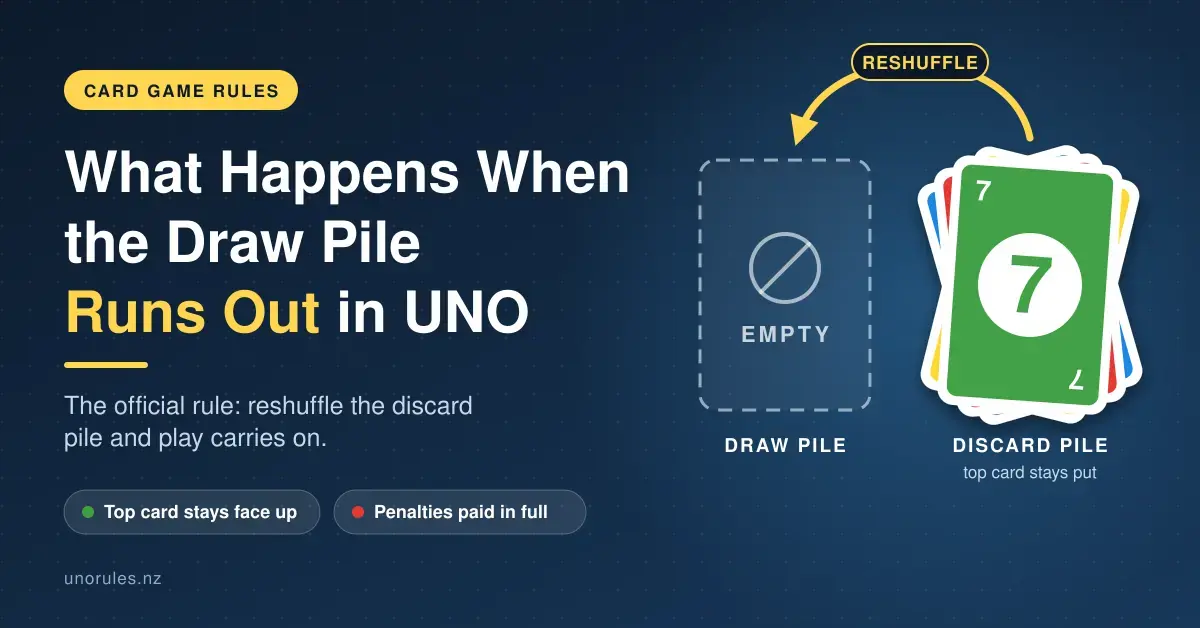
| Bank is Empty | Reshuffle center (except top). | None. |
Scoring Systems and Winning the Match
While a single round determines a "winner," many players in New Zealand use a point-based scoring system to determine the champion of a full evening of play. When a player empties their tray, they receive points based on the dice remaining in their opponents' trays. Numbered dice are worth their face value (a die showing a 5 is 5 points). Action dice like Skip and Reverse are worth 20 points each, and Draw Two dice are worth 20 points. Wild dice are the most valuable, worth 50 points each.
The first player to reach a cumulative total of 500 points across multiple rounds is declared the ultimate winner. This system discourages players from "hoarding" Wild dice or Draw Twos, as being caught with them at the end of a round significantly boosts the winner's score. It adds a layer of risk-management to the game, forcing you to decide whether to play your high-value dice early or save them for a strategic block later on.
- Number Dice: Face value (1-6).
- Skip/Reverse/Draw Two: 20 Points each.
- Wild Dice: 50 Points each.
- Match Winner: First to 500 points.
Number Dice: Face value (1-6).
Skip/Reverse/Draw Two: 20 Points each.
Wild Dice: 50 Points each.
Match Winner: First to 500 points.
Advanced Strategy: Tray Management
Managing your tray is about more than just matching colors; it's about probability. Since there are fewer dice than cards, you can often track which colors have been played recently. If you notice a lot of Green dice are currently in the Bank or in other players' trays, switching the color to Green using a Wild might be a poor move for you but a great way to block a specific opponent. In New Zealand's competitive social gaming scene, "Defensive Rolling" is a common term used for players who intentionally switch colors to force a draw.
Another key strategy is "Number Baiting." If you have two 4s of different colors, play one to see if the next player can match the number. If they can't and are forced to draw, you have successfully narrowed their options. Always keep your dice organized in your tray so you can see your matches at a glance; the speed of Uno Dice means that fumbling with your tray can lead to missed opportunities or accidental reveals of your hand to opponents.
| Strategy Type | Action | Objective |
|---|---|---|
| Aggressive | Play Draw Twos early. | Force opponents to fill trays. |
| Defensive | Save a Wild for your last die. | Ensure a win on the final turn. |
| Observational | Track which colors players draw on. | Identify and exploit weaknesses. |
| Reflexive | Shout “Uno” as the die leaves your hand. | Avoid the 2-dice penalty. |
Playing Uno Dice with Two Players
Uno Dice is highly adaptable for two players, but the dynamics shift. The "Reverse" die, which normally changes the direction of play, becomes a "Skip" die. This allows one player to potentially take multiple turns in a row if they have several Reverse or Skip dice. In 1v1 play, the game becomes much more aggressive, with players "stacking" penalties (if agreed upon as house rules) to try and bury the opponent under a dozen dice.
For a balanced two-player experience, many Kiwi households use a lower point threshold for winning the match, such as 250 points instead of 500. This keeps the match moving quickly and allows for more "rematches." Because you only have one person to worry about, you can focus entirely on blocking their specific colors, making the game feel much more like a strategic duel than a chaotic group activity.
- Reverse = Skip: The turn returns to you immediately.
- Targeting: You only have one opponent to block, making color tracking easier.
- Point Caps: Consider playing to 250 points for a shorter session.
- Draw Frequency: Rolls are more frequent, leading to faster Bank depletion.
Reverse = Skip: The turn returns to you immediately.
Targeting: You only have one opponent to block, making color tracking easier.
Point Caps: Consider playing to 250 points for a shorter session.
Draw Frequency: Rolls are more frequent, leading to faster Bank depletion.
Common Mistakes and Rule Clarifications
A frequent mistake in Uno Dice is forgetting that you must roll the die you take from the Bank. You cannot just add it to your tray and end your turn. The act of rolling gives you a chance to play it immediately, and skipping this step is a common technical error. Another point of confusion is the "Wild" declaration; you must declare the color before the next player rolls or plays. If you forget, the next player can technically choose the color themselves in some strict tournament settings.
Finally, keep an eye on the Bank. If the Bank runs out of dice, the round doesn't end. Instead, you take all the dice in the center play area (except for the very top die), roll them all to "reset" the randomness, and place them back in the Bank. This rarely happens in 4-player games but can occur in 2-player duels where both participants have had a streak of bad luck and have filled their trays with a dozen dice each.
- Must Roll the Draw: You cannot simply "take" a die.
- Declaring Colors: Be prompt and clear to avoid disputes.
- Empty Bank: Reshuffle the center pile to keep the game going.
- Die Placement: Dice must be placed clearly in the center to be "active."
Must Roll the Draw: You cannot simply "take" a die.
Declaring Colors: Be prompt and clear to avoid disputes.
Empty Bank: Reshuffle the center pile to keep the game going.
Die Placement: Dice must be placed clearly in the center to be "active."
Final Thoughts on Uno Dice
Uno Dice is a brilliant evolution of a classic, offering a unique blend of tactile satisfaction and strategic depth. Its portability and speed make it an essential addition to any New Zealand game collection, particularly for those who enjoy the "take that" style of gameplay that the Uno franchise is known for. By mastering the action symbols, managing your tray with probability in mind, and never forgetting that all-important "Uno" shout, you can turn a simple game of luck into a showcase of tabletop skill. Whether playing a casual round at a Kiwi BBQ or a competitive match to 500 points, Uno Dice delivers excitement in every roll.
Quick Reference Summary Table
| Game Aspect | Detail |
|---|---|
| Winning Score | 500 Points (Standard). |
| Starting Hand | 5 Dice per player. |
| Action Penalty | Draw Two (Adds 2 dice and skips turn). |
| Special Rules | Must shout “Uno” on last die. |
FAQ
How many dice are in a standard Uno Dice game? Most sets come with 11 specialized dice, though some "Deluxe" or "Travel" versions may vary slightly in quantity.
What happens if I draw a Wild die from the Bank? If you draw it on your turn, you roll it. If it lands on a Wild face, you can play it immediately and choose the next color.
Can you stack "Draw Two" dice in Uno Dice? According to official rules, no. However, many New Zealand families play "Stacking" as a popular house rule.
What age is Uno Dice suitable for? The game is recommended for ages 7 and up, as it requires basic number and color recognition and simple strategy.
How do you score a round if nobody can move? If the Bank is empty and no one can play, the player with the fewest points in their tray wins the round.
Can I play a Skip die as my last die? Yes, you can win the game by playing any legal die, including action dice.
Is there a difference between the colors on the trays and the dice? No, the tray colors are just to help players identify their own dice; they have no mechanical impact on the matching rules.
What if a die lands on the floor? Standard "Kiwi rules" usually dictate a re-roll of that specific die.
Can I hide my dice from other players? Yes, the trays are specifically designed to keep your "hand" hidden from your opponents.
How long does a full match to 500 points take? Depending on the number of players, a full match can take anywhere from 30 to 60 minutes.