UNO ColorADD is an edition of the classic card game built so that people with colour blindness can identify every card without relying on colour alone. It pairs the familiar UNO deck with the ColorADD symbol system — a small set of geometric shapes that stand in for each colour. This guide explains what the edition is, how the symbols work, how a game is set up and played, how scoring and the “Uno” call work, and who the game suits. Every rule matches the official UNO ruleset; only the colour cues are added.
Key Points
- What it is: UNO with the ColorADD symbol system printed on every card for colour-blind-friendly play.
- Same rules: gameplay, scoring and the “Uno” call are identical to standard UNO.
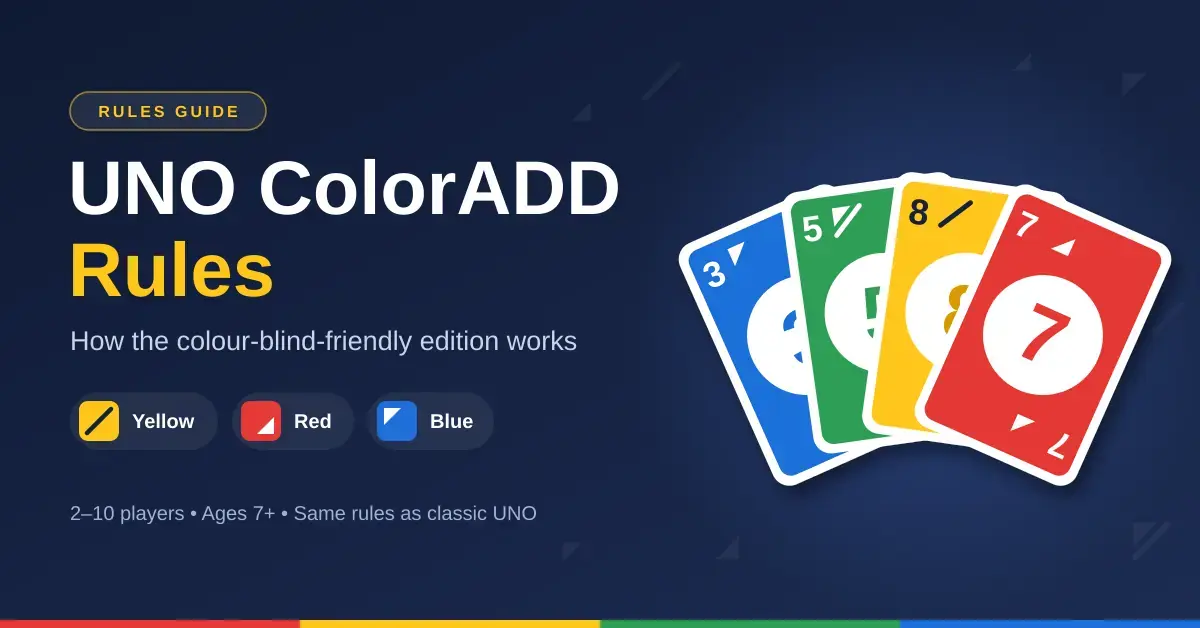
- Three base symbols: a diagonal line (yellow), an upward triangle (red) and a downward triangle (blue); combinations show green, orange and purple.
- Made by: Mattel, using the ColorADD code created by Miguel Neiva.
- For whom: 2–10 players, ages 7+, including mixed colour-blind and colour-sighted groups.
What UNO ColorADD Is
UNO ColorADD is a version of UNO released by Mattel on 6 September 2017, a date chosen to coincide with International Colour Blind Awareness Day. It plays exactly like the standard UNO rules; the only difference is that every card carries a small ColorADD icon in two of its corners, so the colour can be read as a shape rather than as a hue.
The ColorADD system was created in 2009 by Portuguese designer Miguel Neiva. Mattel licensed it so that colour-blind and fully sighted players can compete on equal footing. Colour vision deficiency is common — it affects roughly 1 in 12 men (about 8%) and around 1 in 200 women — and its most frequent form makes red and green hard to tell apart, which is exactly the distinction that ordinary UNO leans on. If you are interested in accessible editions, Mattel also produces a tactile UNO Braille edition.
Quick Facts
| Game | UNO ColorADD |
| Publisher | Mattel |
| Colour system | ColorADD, created by Miguel Neiva (Portugal, 2009) |
| First released | 6 September 2017 (International Colour Blind Awareness Day) |
| Players | 2–10 |
| Recommended age | 7 and up |
| Deck | 108 cards (standard UNO composition) |
| Launch price | US.99 (MSRP at release) |
| Availability | Limited release; stock varies at retailers |
How the ColorADD Symbol System Works
ColorADD gives each primary colour a single simple shape. Secondary colours are shown by combining two primary shapes, which mirrors how those colours are physically mixed. Once you learn three symbols, you can read the whole deck.
| Colour | ColorADD symbol | How to read it |
|---|---|---|
| Yellow | Diagonal line (slash) | A single slanted stroke. |
| Red | Triangle pointing up | A triangle with its point angled upward. |
| Blue | Triangle pointing down | A triangle with its point angled downward. |
| Green | Blue triangle + yellow slash | The two primaries that mix to make green. |
| Orange | Red triangle + yellow slash | The two primaries that mix to make orange. |
| Purple | Red triangle + blue triangle | The two primaries that mix to make purple. |
Only three base shapes need memorising: the diagonal line, the upward triangle and the downward triangle. Green, orange and purple simply place two of these shapes together on one card. Even when two shapes appear, the card still represents a single colour — not two separate instructions.
Setting Up a Game
Setup is identical to classic UNO. Shuffle the deck and deal seven cards face down to each player. Place the remaining cards face down as the draw pile, then turn the top card over to start the discard pile. If that first card is an action card, its effect applies to the first player (for example, a Draw Two makes them draw two cards and miss their turn).
Because the ColorADD icons are small, a flat, well-lit surface helps everyone read them clearly — a small courtesy that also helps players with other visual impairments.
| Step | Action | Who does it |
|---|---|---|
| 1. Shuffle | Mix the full deck thoroughly. | Dealer |
| 2. Deal | Give seven cards to each player. | Dealer |
| 3. Start pile | Flip the top card to begin the discard pile. | Dealer |
| 4. Check icons | Make sure everyone can see the ColorADD symbols. | All players |
Matching Cards by Colour, Number or Symbol
On your turn you play a card that matches the top of the discard pile by colour, number or action symbol. This is where ColorADD helps: a colour-blind player can match by colour simply by looking for the same shape. If the top card is a Red 7, you may play any red card (look for the upward triangle), any 7 of another colour, or a Wild.
- Colour match: play a card with the same ColorADD shape.
- Number match: play a card with the same digit (0–9), whatever its colour.
- Symbol match: play an action card on another of the same type.
- Wild: a Wild card can be played on any turn.
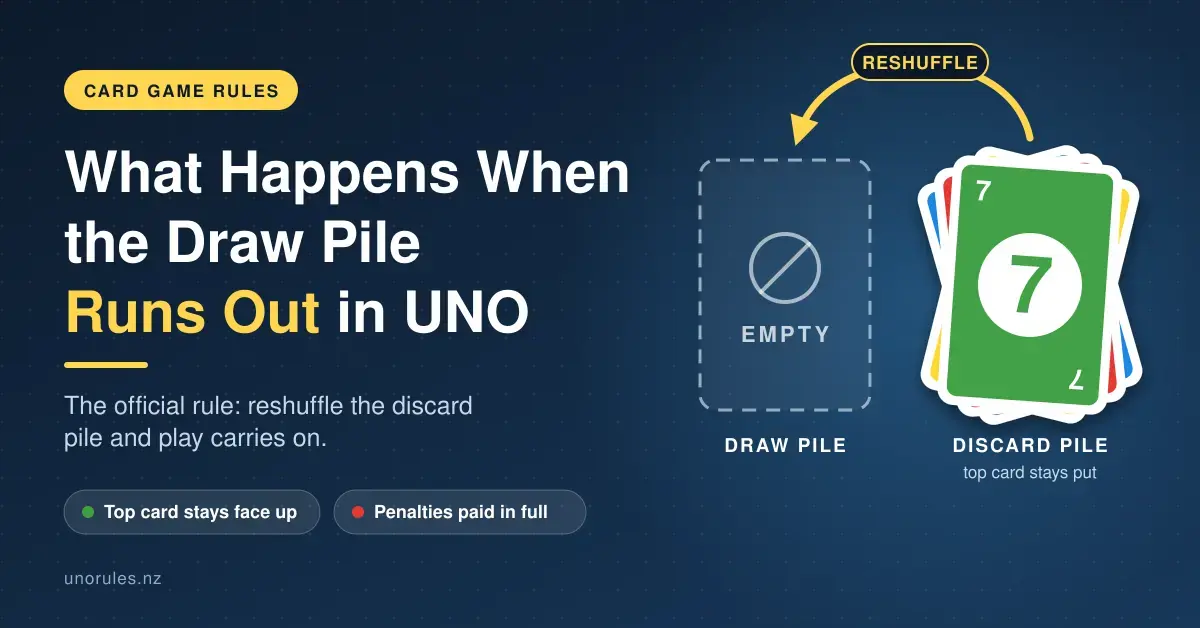
If you cannot match, draw one card from the draw pile. If that card is playable you may play it straight away; if not, your turn ends and play passes on. You draw only once per turn — you cannot keep drawing in search of a better card.
Action Cards: Skip, Reverse and Draw Two
Action cards add the tactical bite to UNO. A Skip makes the next player miss their turn. A Reverse flips the direction of play; in a two-player game the Reverse card effectively acts as a Skip. A Draw Two forces the next player to take two cards and lose their turn. All of these are colour-coded and carry the ColorADD symbol, so they can be played on a matching colour or on another action card of the same type.
Under official Mattel rules you cannot “stack” a Draw Two on another Draw Two to pass along the penalty unless everyone agrees to that house rule before play begins. Keeping to the official rule avoids mid-game disputes. For general background reading, see Wikipedia.
| Action card | What it does | Effect on the next player |
|---|---|---|
| Skip | Skips the next turn. | Player is bypassed. |
| Reverse | Changes the direction of play. | Turn order switches; in 2-player it acts as a Skip. |
| Draw Two | Forces a draw and a skip. | Next player draws 2 cards and loses their turn. |
Wild and Wild Draw Four Cards
There are two Wild cards. A standard Wild can be played at any time and lets you choose the next colour. For accessibility, the player choosing the colour should say both the colour name and its shape — for example, “Blue, the downward triangle” — so every player, sighted or colour-blind, knows what is in play.
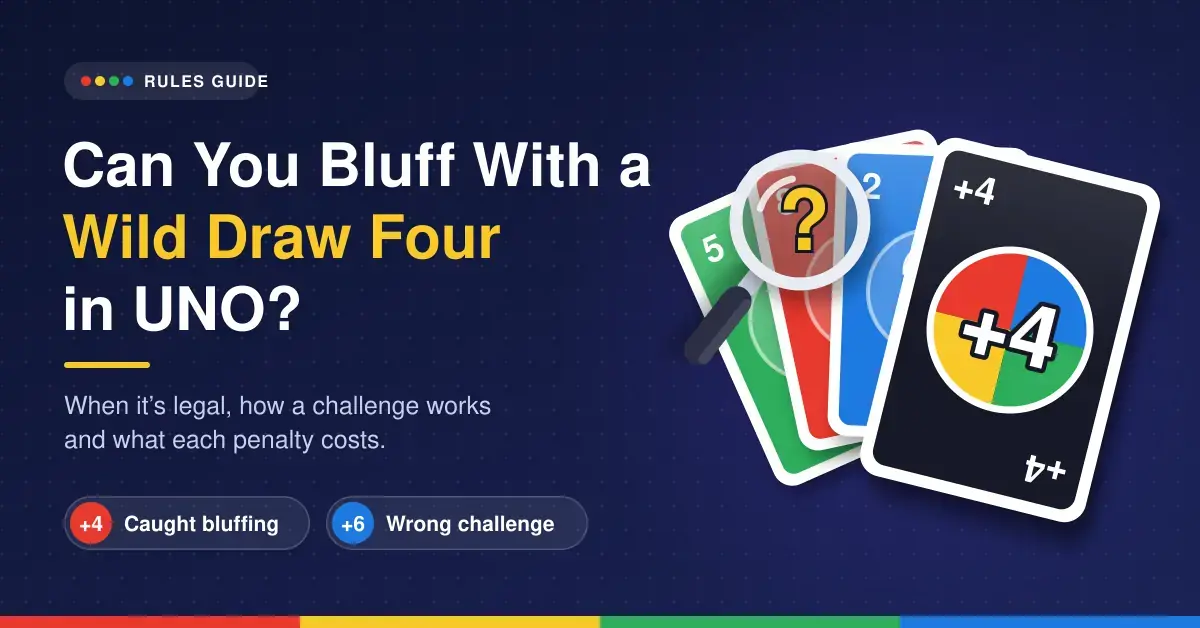
The Wild Draw Four changes the colour and makes the next player draw four cards and miss their turn, but you may only play it when you have no card matching the current colour. A suspicious opponent can challenge you: if you played it illegally, you draw the four cards yourself; if the challenge is wrong, the challenger draws six (the four plus a two-card penalty). Our full guide to the Wild Draw Four rules covers the challenge in detail.
Scoring and Winning
You win a round by being the first to empty your hand. In the official scoring game the winner then collects points from the cards still held by everyone else, which is why it pays to play high-value cards early. The first player to reach 500 points across several rounds wins overall. Our explainer on how UNO scoring works walks through the maths.
| Card type | Points |
|---|---|
| Number cards (0–9) | Face value. |
| Skip, Reverse, Draw Two | 20 points each. |
| Wild and Wild Draw Four | 50 points each. |
Calling “Uno” and the Penalty
When you play your second-to-last card, leaving one card in hand, you must call “Uno!” If you forget and an opponent catches you before the next player takes their turn, you draw two cards as a penalty; once the next turn has begun, it is too late to be caught. See what happens when you forget to say “Uno” for the finer points.
| Situation | Result |
|---|---|
| One card left, called “Uno” | No penalty; play continues. |
| One card left, forgot — caught in time | Draw 2 cards. |
| Caught after the next turn starts | Too late; no penalty. |
Playing with Children and in Classrooms
UNO ColorADD works well as a teaching tool. Alongside turn-taking and simple arithmetic, it introduces the idea of universal design: children learn that a colour can be shown in more than one way, which builds empathy for classmates who see colour differently. With younger players you can drop the scoring and the Wild Draw Four challenge at first and focus on symbol recognition — asking “is that a line or a triangle?” turns each card into a small puzzle.
Common Mistakes to Avoid
- Misreading combined symbols: a card showing two shapes (green, orange or purple) is still one colour, not two separate instructions.
- Drawing when you have a match: if you draw voluntarily you may end up unable to play a card you were already holding on that turn.
- Losing track of direction: after several Reverses, confirm which way play is going.
- Dirty or worn cards: grime can hide the small icons, so keep the deck clean.
Who UNO ColorADD Suits
The edition suits any group that wants colour-blind players fully included — families, classrooms, clubs and mixed-ability game nights — without changing a single rule of the game they already know. It is aimed at 2 to 10 players aged 7 and up.
One practical note: UNO ColorADD was a limited, low-cost release rather than a permanent line, so it can be hard to find new. If it is out of stock, the ColorADD symbols themselves are a public accessibility system, and standard UNO can still be adapted; check current retailer listings for availability.
Sources
Frequently Asked Questions (FAQ)
What is the difference between UNO ColorADD and regular UNO?
The rules are identical. UNO ColorADD adds a small ColorADD symbol to every card so the colour can be identified as a shape, letting colour-blind players read their hand without relying on hue.
What are the three primary ColorADD symbols?
A diagonal line for yellow, a triangle pointing up for red, and a triangle pointing down for blue. Green, orange and purple are shown by combining two of these shapes.
How many cards are in a UNO ColorADD deck?
It uses the standard 108-card UNO composition: number cards, Skip, Reverse and Draw Two action cards, plus Wild and Wild Draw Four cards.
Is UNO ColorADD suitable for all types of colour blindness?
The ColorADD system is designed to be universal, so it helps across the common forms of colour vision deficiency. It is most valuable for red–green types, which are the most widespread.
Can you still buy UNO ColorADD?
It was released by Mattel in 2017 as a limited edition and is not a permanently stocked line, so availability varies. Check current retailer and reseller listings, as stock appears intermittently.