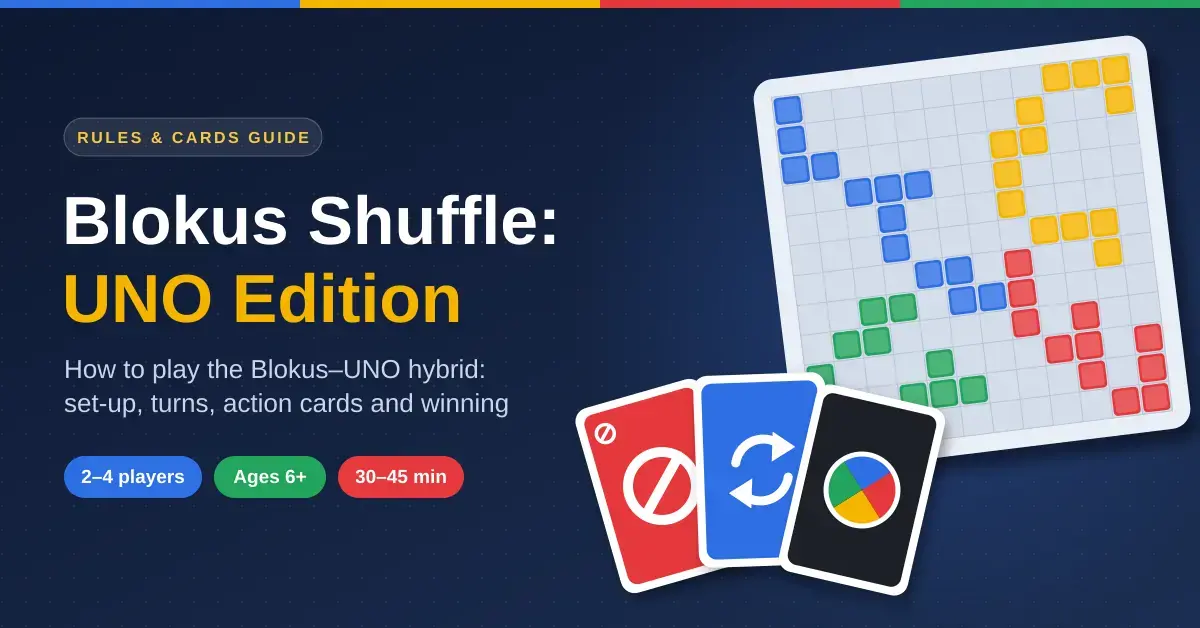
This detailed guide explores the unique fusion of two board game classics in Uno Blokus Shuffle, providing a deep dive into the rules, piece placement strategies, and card-driven mechanics that define this hybrid. We cover the fundamental objectives of reducing your hand of cards while simultaneously occupying the game board with Blokus pieces, the specific functions of "Shuffle" cards that can alter the board state, and the scoring system used in New Zealand competitive play. By understanding the intersection of spatial reasoning and card management, players will learn how to block opponents effectively while navigating the unpredictable shifts triggered by Uno-style action cards. Whether you are a fan of the original grid-based strategy or the fast-paced nature of Uno, this guide ensures you master the specific nuances of the Uno Blokus Shuffle rules.

Understanding the Fusion of Uno and Blokus
Uno Blokus Shuffle is a hybrid game that blends the spatial puzzle-solving of Blokus with the card-matching chaos of Uno. Unlike the original Blokus, where you simply place pieces on a board, in this version, your ability to place pieces is dictated by the cards you hold in your hand. Each player starts with a set of colored Tetris-like pieces and a hand of cards that match those colors. The objective is twofold: you want to play as many pieces as possible onto the board while also trying to empty your hand of cards. This creates a dual-layered strategy where you must decide whether to focus on board control or card depletion, making it a favorite for New Zealand game nights that require a bit more brainpower than standard Uno.
The Core Components of the Game
The game includes a specialized game board grid, 84 Blokus pieces (21 for each of the four colors: Red, Blue, Yellow, and Green), and a deck of cards. The cards are the engine of the game; they tell you which color piece you can play and often include special "Shuffle" or "Action" instructions. In the New Zealand market, this game is praised for its high replayability, as the randomized card draw ensures that no two board layouts are ever the same. Understanding how your pieces fit into the grid is only half the battle; you must also manage your cards to ensure you aren't blocked from making a move later in the game.
- Game Board: A square grid where all pieces are placed.
- Blokus Pieces: 84 pieces in four colors, ranging from single squares to five-square polyominoes.
- Action Cards: Cards that allow piece placement or trigger special board events.
- The Shuffle Element: Unique cards that can force players to move pieces or swap hands.
Game Board: A square grid where all pieces are placed.
Blokus Pieces: 84 pieces in four colors, ranging from single squares to five-square polyominoes.
Action Cards: Cards that allow piece placement or trigger special board events.
The Shuffle Element: Unique cards that can force players to move pieces or swap hands.
Setting Up Your Uno Blokus Shuffle Match
To begin a match of Uno Blokus Shuffle, place the board in the center of the table and have each player choose a color. Each player takes the 21 pieces of their chosen color and places them in front of them. The dealer shuffles the Uno Blokus deck and deals a starting hand to each player (typically seven cards). The remaining cards form the Draw Pile. In the New Zealand tradition of fair play, the youngest player usually starts, or a high-card draw is used to determine the first turn. The game then proceeds in a clockwise direction, with each turn revolving around the card played from the hand.
Initial Piece Placement Rules
The first piece played by each player must cover their designated corner square on the board. This is a critical rule that ensures everyone starts from a different point of the grid. When you play a card, it will specify a color. If you play a Blue card, you may place one of your Blue pieces on the board, following the standard Blokus rule: your pieces must touch at least one other piece of your own color, but only at the corners. They cannot touch along the flat edges. This creates the "branching" effect that is characteristic of the Blokus franchise.
| Setup Step | Action Required | Detail |
|---|---|---|
| 1. Choose Color | Select Red, Blue, Yellow, or Green. | Take all 21 corresponding pieces. |
| 2. Deal Cards | Shuffle and deal 7 cards per player. | Draw pile goes in the center. |
| 3. First Move | Play a card to place your first piece. | Must cover your starting corner. |
| 4. Draw/Play | Match color or play an action card. | Follow piece placement restrictions. |
Mastering the Connection Rules
The most important strategic element of Uno Blokus Shuffle is the "Corner-to-Corner" rule. As you expand your territory on the board, every new piece of your color must touch at least one other piece of your color at a corner. It is strictly forbidden for two pieces of the same color to share an edge. However, there are no restrictions on how your pieces touch the pieces of your opponents; in fact, touching edges with an opponent's piece is a primary defensive tactic used to block them from expanding into your territory.
Navigating the Grid Constraints
As the board fills up, finding a legal corner connection becomes increasingly difficult. This is where the Uno cards provide a lifeline. Some cards allow you to "jump" or ignore certain placement rules for a single turn. In New Zealand competitive circles, players often save their smallest pieces (like the single square or the two-square bar) for the end of the game when the board is crowded. Playing your large, complex pieces early is generally the best strategy, as they are the hardest to fit into the grid once your opponents have established their defensive lines. .Read more in Wikipedia.
- Corner Touch: Your own pieces must touch at least one corner of your existing pieces.
- No Edge Touch: Same-colored pieces cannot share a flat side.
- Opponent Interaction: You can touch edges or corners of any opponent's pieces.
- Grid Boundaries: Pieces must stay within the 20×20 grid of the board.
Corner Touch: Your own pieces must touch at least one corner of your existing pieces.
No Edge Touch: Same-colored pieces cannot share a flat side.
Opponent Interaction: You can touch edges or corners of any opponent's pieces.
Grid Boundaries: Pieces must stay within the 20×20 grid of the board.
The Role of Uno Action Cards
The "Shuffle" part of the game comes from the Uno cards. These aren't just for choosing colors; they are weapons used to disrupt the board. For example, a "Wild" card allows you to place a piece of your color regardless of the current color in play. A "Skip" card prevents the next player from placing a piece, which can be devastating if they were about to secure a vital corner. The most unique card is the "Shuffle" card, which may require players to rearrange certain unplaced pieces or even swap their hand of cards with another player, just like in traditional Uno.
Specialized Piece Placement Cards
Some cards in the deck feature symbols that allow for "Extra Moves" or "Special Placements." If you play a card with a "Double" symbol, you might be allowed to place two pieces in a single turn, provided you have the legal connections on the board. This can be used to suddenly burst through an opponent's blockade. In the local New Zealand gaming scene, these cards are often called "Game Changers" because they take the predictable nature of Blokus and add a layer of tactical uncertainty that rewards flexible thinking.
| Card Type | Effect on Gameplay | Strategic Use |
|---|---|---|
| Color Card | Place a piece of the matching color. | Standard expansion and territory building. |
| Wild Card | Choose any color for piece placement. | Use when you have no matching cards. |
| Skip Card | Next player misses their turn. | Block an opponent from a key spot. |
| Shuffle Card | Swap hands or move pieces. | Disrupt a leading player’s strategy. |
Strategic Territory Control
In Uno Blokus Shuffle, control of the center of the board is paramount. Players who manage to reach the middle of the grid early have more directions in which to expand their "branches." If you are pushed to the edges of the board, your movement options are halved, making it much easier for opponents to "box you in." A common mistake for beginners is to play defensively near their corner; instead, you should aim to play your largest pieces aggressively toward the center to create as many "open corners" as possible for future turns.
The Art of Blocking
Blocking is as much a part of Uno Blokus Shuffle as piece placement. By placing a piece so that it sits flush against the edge of an opponent's piece, you prevent them from ever using that corner to expand in that direction. Since they can only touch their own corners, an edge-to-edge contact with an opponent is a "dead end" for them. In high-level New Zealand play, experts will often sacrifice a turn of optimal expansion just to place a piece that completely shuts down an opponent's access to a large section of the board.
- Center Control: Move toward the middle to maximize expansion opportunities.
- Defensive Edging: Place pieces against opponent edges to block them.
- Open Corners: Always try to leave multiple corners available for your next turn.
- Piece Management: Save small pieces for "squeezing" into tight gaps late-game.
Center Control: Move toward the middle to maximize expansion opportunities.
Defensive Edging: Place pieces against opponent edges to block them.
Open Corners: Always try to leave multiple corners available for your next turn.
Piece Management: Save small pieces for "squeezing" into tight gaps late-game.
Scoring and Winning the Round
The game ends when no players can place any more pieces on the board or when one player has placed all of their pieces. Scoring is calculated based on the number of squares in the pieces that a player failed to place. Each individual square counts as one negative point. For example, if you have a five-square piece and a three-square piece left, your score is -8. However, if you manage to place all 21 of your pieces on the board, you receive a massive bonus of +15 points. If the last piece you played was the single-square piece, that bonus increases to +20 points.
Tracking the Leaderboard
In the New Zealand tournament format, multiple rounds are played, and scores are tallied to find an overall winner. This encourages players to play efficiently even if they know they won't win the current round, as every square placed reduces their negative score. The combination of card-playing (Uno) and piece-placing (Blokus) means that even if you have "bad cards," you can still mitigate your losses by making clever placements on the board with the few opportunities you are given.
| Outcome | Point Value |
|---|---|
| Each Remaining Square | -1 Point |
| Placed All Pieces | +15 Bonus Points |
| Last Piece was 1-Square | +20 Bonus Points |
| Card Hand Penalty | (Variant) -5 Points per card left. |
The "Uno" Penalty in Blokus Shuffle
Because this is an Uno-branded game, the "Uno" rule still applies, but with a twist. When you have only one card left in your hand, you must shout "Uno!" If you are caught by an opponent before the next player starts their turn, you must draw two cards. This is critical because having more cards in your hand gives you more options for color matching, but it also increases the risk of being stuck with cards at the end of the game, which can lead to point penalties in some house-rule variations used across New Zealand.
Managing Your Hand Size
Having a large hand of cards might seem like a disadvantage, but in Uno Blokus Shuffle, it actually gives you more flexibility in which pieces you can place. However, the game encourages you to play cards as quickly as possible. If you have no cards left, you can no longer play pieces, even if there is room on the board. Therefore, a balance must be struck: you want to use your cards to place your most difficult pieces, but you don't want to run out of cards while you still have large pieces sitting in your tray.
- Shout Uno: When down to your final card.
- The Draw Penalty: Two cards if you are "caught" without saying Uno.
- Card-Piece Synergy: Ensure you have the right colors to play your remaining pieces.
- Hand Swapping: Be wary of Shuffle cards that might take your "perfect" hand away.
Shout Uno: When down to your final card.
The Draw Penalty: Two cards if you are "caught" without saying Uno.
Card-Piece Synergy: Ensure you have the right colors to play your remaining pieces.
Hand Swapping: Be wary of Shuffle cards that might take your "perfect" hand away.
Common Misunderstandings of the Rules
One of the most frequent errors in Uno Blokus Shuffle is the placement of pieces that touch along the sides. Players often forget that while they can touch an opponent's piece on the side, they cannot touch their own. Another common mistake involves the "Shuffle" cards; players sometimes think these cards allow them to ignore the corner-touch rule, which is incorrect. Shuffle cards affect the cards in your hand or the state of the board, but the fundamental Blokus placement rules (corner-to-corner) are always in effect unless a card explicitly states otherwise.
Resolving Board Jams
As the board becomes congested, disputes often arise over whether a piece truly fits. It is a rule that if a piece is placed and it is later found to be an illegal move (touching an edge), the piece must be removed, and the player loses their turn. In New Zealand home games, it's recommended to have a "no-take-back" policy once a player has let go of the piece to ensure the game maintains its pace and competitive integrity.
- Illegal Touches: Check corners and edges carefully before releasing a piece.
- Shuffle Execution: Follow card instructions precisely to avoid turn confusion.
- Piece Removal: Illegal moves result in the piece returning to the player's tray.
- Turn Sequence: Playing the card always happens before placing the piece.
Illegal Touches: Check corners and edges carefully before releasing a piece.
Shuffle Execution: Follow card instructions precisely to avoid turn confusion.
Piece Removal: Illegal moves result in the piece returning to the player's tray.
Turn Sequence: Playing the card always happens before placing the piece.
Playing with Different Group Sizes
Uno Blokus Shuffle is designed for 2 to 4 players, and the dynamics change significantly based on the group size. In a 4-player game, the board becomes crowded very quickly, and players must be extremely aggressive. In a 2-player game, each player usually controls two colors (e.g., one player takes Blue and Red, the other takes Yellow and Green). This creates a deep strategic layer where you are essentially playing a "team" game against yourself, trying to coordinate two different colors to block your opponent's two colors.
The Two-Player Challenge
For Kiwi players looking for a serious mental workout, the 2-player variant is the gold standard. You must manage two hands of cards and two sets of pieces. The turn order alternates between the four colors (e.g., Blue, then Yellow, then Red, then Green). This means you have to plan your moves four steps ahead, considering how your "first color" can set up a corner that your "second color" can then use or protect. It transforms the game into a complex tactical simulation.
| Players | Setup Variation | Gameplay Feel |
|---|---|---|
| 4 Players | 1 Color each. | Fast-paced, social, and chaotic. |
| 3 Players | 1 Color each (1 color remains unused). | More space, but harder to block effectively. |
| 2 Players | 2 Colors each. | Highly strategic, long-term planning required. |
Advanced Piece Placement Strategy
To truly excel at Uno Blokus Shuffle, you must treat your pieces as resources. The 5-square pieces are your "heavy hitters." They take up the most space and are the hardest to place late in the game, so they should be your priority. The "I" piece (5 squares in a straight line) is particularly useful for reaching across the board to "snag" a corner that an opponent thought was safe. Conversely, the "L" and "Z" shaped pieces are excellent for wrapping around obstacles and navigating tight corners created by opponent blockades.
Evaluating Your Hand
Before making a move, look at your cards and your pieces simultaneously. If you have three Green cards and a large, awkward Green piece, your priority should be finding a spot on the board for that piece immediately. Don't waste your Green cards on small pieces that can be easily placed later. In the New Zealand context, where "efficiency" is often the key to victory in tabletop games, managing the relationship between the shapes in your tray and the colors in your hand is what defines a champion.
- Priority 5s: Place 5-square pieces as early as the cards allow.
- Shape Utility: Use long pieces for reach and angled pieces for navigation.
- Card Efficiency: Don't use a Wild card on a color you already have plenty of.
- The "Endgame" 1s: Keep your single-square piece as your final move for the +20 bonus.
Priority 5s: Place 5-square pieces as early as the cards allow.
Shape Utility: Use long pieces for reach and angled pieces for navigation.
Card Efficiency: Don't use a Wild card on a color you already have plenty of.
The "Endgame" 1s: Keep your single-square piece as your final move for the +20 bonus.
Final Thoughts and Game Summary
Uno Blokus Shuffle is a brilliant example of how two disparate game styles can be merged into a cohesive and challenging experience. It takes the spatial satisfaction of Blokus and injects it with the "take-that" energy of Uno, creating a game that appeals to both casual family players and serious strategy enthusiasts. For New Zealanders, it offers a fresh take on two household names, providing a social yet competitive atmosphere. By mastering the placement rules and using the action cards strategically, you can dominate the grid and leave your opponents with a tray full of unplaced pieces.
Quick Reference Table
| Feature | Details |
|---|---|
| Game Type | Strategy / Card Game Hybrid. |
| Number of Pieces | 84 (21 per color). |
| Placement Rule | Corner-to-corner only (same color). |
| Winning Condition | Lowest number of squares remaining + bonuses. |
FAQ
Do I have to say "Uno" in this game? Yes, you must shout "Uno" when you have only one card remaining in your hand.
What happens if I can't place any more pieces? If you cannot make a legal move, you must pass your turn. You can still play action cards that don't require placement, depending on the specific variant rules.
Can pieces of different colors touch edges? Yes, pieces of different colors can touch edges. Only pieces of the same color are restricted to corner-to-corner contact.
How do I calculate the final score? Count the individual squares of all unplaced pieces in your tray. Each square is -1 point. Add bonuses if you placed all pieces.
What is the best piece to save for the end? The single-square piece is the best to save, as it can fit anywhere and gives you a +20 bonus if it's your last piece played.
Can I play a piece if I don't have a matching card? No, you must play a card that matches the color of the piece you want to place, or play a Wild card.
What does the Shuffle card do? The Shuffle card usually forces players to swap their hands of cards, adding an unpredictable element to your planning.
How many cards are dealt at the start? Standard rules usually suggest dealing 7 cards to each player at the beginning of the match.
Is there a digital version of Uno Blokus Shuffle? While Blokus and Uno have individual digital versions, the "Shuffle" crossover is primarily a physical board game experience.
Can three people play Uno Blokus Shuffle? Yes, but one color will remain unplayed on the board, which provides more room for expansion for the three active players.