Table of Contents
Uno Super Mario follows the fundamental “matching” logic of the original card game but introduces a visual and mechanical layer inspired by the iconic platforming franchise. For fans in New Zealand, where indoor tabletop gaming is a staple of social gatherings, understanding these specific variations is key to a smooth and competitive game night.
The deck consists of 112 cards, featuring standard suits (Red, Yellow, Blue, and Green) numbered 0 through 9, alongside the familiar Skip, Reverse, and Draw Two cards. However, the true distinction lies in the thematic artwork and the inclusion of the “Mario Super Star” and “Customizable” cards. This guide provides a deep dive into the unique mechanics, specialized cards, and strategic nuances of the Uno Super Mario edition, ensuring you have the tactics required to dominate the Mushroom Kingdom.

Understanding the Basics of Uno Super Mario
Uno Super Mario follows the fundamental “matching” logic of the original card game but introduces a visual and mechanical layer inspired by the iconic platforming franchise. Players are dealt seven cards each, with the objective being the first to deplete their hand by matching the top card of the discard pile by color, number, or symbol. In the New Zealand context, where indoor tabletop gaming is a staple of social gatherings, understanding these specific variations is key to a smooth game night. The deck consists of 112 cards, featuring standard suits (Red, Yellow, Blue, and Green) numbered 0 through 9, alongside the familiar Skip, Reverse, and Draw Two cards. However, the true distinction lies in the thematic artwork and the inclusion of the “Mario Super Star” and “Customizable” cards, which add a layer of unpredictable strategy not found in the standard deck.
Each number card features a beloved character: 0 represents Mario, 1 is Luigi, and characters like Yoshi, Peach, and Donkey Kong adorn the rest. This thematic integration makes the game highly recognizable for fans. The inclusion of the “Super Star” mechanic mirrors the invincibility power-up from the video games, providing a defensive tool that can completely shift the momentum of a round. Mastering the timing of this card is what separates a novice from a seasoned Uno Super Mario veteran.
Game Specifications
- Total Cards: 112 cards (108 standard + 2 Super Star + 2 Customizable).
- Colours: Red, Yellow, Blue, and Green.
- Special Cards: Skip, Reverse, Draw Two, Wild, Wild Draw Four, Mario Super Star, and Customizable Wild.
- Target Audience: Recommended for ages 7 and up, accommodating 2 to 10 players.
| Card Type | Quantity | Description |
|---|---|---|
| Number Cards | 19 per color | 0-9 in each of the four colors. |
| Skip / Reverse / Draw 2 | 2 per color | Standard action cards. |
| Wild / Wild Draw 4 | 4 of each | Universal color changers and penalties. |
| Special Rules | 4 total | 2 Super Star cards and 2 Customizable Wilds. |

Setting Up Your Game in the Mushroom Kingdom

Preparation is the foundation of any competitive Uno match, and the Super Mario edition requires a careful shuffle to ensure the special action cards are evenly distributed. Begin by selecting a dealer through a high-card draw; the player with the highest numerical value takes the lead (symbols count as zero). The dealer shuffles the deck and distributes seven cards face-down to each participant. The remaining cards form the Draw Pile, while the top card is flipped over to create the Discard Pile.
If the first card flipped is an action card, specific rules apply. For example, if it is a Skip, the player to the dealer’s left misses their turn. If it is a Wild Draw Four, it must be returned to the deck and a new card flipped. In New Zealand home games, it is common practice for the dealer to also act as the “rule referee” to settle any disputes regarding the timing of “Uno” declarations. Proper setup ensures that the elemental “Mario” mechanics can be introduced fairly into the rotation.
The Setup Checklist
- Choose the Dealer: Every player draws one card from the deck. The player who draws the card with the highest numerical value takes the role of the dealer (symbols count as zero).
- Distribute Hands: The dealer shuffles the deck and distributes seven cards face-down to every participant.
- Prepare the Piles: Place the remaining cards face-down to form the Draw Pile, then flip the top card to start the Discard Pile.
- Handle Initial Action Cards: If the first card flipped is a Skip, the player to the dealer’s left misses their first turn. If it is a Wild Draw Four, return it to the deck and flip a different card.
| Setup Step | Action Required | Responsibility |
| 1. Dealer Draw | Players draw one card; highest value deals. | All Players |
| 2. Deal | Distribute 7 cards face-down to everyone. | Dealer |
| 3. Stockpile | Place remaining cards face-down as the stock. | Dealer |
| 4. Reveal | Flip the top stock card to start the discard. | Dealer |
Mastering the Standard Action Cards
While the Mario theme is the primary drawcard, the mechanics of the standard action cards remain the engine of the game. A Skip card forces the next player in the current rotation to lose their turn, which is a vital tool for preventing an opponent with few cards from winning. The Reverse card switches the direction of play—clockwise to counter-clockwise or vice versa—which can be used tactically to return the turn to yourself in a two-player game or to bypass a player who is currently holding a strong lead.
Skip and Reverse Cards

A Skip card forces the next player in the rotation to lose their turn, which is a vital tool for preventing an opponent with few cards from winning. The Reverse card switches the direction of play—clockwise to counter-clockwise or vice versa—allowing you to return the turn to yourself in a two-player game or bypass a player holding a strong lead.
Draw Two Cards

The Draw Two card is an offensive staple. It forces the next player to pick up two cards and forfeit their turn. While some “house rules” in New Zealand allow for “stacking” Draw Twos, official rules generally dictate that the next player must simply draw the penalty. Always clarify these variations before the match begins.
The Mario Super Star Card Explained
The unique selling point of the Uno Super Mario edition is the Mario Super Star Card, which introduces an “invincibility” mechanic reflective of the game’s source material. When another player plays a Draw Two or Wild Draw Four card against you, you can play the Super Star Card to “bounce” the power back to that player. Instead of you drawing, the person who played the penalty card must draw the two or four cards themselves! This makes the Super Star card one of the most powerful defensive tools in the Uno universe.
Beyond its defensive capabilities, the Super Star card also functions as a Wild card. You can play it on your turn, even if no penalty has been played against you, allowing you to choose the colour that resumes play. Saving this card until an opponent tries to bury you with a Draw Four is a classic winning tactic. Read more in Wikipedia.
| Card Feature | Standard Wild Card | Mario Super Star Card |
|---|---|---|
| Color Choice | Yes. | Yes. |
| Defense Ability | None. | Bounces Draw 2 and Wild Draw 4 back. |
| Timing | On your turn. | On your turn OR as a reaction to a draw card. |
| Point Value | 50 Points. | 50 Points. |
Customizing Your Game with House Rules
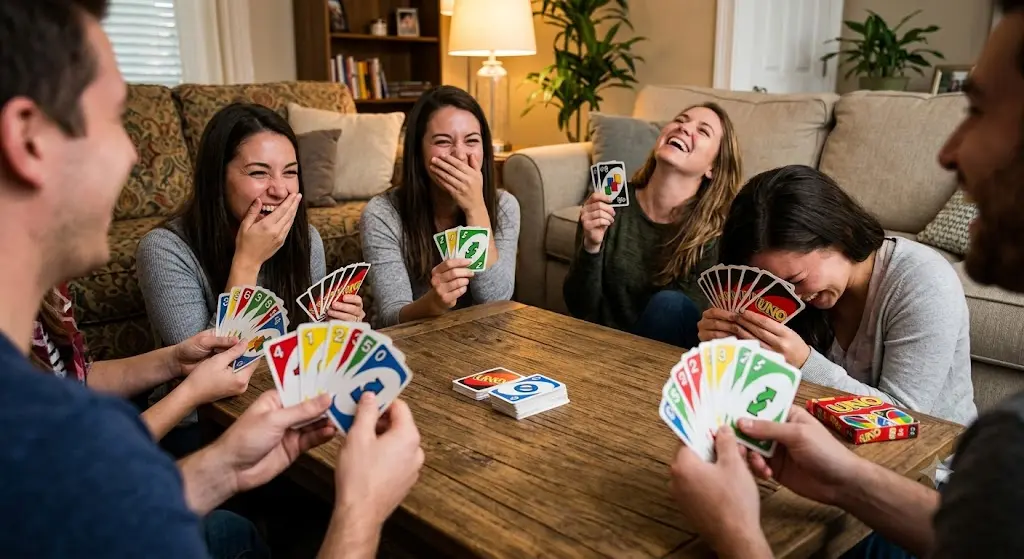
Uno Super Mario includes two Customizable Wild Cards that allow players to invent their own “House Rules.” These cards are blank spaces where you can write a penalty or action using a pencil (so it can be erased for future games). This feature is particularly popular in New Zealand social clubs, where players often create rules like “Everyone swaps hands” or “The player with the most cards must draw two.”
To use these correctly, all players must agree on the rule before the game begins. Once played, the rule on the card must be followed immediately by the targeted player(s), and the person who played the card chooses the next color. This adds a layer of creative strategy, as the “House Rule” can be tailored to counter the specific playstyles of your group.
Creative House Rule Ideas

- The Power-Up: “The player who plays this card can immediately draw two cards from the pile to add to their hand.”
- The Warp Pipe: “Swap hands with the player currently holding the most cards.”
- The Bullet Bill: “Skip the next two players instead of just one.”
- The Banana Peel: “The next player must draw one card and then skip their turn.”
Scoring and Winning the Match
Winning a single round of Uno Super Mario is achieved by being the first to play your last card, but the overall “match” winner is determined by points. When a player goes out, they receive points based on the cards remaining in their opponents’ hands. This encourages players to play their high-point cards (like Super Stars and Wild Draw Fours) earlier in the round to avoid being caught with them if someone else wins.
In a standard competitive match, the first player to reach 500 points across multiple rounds is declared the ultimate champion. In New Zealand, many families prefer the “low score wins” variant where points are tracked against the person who held them, but the official 500-point goal remains the gold standard for strategic balance.
- Numbers 0-9: Face value.
- Skip/Reverse/Draw Two: 20 points each.
- Wild/Wild Draw Four: 50 points each.
- Super Star / Customizable: 50 points each.
| Card Category | Point Value | Risk Level |
|---|---|---|
| Standard Numbers | 0 – 9 | Low |
| Standard Actions | 20 | Medium |
| Special Wilds | 50 | High |
The Essential “Uno” Shout and Penalties
The most iconic rule in the Uno franchise is the “Uno” shout. When a player has exactly one card left in their hand, they must loudly announce “Uno.” If they are caught by another player before the next person begins their turn, they must draw two penalty cards from the draw pile. This rule ensures that players cannot sneakily win the game and keeps the tension high as the round nears its conclusion.
In Uno Super Mario, the “Super Star” card can complicate this. If you are down to two cards and one of them is a Super Star, you can still be penalized if you play your other card and forget to shout. Always be vigilant; in the fast-paced environment of a Kiwi game night, opponents will be watching you like a Lakitu to catch any slip-ups.
- Timing: Shout when you have only one card left.
- Catching: Opponents must catch you before the next player takes a card or plays.
- Penalty: Draw 2 cards if caught.
- Final Card: If your last card is a Draw 2 or Draw 4, the penalty must still be served by the victim before the round ends.
Strategic Advice for Kiwi Players
The New Zealand gaming culture often values a mix of aggressive play and social banter, and Uno Super Mario provides plenty of opportunities for both. One effective strategy is “Star Hoarding,” where you keep your Super Star card specifically to counter an opponent who has been holding onto their Wild Draw Four. This not only protects you but forces the “aggressor” to take the very penalty they tried to inflict on you.
Additionally, pay attention to which characters are being played. If a player is consistently drawing when “Blue” (Donkey Kong) cards are active, it is a safe bet they are lacking that color. Use your Wild cards to switch the game to their weak color to force them to draw more cards. This observational strategy is what separates casual players from Mushroom Kingdom masters.
- Hold the Star: Save your invincibility for Draw 4s rather than using it as a simple color changer.
- Watch the Leader: Use Skips and Draw 2s specifically on the player with the fewest cards.
- Custom Strategy: Write House Rules that target the strongest player.
- Color Tracking: Observe which colors opponents are drawing for.
| Strategy Type | Action | Objective |
|---|---|---|
| Defensive | Save Super Star for +4 cards. | Reverse the penalty and protect your hand. |
| Offensive | Play Skips on players with 1 card. | Prevent them from going out. |
| Psychological | Bluff your hand strength. | Discourage others from attacking you. |
Playing with Children and Thematic Immersion
Uno Super Mario is an exceptional tool for engaging younger players, as the familiar faces of Luigi, Peach, and Bowser make the rules easier to remember. For parents in New Zealand, this version can serve as a bridge to more complex board games. To enhance the experience, you can encourage children to shout “Super Star!” when playing the special card or “Mamma Mia!” when they are forced to draw.
To keep the game fair for younger participants, you might consider a “Mercy Rule” where the maximum number of cards a player can draw in one turn is limited. However, for the most part, the thematic elements of Super Mario naturally encourage kids to stay focused on the game state, as they want to see their favorite characters come into play.
- Visual Cues: Use character names to help kids identify matches.
- Engagement: The Super Star mechanic is highly exciting for children.
- Social Skill: Teaches kids how to handle sudden “bounced” penalties gracefully.
- Memory: Helps develop color and number recognition.

Common Mistakes and Rule Clarifications
One of the most frequent errors in Uno Super Mario is misinterpreting the Super Star bounce. Remember: the Super Star can only be played in response to a Draw 2 or Wild Draw 4 played on you. You cannot use it to “pass” a penalty to a third player; the draw penalty goes directly back to the person who played it. Furthermore, once the penalty is bounced, that player’s turn is over, and it becomes the turn of the person after you.
Another common mistake involves the Customizable Wilds. Some players think these can be played out of turn like the Super Star. They cannot. Customizable cards follow standard Wild rules and must be played on your actual turn. Clarifying these technicalities before the first deal prevents frustration and ensures a competitive, fun atmosphere for everyone at the table.
- Bouncing Limits: The penalty only goes back to the person who played the draw card.
- Turn Order: After a bounce, the player who had to draw loses their turn.
- Custom Cards: Must be played on your turn, not as a reaction.
- Wild Draw 4 Challenge: Standard Uno rules apply; you can challenge if you think they had a matching color.
Final Thoughts
Uno Super Mario is a brilliant evolution of the classic card game, successfully blending the high-energy “take-that” mechanics of Uno with the beloved imagery of Nintendo’s flagship series. The introduction of the Mario Super Star card adds a layer of defensive strategy that makes every “Draw Four” a calculated risk, while the Customizable cards allow for a personalized experience that can be adapted for any group. For New Zealanders, it offers a fantastic social outlet that is easy to learn but difficult to master. By understanding the nuances of the Super Star bounce and the importance of the 500-point scoring system, you can ensure that your next game night is a “Super” success.
Quick Reference Summary Table
| Game Element | Detail |
|---|---|
| Special Card | Mario Super Star (Bounce penalties). |
| Winning Score | 500 Points (Winner of round gets points from others). |
| Penalty for No “Uno” | Draw 2 cards if caught. |
| Action Cards | Skip, Reverse, Draw 2, Wild, Wild Draw 4. |
FAQ
What does the Mario Super Star card do?
It acts as an “invincibility” card. If someone plays a Draw 2 or Wild Draw 4 on you, play this card to force them to draw those cards instead.
Can I play the Super Star card on my turn if no one attacked me?
Yes, it functions as a regular Wild card if you play it on your turn, allowing you to choose the next colour.
How many cards are in an Uno Super Mario deck?

The deck has 112 cards: 108 standard cards and 4 special cards (2 Super Stars and 2 Customizable Wilds).
What is the penalty for not saying “Uno”?

If an opponent catches you before the next player begins their turn, you must draw two cards.
How many points are the special cards worth?
Both the Mario Super Star and the Customizable Wild cards are worth 50 points if they are in an opponent’s hand at the end of a round.
Can you stack Draw Two cards in this version?
Official rules do not allow stacking; however, the Super Star card acts as a “bounce” which is a unique form of stacking/reversal.
Can I challenge a Wild Draw 4 in Uno Super Mario?
Yes, the standard challenge rule applies. If you think the player had a matching color in their hand, you can challenge them.
What happens if the first card flipped is a Super Star?
The player to the dealer’s left treats it as a Wild and chooses the starting color.
How do I win a match?
The first player to reach a cumulative total of 500 points across multiple rounds wins.
Is Uno Super Mario suitable for two players?

Yes, though the Reverse card functions as a Skip in 1v1 play, making it a very fast-paced duel.
Can I write any rule on the Customizable Wild?
Yes, provided all players agree on the rule before the start of the game.
Are the number cards different from regular Uno?
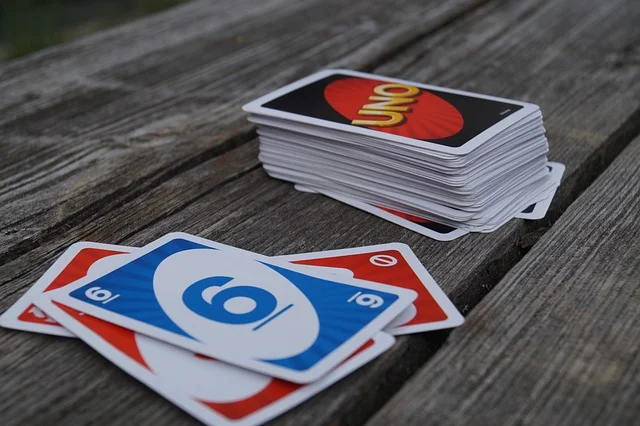
The numbers are the same, but they feature different characters to match the Super Mario theme.
What if I don’t have a playable card?
You must draw from the stockpile until you find a card that matches the colour, number, or symbol of the top card on the discard pile.
Are there team-based rules?
You can play in teams of two, but this is a house rule variation rather than an official one.
Does the game ever end in a draw?
Rarely. With 500 points as the target, one player usually hits the threshold before a stalemate occurs.
Where can I find more rule updates?
Check the back of the instruction manual that comes with your specific deck for the most recent updates from the manufacturer.
Does the Mario theme affect the gameplay speed?
Not directly, but the excitement of using the Super Star card often makes players move faster and play more aggressively.
What do I do if I run out of draw cards?
If the Draw Pile runs out, shuffle the Discard Pile to create a new Draw Pile and continue the game.
Can I play a Skip card on a different colour?
No, unless it is a Wild card or you have a matching colour Skip card, you must follow standard matching rules.
Can the Customizable cards be changed every round?
Yes, using a pencil allows you to wipe them clean and write a new rule for every game session.